
|
Getting your Trinity Audio player ready...
|
The difference between quantum cryptography vs classical cryptography is not just technical it is the difference between a lock that can eventually be picked and a lock that physically tells you the moment someone even touches it. If you store sensitive data, run a business online, or simply care about privacy, this comparison is written for you. Right now in 2026, the encryption protecting your bank account, your emails, and national secrets is almost entirely classical and quantum computers are getting closer to cracking it.
Do not worry this article will break down every critical difference between quantum cryptography and classical cryptography in plain language. No PhD required. By the end, you will know exactly which system is more secure, why the world is rushing to switch, and what this means for your digital life.
⚡ Quick Facts — Quantum vs Classical Cryptography
Table of Contents
What Is Classical Cryptography?
Classical cryptography is the system that protects nearly all digital data today. It works by turning readable information into scrambled code using mathematical problems that are extremely hard to solve. The idea is simple: if cracking the code would take millions of years on a normal computer, the data is safe.
The three most common classical encryption methods you encounter every day are RSA (Rivest-Shamir-Adleman), AES (Advanced Encryption Standard), and ECC (Elliptic Curve Cryptography). RSA is used to secure websites (that padlock in your browser), AES protects files and communications, and ECC is widely used in mobile apps and banking because it gives strong encryption with shorter key lengths.
Here is the brutal truth: all three rely on a single assumption that factoring enormous numbers or solving discrete logarithm problems takes too long to be practical. That assumption held up perfectly for decades. But quantum computers are about to shatter it.
📘 Key Definition
Classical Cryptography is a method of securing data using mathematical complexity. It depends on computational problems — like factoring large prime numbers — that take too long to solve with traditional computers. Common algorithms include RSA, AES, and ECC. Its biggest vulnerability: a sufficiently powerful quantum computer running Shor’s Algorithm can break RSA and ECC in polynomial time.
What Is Quantum Cryptography? The Physics-Powered Lock
Quantum cryptography is a completely different approach. Instead of relying on math that is hard to solve, it uses the laws of quantum mechanics — laws that are physically impossible to break. The most important application is Quantum Key Distribution (QKD), which lets two people create a shared secret encryption key using photons (particles of light).
Here is what makes it extraordinary: in quantum mechanics, the very act of measuring a quantum particle changes it. So if an eavesdropper tries to intercept the photons carrying your key, they unavoidably disturb the quantum state and you immediately know someone tried to intercept it. This is not a software feature you can bypass. It is a law of the universe.
The most famous quantum protocol is BB84, developed in 1984 by Charles Bennett and Gilles Brassard. It was the first practical QKD protocol and it remains the most studied and deployed today. More recent protocols like E91 (using quantum entanglement) and continuous-variable QKD protocols are expanding the possibilities even further in 2026.
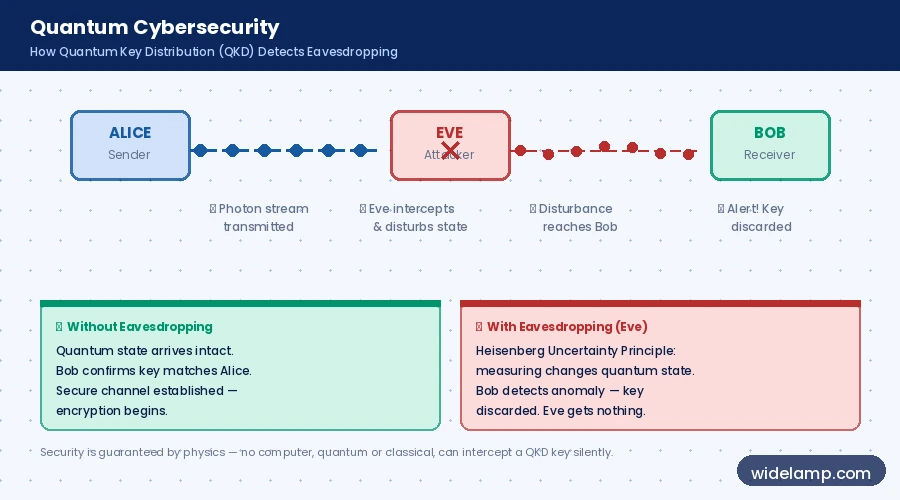
🔬 Key Definition
Quantum Cryptography secures communication using the fundamental laws of quantum mechanics rather than mathematical complexity. Its cornerstone is Quantum Key Distribution (QKD) — a method where encryption keys are transmitted as quantum photons. Any interception physically disturbs the photons and is instantly detected. It is theoretically immune to attacks from both classical and quantum computers.
“Classical cryptography asks: can you solve this math problem? Quantum cryptography asks: can you break the laws of physics? So far, no one can.”
— WideLamp Editorial, 2026
Quantum Cryptography vs Classical Cryptography: 7 Critical Differences
This is the core of the debate. Below are the 7 most important differences between quantum cryptography and classical cryptography, explained clearly, no fluff.
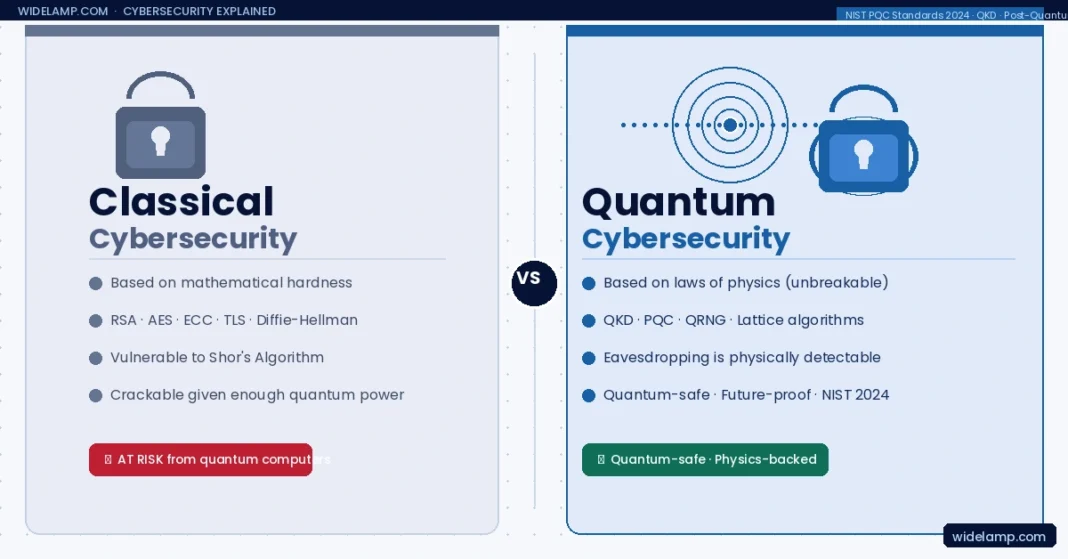
| Dimension | Classical Cryptography (RSA / AES / ECC) | Quantum Cryptography (QKD) |
|---|---|---|
| 1. Security Basis | Mathematical complexity (factoring, discrete log) | Laws of quantum physics (Heisenberg uncertainty, no-cloning) |
| 2. Key Distribution | Public key exchange over classical network (vulnerable to MITM) | Quantum Key Distribution — photons transmitted over quantum channel |
| 3. Quantum Attack Vulnerability | ⚠ Highly Vulnerable — Shor’s Algorithm breaks RSA and ECC | ✓ Immune — security based on physics, not math |
| 4. Eavesdropping Detection | ⚠ None inherent — interception can go undetected | ✓ Instant — quantum state disturbance alerts both parties |
| 5. Scalability | Highly scalable — runs on existing internet infrastructure | Limited — needs specialised fibre-optic or satellite channels |
| 6. Core Algorithms / Protocols | RSA-2048, AES-256, ECC (P-256, P-384), Diffie-Hellman | BB84, E91, CV-QKD, MDI-QKD, Twin-Field QKD |
| 7. Future Status (2026 onward) | ⚠ At serious risk — NIST is migrating to post-quantum standards | ✓ Quantum-safe — designed for the post-quantum era |
How Does Shor’s Algorithm Threaten Classical Cryptography?
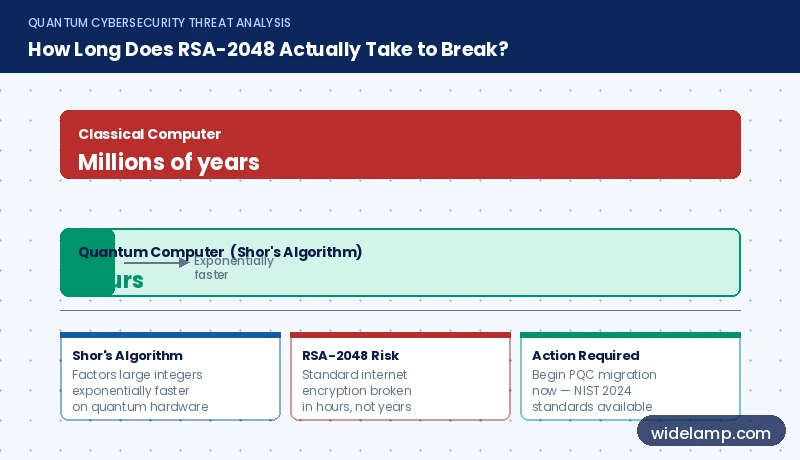
Developed by mathematician Peter Shor in 1994, Shor’s Algorithm is the single biggest reason why classical cryptography is considered at risk. On a classical computer, factoring a 2048-bit RSA key would take millions of years. On a sufficiently powerful quantum computer, Shor’s Algorithm can do it in polynomial time potentially hours or days.
The largest number factored by Shor’s Algorithm so far is 21, achieved on a small-scale quantum processor. That sounds modest but quantum hardware is improving rapidly. As of 2026, both IBM and Google are racing past the 1,000-qubit threshold. The cryptographic community is taking this extremely seriously.
Why AES-256 Is Safer But Still Not Immune
Unlike RSA and ECC, symmetric encryption like AES-256 is not broken by Shor’s Algorithm. However, Grover’s Algorithm another quantum algorithm effectively halves AES’s security level. AES-256 drops to roughly AES-128 security under a quantum attack. That is still strong enough for now, but it is not something to ignore for long-term data security.
⚠️ Critical Warning
“Harvest Now, Decrypt Later” Attacks Are Already Happening. Nation-state attackers are believed to be collecting encrypted data today — even data they cannot crack yet. When quantum computers become powerful enough, they will decrypt it retrospectively. If your data must stay secret for 10+ years, classical encryption is already compromised in planning.
How Quantum Cryptography Solves the Eavesdropping Problem Forever
The most brilliant thing about quantum cryptography is not just that it is secure it is that it is provably self-monitoring. The quantum no-cloning theorem states that it is physically impossible to copy an unknown quantum state. This means an eavesdropper (call her Eve, as researchers do) cannot make a copy of the photons carrying your key. She must measure them and measuring quantum photons changes them permanently.
This disturbance shows up as increased error rates in the key something Alice and Bob immediately detect when they compare a small sample of their transmitted bits over a classical channel. If the error rate is above a threshold (around 11% for BB84), they know the channel is compromised and they abort the session. No guessing. No forensic analysis after the fact. Instant, built-in, physics-guaranteed detection.
What Happens in a Real QKD Deployment Today?
In 2026, QKD is no longer just laboratory science. China’s Micius satellite has demonstrated satellite-based QKD over 1,200 km. The European Quantum Internet Alliance is building pan-European quantum networks. In India, research teams at IIT Delhi and DRDO are actively developing domestic QKD infrastructure. The technology works the challenge now is making it cheaper, longer-range, and integration-ready.
“The quantum no-cloning theorem is the best security feature ever written — and it was not written by any programmer. The universe wrote it.”
— WideLamp Editorial, 2026
Real-World Applications: Where Each System Is Used Today
Classical Cryptography in Your Daily Life
Every time you open a website with HTTPS, your browser uses RSA or ECC to negotiate a session key. Every WhatsApp message is protected by AES-256 symmetric encryption. Your UPI payment, your Gmail login, your Netflix subscription all running on classical cryptography. It is fast, scalable, and cheap to deploy on existing hardware. That is why the world has not switched yet.
Where Quantum Cryptography Is Deployed Right Now
Quantum cryptography is currently used in high-security sectors where the cost and infrastructure demands are justified. Government communications, military command networks, critical financial infrastructure (stock exchanges, central banks), and healthcare data systems are the primary users. The Swiss national elections of 2007 were actually secured using a QKD network one of the first real-world deployments of quantum cryptography in voting security.
🔐 HTTPS / TLS
Uses RSA/ECC for key exchange. Secures every website you visit. Classical cryptography at work.
💳 Banking & UPI
AES-256 and ECC protect payment transactions. Classical cryptography — fast and scalable.
🛡️ Government / Military
QKD networks protect classified communications. Quantum cryptography — deployed for highest-security use.
🛰️ Satellite QKD
China’s Micius satellite proved QKD over 1,200 km. Long-distance quantum-secure comms are operational.
🏥 Healthcare Data
Medical records with 30-year secrecy requirements are moving toward quantum-safe encryption now.
🗳️ Secure Voting
Switzerland used QKD to secure election results in 2007 — one of the first real-world quantum deployments.
Limitations of Quantum Cryptography vs Classical Cryptography
It would be dishonest to say quantum cryptography is perfect. The biggest limitation is infrastructure. QKD requires dedicated quantum channels usually specialised fibre-optic cables or satellite links. You cannot just run it on standard internet hardware. This makes it expensive to deploy and limited in distance (without quantum repeaters, current fibre-based QKD maxes out around 400–500 km).
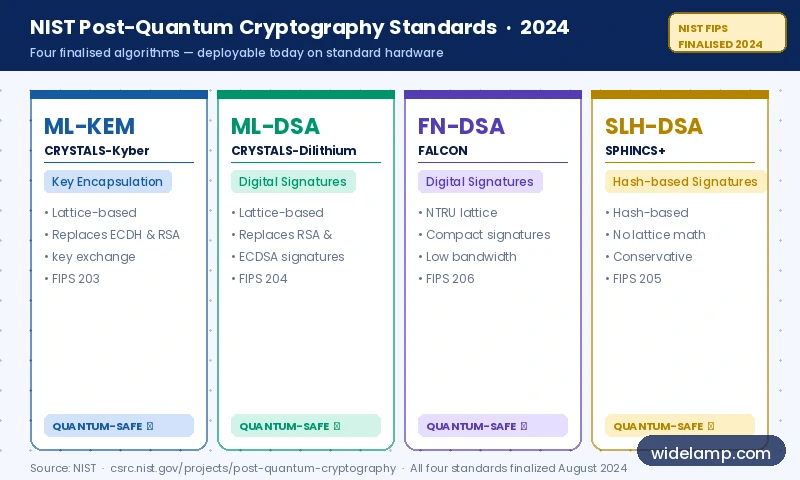
Classical cryptography, by contrast, runs on every device connected to the internet right now. It is fast, cheap, and scalable to billions of users. For most everyday use cases in 2026, classical encryption with post-quantum-safe algorithms (like NIST’s newly selected CRYSTALS-Kyber and CRYSTALS-Dilithium) is the practical near-term solution while QKD infrastructure matures.
🔭 Research Spotlight
In 2022, NIST (the US National Institute of Standards and Technology) selected the first wave of post-quantum cryptographic algorithms after a 6-year international competition. The winners — CRYSTALS-Kyber (for key encapsulation) and CRYSTALS-Dilithium (for digital signatures) — are based on hard lattice problems that even quantum computers cannot easily solve. These are not quantum cryptography, but they are the bridge keeping classical systems safe until QKD infrastructure is globally deployable.
“The 2020s will be remembered as the decade the world realised its entire digital security infrastructure was built on borrowed time — and started rebuilding it from scratch.”
— WideLamp Editorial, 2026
Which Should You Choose? Quantum Cryptography or Classical Cryptography?
The honest answer depends on your use case and timeline. For everyday internet use, mobile apps, e-commerce, and consumer products classical cryptography with post-quantum-safe algorithms is your practical choice today. It runs on existing hardware, is cost-effective, and NIST’s new standards are designed to be quantum-resistant.
For government agencies, national security communications, financial institutions handling data with 20+ year secrecy requirements, or any organisation worried about “harvest now, decrypt later” attacks quantum cryptography via QKD should be on your roadmap right now. The investment is significant, but the security guarantee is absolute.
The Hybrid Approach — What Most Experts Recommend
Most cybersecurity experts in 2026 recommend a hybrid approach: implement post-quantum classical algorithms immediately as your baseline, and begin piloting QKD infrastructure for your most sensitive channels. This gives you both near-term and long-term protection without betting everything on one technology.
🏆 Challenge — Guaranteed Reward for the Best Answer
Can QKD Truly Be Secure if the Classical Authentication Channel It Depends On Is Compromised?
QKD relies on an authenticated classical channel to compare measurement bases between Alice and Bob. If an attacker controls that classical channel from the start (a man-in-the-middle during authentication), does the quantum channel’s security still hold? Provide a technically rigorous, synthesised answer explaining whether QKD’s unconditional security claim survives this scenario — and what countermeasures exist.
🎁 A guaranteed reward is waiting for the best answer submitted.
Open to students, researchers, and security professionals worldwide.
📧 Submit your answer before 3 June 2026: contact@widelamp.com
Frequently Asked Questions — Quantum Cryptography vs Classical Cryptography
The gap between quantum cryptography vs classical cryptography is no longer a distant theoretical debate it is the most urgent security conversation happening in government buildings, bank boardrooms, and research labs around the world right now. If you made it this far, you are already better informed than most people making decisions about digital security in 2026. Got a question, spotted an error, or want to contribute research? Write to the WideLamp team at contact@widelamp.com. We read every message.
📚 Resources & References
Official & Standards Sources
- NIST Post-Quantum Cryptography Project — Official NIST resource on standardised post-quantum algorithms including CRYSTALS-Kyber and Dilithium.
- Wikipedia — Quantum Key Distribution — Comprehensive overview of QKD protocols, BB84, E91, and real-world implementations.
Technical & Academic References
- arXiv — Post Quantum Cryptography & Comparison with Classical — Peer-reviewed academic comparison of classical and post-quantum cryptographic systems.
- SpinQuanta — How Shor’s Algorithm Breaks RSA — Detailed technical explanation of Shor’s Algorithm and its implications for RSA and ECC.
- The Quantum Insider — QKD Real-World Eavesdropping Study — 2024 study testing BB84 under noisy real-world quantum hardware conditions.
Industry Reports & News
- Juniper Research — Classical vs Quantum Cryptography Strengths — 2025 industry infographic analysing deployment challenges and strengths of both cryptographic approaches.
- SafeCipher — Transitioning from Classical to Quantum Cryptography — Practical guide to migration challenges and infrastructure requirements for quantum adoption.
Learning Platforms & Further Reading
- AWS Quantum Blog — Implementing BB84 on Amazon Braket — Hands-on practical guide to implementing the BB84 QKD protocol using Amazon’s quantum computing platform.
- GeeksForGeeks — Classical and Quantum Cryptography Differences — Beginner-friendly technical explanation for students and developers new to cryptography.
- Quantropi — Classical vs Quantum vs Post-Quantum Cryptography — Three-way comparison explaining how post-quantum cryptography bridges the gap between the two systems.