
|
Getting your Trinity Audio player ready...
|
Quantum machine learning, the fusion of quantum computing and artificial intelligence, is no longer a theory locked away in physics papers. In 2025, it is reshaping drug discovery, financial modeling, and engineering simulation in ways classical AI simply cannot match. Whether you are a curious student, a working professional, or a researcher chasing the next big breakthrough, this guide gives you everything you need to understand what quantum machine learning actually is, how it works, and why the world’s biggest technology companies are betting billions on it right now. The last date to ignore this field has already passed. Quantum machine learning is here, and it’s moving fast.
Table of Contents
What Is Quantum Machine Learning? A Simple, Clear Answer
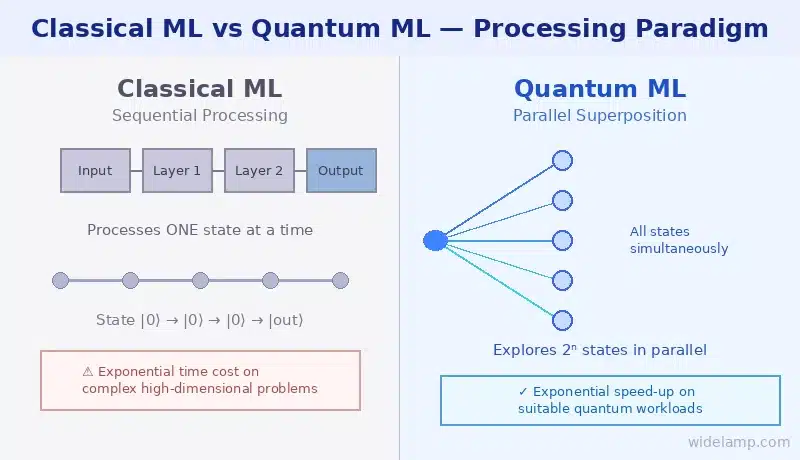
Quantum machine learning (QML) is a branch of computer science that combines the rules of quantum physics with the pattern-finding power of machine learning. Think of it this way: classical machine learning is like searching a massive library one shelf at a time. Quantum machine learning is like reading every shelf simultaneously and instantly knowing exactly where your answer is.
At the heart of QML are qubits the quantum version of the classical binary bit. While a normal computer bit is always either a 0 or a 1, a qubit can exist as both 0 and 1 at the same time (a state called superposition). Add to this another quantum trick called “entanglement,” where two qubits are linked so that changing one instantly affects the other, and you have a machine that can process enormous amounts of data in parallel, in ways a classical computer simply cannot replicate.
The result? Machine learning models that can potentially train faster, find patterns in far more complex data, and solve optimization problems that would take today’s best supercomputers thousands of years to crack.
📘 Key Definition: Quantum Machine Learning (QML)
Quantum machine learning is the field that applies quantum computing principles superposition, entanglement, and quantum interference to build machine learning models that are faster, more efficient, or capable of solving problems beyond the reach of classical computers. QML algorithms can run on quantum hardware, classical simulations of quantum hardware, or hybrid systems that combine both. The field was formally named in 2016 in a landmark paper in the journal Nature by Biamonte et al., and has grown exponentially since.
How Does Quantum Machine Learning Actually Work?
The 3 Quantum Principles That Power QML
To understand quantum machine learning, you only need to understand three core ideas from quantum physics. Don’t worry, no physics degree required.
Superposition is the ability of a qubit to represent 0 and 1 at the same time. In a classical neural network, each neuron is either active or not. In a quantum neural network, each qubit can explore both states simultaneously, meaning the system evaluates many possible answers at once rather than one at a time. It’s like tossing a coin and it landing on both heads and tails at the same time until you look at it.
Entanglement links two or more qubits so that the state of one instantly determines the state of the other, no matter how far apart they are. In machine learning terms, this creates correlations between data features that are impossible to encode efficiently in a classical model. This is why quantum models can sometimes find patterns that classical models completely miss.
Quantum interference is the mechanism that cancels out wrong answers and amplifies correct ones during computation. Think of it like noise-cancelling headphones; it suppresses the computational “noise” so that the right solution comes through clearly. Quantum machine learning algorithms are deliberately designed to exploit interference to guide the learning process toward accurate predictions faster.
What Are Variational Quantum Circuits (VQCs)?
The most widely used building block in quantum machine learning today is the Variational Quantum Circuit (VQC), also called a parameterized quantum circuit (PQC) or a quantum neural network (QNN). Think of a VQC exactly like a classical neural network layer, but built from quantum gates instead of mathematical weights.
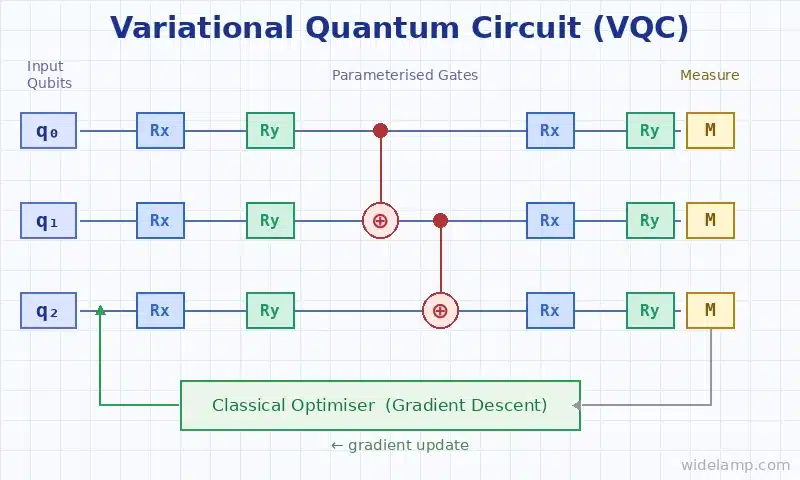
Here is how a VQC learns, step by step:
- Classical data (numbers, images, text features) is encoded into the quantum circuit using a process called data embedding.
- The circuit applies a series of quantum gates—parameterized operations that can be tuned, just like weights in a neural network.
- The output is measured and compared to the correct answer using a loss function.
- A classical optimizer (like gradient descent) updates the circuit parameters to reduce the error.
- Steps 2–4 repeat until the circuit learns to make accurate predictions.
This quantum–classical feedback loop is the foundation of nearly all QML algorithms running on today’s hardware. The VQC’s resilience against quantum noise makes it ideal for current NISQ (Noisy Intermediate-Scale Quantum) devices, the type of quantum computers that exist right now.
Classical AI learns by trying one possibility at a time. Quantum machine learning explores millions of possibilities simultaneously and that difference is about to change everything.”
Quantum Machine Learning vs Classical Machine Learning: What’s the Real Difference?
Before we go further, let’s be honest about something: classical machine learning is extraordinarily powerful. Deep learning models today can write code, diagnose cancer, generate photorealistic images, and translate between hundreds of languages. So why do we need quantum machine learning at all?
| Feature | Classical Machine Learning | Quantum Machine Learning |
|---|---|---|
| Basic Unit | Bit (0 or 1) | Qubit (0, 1, or both via superposition) |
| Processing Style | Sequential — one state at a time | Parallel — many states simultaneously |
| Best For | Large datasets, image/text/audio tasks | Complex optimisation, molecular simulation, high-dimensional data |
| Hardware | CPUs, GPUs, TPUs — mature, widely available | Quantum processors — early stage, cloud access only |
| Current Status | Production-ready, deployed at scale | NISQ era — hybrid systems showing early advantage |
| Key Limitation | Exponential compute cost for certain problems | Qubit noise, decoherence, limited qubit count |
| Famous Example | GPT-4, AlphaFold, DALL-E | Quantum GAN for drug molecules, QNN for finance |
The honest truth is this: for most everyday AI tasks, like writing, image recognition, and recommendation engines, classical machine learning will remain the right tool for years to come. But for a specific class of problems involving molecular simulation, large-scale optimisation, and high-dimensional quantum data, quantum machine learning offers a genuine and growing advantage. Now let’s look at where that advantage is already being felt.
7 Quantum Machine Learning Breakthroughs You Need to Know
We know how much you’ve been hearing about “quantum computing” as a future technology, always five years away, always theoretical. This section is different. These are seven real breakthroughs that happened in 2025 or the lead-up to it, backed by actual data and named companies.
1. Google’s Quantum Computer Runs 13,000× Faster Than a Supercomputer
In 2025, Google announced that their quantum processor completed a verifiable test 13,000 times faster than the world’s fastest classical supercomputer and unlike previous claims, this was done using a verifiable algorithm that any researcher could independently test. This is the first time in history that a quantum computer demonstrated a speed advantage on a provably checkable benchmark. For quantum machine learning, this matters enormously because faster hardware means that training quantum models becomes genuinely practical at scale.
2. HSBC Improves Bond Trading Predictions by 34% Using IBM Quantum
HSBC used IBM’s Heron quantum computer to enhance bond trading prediction models, achieving a 34% improvement over classical computing methods. This is one of the clearest real-world demonstrations that hybrid quantum-classical machine learning, where quantum layers enhance classical models, is not just theoretical. Financial firms that dismiss quantum ML today may find themselves at a serious disadvantage within just a few years.
3. IonQ Achieves Quantum Advantage in Drug Discovery
IonQ announced in October 2025 that it had achieved genuine quantum advantage in drug discovery and engineering applications, and separately surpassed classical methods in chemistry simulations. Their earlier collaboration with Ansys in March 2025 demonstrated a 12% speedup in fluid interaction analysis for medical devices. These are the kinds of small but real percentage gains that compound over thousands of simulations to dramatically shorten drug development timelines.
4. Google + Boehringer Ingelheim Simulate a Key Human Enzyme
Google collaborated with pharmaceutical giant Boehringer Ingelheim to simulate Cytochrome P450 a critical human enzyme involved in drug metabolism using a quantum approach that was more efficient and precise than traditional classical simulation methods. This type of molecular simulation is exactly where quantum machine learning shines: the number of quantum states in a molecule grows exponentially, making classical computers progressively worse at the task. Quantum computers handle this natively.
5. Quantinuum Raises $800 Million at a $10 Billion Valuation
Quantinuum widely considered to produce the world’s most accurate quantum computer as of 2025 — raised $800 million in funding, with Fidelity joining the latest round. The company’s hardware is now being tested by SoftBank, JPMorgan Chase, Amgen (exploring hybrid quantum-machine learning for biologics), and BMW (researching quantum approaches for fuel cells). A $10 billion valuation is not a bet on the future. It’s a statement that the future is already arriving.
6. Ford Otosan Deploys Quantum AI in Production — Not Just Testing
Ford Otosan used D-Wave’s quantum annealing technology to reduce factory scheduling times from 30 minutes to under five. Crucially, this was not a research experiment it was deployed in live production. This is a landmark moment for quantum machine learning applications: the technology has moved from the laboratory to the factory floor.
7. The World’s First Hybrid Quantum Large Language Model (QLLM)
In early 2025, SECQAI announced the world’s first hybrid Quantum Large Language Model a QLLM that combines a quantum attention mechanism with classical LLM architecture. The system uses an in-house quantum simulator capable of supporting gradient-based learning and integrates a quantum attention layer directly into existing large language model architectures. If this approach scales, it could eventually give AI language models the ability to process relational patterns in text with a depth of correlation that purely classical transformers cannot achieve.
✅ What “Quantum Advantage” Actually Means
Quantum advantage sometimes called quantum supremacy is the point at which a quantum computer completes a specific task faster, more accurately, or more efficiently than any classical computer. It does NOT mean quantum computers replace all classical computing. It means there is at least one real problem where quantum wins. In 2025, that list of problems is growing rapidly. Drug simulation, financial optimisation, and engineering modelling are already on it.
“Every year, the question ‘is quantum machine learning real?’ gets harder to ask with a straight face. A 34% improvement in bond trading, a drug discovery breakthrough, a factory running on quantum scheduling — this is not a promise anymore. It is a track record.”
What Are the Main Types of Quantum Machine Learning Algorithms?
Quantum machine learning is not one single algorithm; it’s a growing family of techniques. Here is a plain-language guide to the main types you will encounter in research and industry.
Quantum Neural Networks (QNNs)
Quantum neural networks are the quantum equivalent of the classical neural network layers that power deep learning. Instead of artificial neurons with weighted connections, QNNs use variational quantum circuits, layers of parameterised quantum gates to learn patterns in data. QNNs can be trained using classical gradient-descent methods (like backpropagation), making them accessible via familiar tools such as PennyLane and Qiskit ML. They are the most researched QML architectures today and the most likely to achieve practical advantage on near-term quantum hardware.
Quantum Kernel Method
Kernel methods are a well-established family of classical machine learning algorithms, with Support Vector Machines (SVMs) being the most famous example. In the quantum version, a quantum computer maps input data into a high-dimensional quantum feature space a mathematical space so large that classical computers cannot efficiently compute within it. Research from IBM Quantum has shown that quantum kernel estimation can outperform classical kernels on specific structured datasets, making this one of the most theoretically grounded paths to genuine quantum advantage in machine learning.
Quantum Generative Model
Just as classical AI has GANs (Generative Adversarial Networks) for generating images and text, quantum machine learning has Quantum GANs (qGANs) and Quantum Boltzmann Machines for generating data at the molecular and financial level. Quantum GAN models have been used to generate realistic drug-like molecules from scratch, a task of enormous value in pharmaceutical research, where the search space of possible drug candidates contains more possibilities than atoms in the observable universe.
Quantum Reinforcement Learning (QRL)
Quantum reinforcement learning combines the decision-making framework of classical reinforcement learning with quantum circuits. The result is an agent that can explore a vastly larger decision space in parallel potentially learning optimal strategies far faster than classical RL agents. Research into QRL for robotics, game-playing, and financial trading strategy optimisation is growing rapidly, and several papers from 2025 have demonstrated early proof-of-concept results on real NISQ hardware.
Where Is Quantum Machine Learning Being Used Right Now?
Drug Discovery and Molecular Simulation
This is arguably the most advanced real-world application of quantum machine learning today. Pharmaceutical companies including Boehringer Ingelheim, Roche (through Quantinuum), Amgen, Merck, and Moderna all have active quantum machine learning teams. The core application is molecular property prediction using quantum models to determine how a drug molecule will interact with a target protein, which classically requires enormous compute power because molecules are inherently quantum systems. Yale University researchers in 2025
published work on quantum neural networks for molecular generation and property prediction, specifically in the drug discovery pipeline. This is not a distant future it is ongoing, funded research producing results.
Financial Modelling and Portfolio Optimisation
Finance has emerged as one of the earliest adopter sectors for quantum machine learning. JPMorgan Chase partnered with IBM to explore quantum algorithms for option pricing and risk analysis, with early results indicating quantum models could outperform classical Monte Carlo simulations in both speed and scalability. Multiverse Computing applies QML specifically to portfolio optimisation, risk assessment, and trading strategy targeting use cases where finding the optimal combination among thousands of assets simultaneously is computationally brutal for classical computers.
Engineering Simulation and Materials Science
Beyond pharmaceuticals, quantum machine learning is penetrating heavy industry. The Ansys–IonQ collaboration showed measurable improvements in fluid dynamics simulation for medical devices. BMW is exploring quantum approaches for fuel cell research via Quantinuum. Ford Otosan has deployed quantum optimisation in factory scheduling. Google’s DeepMind has separately begun integrating quantum simulation data into materials science workflows, targeting the discovery of new battery materials and superconductors.
⚠️ The Honest Limitation: What QML Cannot Do Yet
Quantum machine learning is real and growing but let’s be clear about where it stands. Current NISQ-era devices have limited qubit counts, high noise rates, and short coherence times. This means most QML algorithms running on real quantum hardware today are small-scale, and formal mathematical proofs of quantum advantage in machine learning remain elusive in most domains. Barren plateaus a phenomenon where the gradient of a quantum circuit becomes exponentially small as circuit size grows remain an unsolved challenge. Anyone telling you that QML will replace deep learning within three years is overstating the science. The field is promising and progressing, not mature.
Which Tools and Platforms Can You Use to Start Quantum Machine
Learning Today?
The good news you don’t need a quantum computer in your home to start learning quantum machine learning. Every major platform listed below offers free cloud access to real quantum hardware or high-fidelity simulators. Start with PennyLane if you know Python and classical ML the learning curve is surprisingly gentle.
PennyLane by Xanadu
Open-source Python library for quantum machine learning. Integrates with TensorFlow and PyTorch. Ideal starting point for ML practitioners wanting to experiment with quantum circuits without deep physics knowledge.
Best for: Beginners and ML researchers
Qiskit Machine Learning (IBM)
IBM’s open-source framework for building quantum neural networks and quantum classifiers. Free access to real IBM quantum processors via IBM Quantum Experience. Backed by one of the world’s largest quantum research programmes.
Best for: Enterprise and research applications
Google Cirq + TensorFlow Quantum
Google’s framework combines quantum circuit design (Cirq) with classical deep learning (TensorFlow) to build hybrid quantum-classical models. Designed for researchers targeting quantum advantage research and QML experimentation.
Best for: Hybrid model research
Amazon Braket
AWS’s managed quantum computing service provides access to hardware from IonQ, Rigetti, and Oxford Quantum Circuits alongside a high-performance quantum simulator. Well-suited for teams already working within the AWS ecosystem.
Best for: Cloud-native teams and enterprises
Orquestra by Zapata AI
Specialises in hybrid quantum-classical workflows targeting drug discovery and materials science. Re-emerged in 2025 after restructuring with a sharper focus on production-ready quantum ML pipelines for life sciences.
Best for: Drug discovery and life sciences
NVIDIA CUDA-Q
NVIDIA’s quantum computing platform that bridges GPU-accelerated classical AI with quantum processors. Integrated with Quantinuum’s hardware, it enables programmable hybrid workflows for companies already using NVIDIA’s AI infrastructure.
Best for: Enterprise AI teams exploring QML
How Can You Learn Quantum Machine Learning? A Practical Step-by-Step
Path
Don’t worry the path to learning quantum machine learning is clearer than it looks. Follow these seven steps, and you will go from zero to running your first quantum ML model in a matter of weeks.
Step 1 — Brush up on linear algebra and probability. QML is built on matrix operations and probabilistic reasoning. Khan Academy and 3Blue1Brown’s “Essence of Linear Algebra” series on YouTube are free and excellent.
Step 2 — Learn the basics of quantum computing. IBM’s free Qiskit textbook (available at qiskit.org/learn) is one of the best free resources in the world. It is interactive, practical, and written for people with a classical computing background.
Step 3 — Complete the PennyLane QML tutorials. Xanadu’s PennyLane website offers a free series of tutorials that cover quantum neural networks, quantum kernels, and hybrid quantum-classical models. Each one is a working Python notebook.
Step 4 — Run a model on real quantum hardware. IBM Quantum Experience gives you free access to real quantum processors in the cloud. Once you have completed the PennyLane tutorials, run one of your circuits on a real IBM device. The experience of seeing your quantum circuit execute on actual quantum hardware for the first time is something you will not forget.
Step 5 — Follow the research. The arXiv preprint server (arxiv.org — search “quant-ph” and “cs.LG”) is where new QML research appears before formal publication. Follow it weekly to stay current.
Step 6 — Join the community. The Qiskit Slack workspace, PennyLane discussion forums, and the quantum computing subreddit (r/QuantumComputing) are active communities with researchers and practitioners happy to answer beginner questions.
Step 7 — Apply it to something you care about. The fastest way to consolidate your learning is to pick one real problem drug property prediction, a financial classification task, or an optimisation problem and spend a month trying to build a quantum solution. Even a failed attempt teaches you more than ten tutorials.
Now that you know your path forward, let’s look at what the future holds for the field as a whole.
🔬 Research Spotlight: The 2025–2035 QML Roadmap
A 2025 arXiv paper by Thudumu et al. published a ten-year outlook (2025–2035) for supervised quantum machine learning, examining variational quantum circuits, quantum neural networks, and quantum kernel methods. The paper is honest about current limitations including noise, barren plateaus, scalability issues, and the absence of formal proofs of performance improvement over classical methods while outlining a clear roadmap for how QML could transition from research into enterprise systems over the next decade. If you read one QML paper in 2025, make it this one: arXiv:2505.24765.
“The researchers who build expertise in quantum machine learning today are the ones who will define the field in 2030. The learning curve is steep — but so is the reward.”
What Is the Future of Quantum Machine Learning Beyond 2026
The ten-year outlook for quantum machine learning is simultaneously humbling and extraordinary. Here is what the research community genuinely believes is coming and why it matters to you personally.
Fault-tolerant quantum computing, the era of quantum computers with error rates low enough to run deep, complex quantum circuits reliably, is the event horizon for quantum machine learning. When fault-tolerant quantum computers arrive at scale (current estimates range from 2030 to 2040 for early commercial systems), QML algorithms that are today running on 50–100 noisy qubits will be able to run on millions of clean, logical qubits. At that point, the computational gap between quantum and classical machine learning opens up dramatically in domains like chemistry, physics simulation, and cryptography.
Hybrid quantum-classical models will dominate the near term (2025–2030). The most practical near-term path is systems where quantum circuits handle specific subroutines feature mapping, optimisation, kernel computation while classical deep learning handles the rest. Companies building hybrid quantum ML infrastructure today are positioning themselves for a significant competitive advantage as hardware matures.
Quantum advantage in AI is the long-term prize. If quantum machine learning models can be trained exponentially faster than classical neural networks on specific problem types, the impact on drug discovery, climate modelling, materials science, and financial modelling could be transformative on a civilisational scale. The SECQAI hybrid Quantum LLM while still experimental hints at a future where language models themselves acquire quantum-native reasoning capabilities that purely classical models cannot replicate.
If you missed last year’s cut-off on understanding quantum computing, this updated deep dive on quantum machine learning is written especially for your comeback. The field needs people who understand both the technology and its limitations — and that combination is rarer than raw coding skill.
“Classical AI was built on transistors measured in nanometres. Quantum machine learning is built on the laws of physics themselves. That is not an incremental improvement. That is a different game entirely.”
🏆 Challenge — Guaranteed Reward for the Best Answer
The Challenge Question:
Variational Quantum Circuits suffer from a phenomenon called the “barren plateau” — a
condition where the gradient of the cost function vanishes exponentially as the number of
qubits increases, making training effectively impossible at scale. Propose a theoretically
grounded and practically actionable strategy to either avoid or mitigate barren plateaus
in a hybrid quantum-classical machine learning pipeline targeting molecular property
prediction in drug discovery. Your answer should address both circuit design and
optimisation strategy, and explain why your approach would remain viable on near-term
NISQ hardware.
A guaranteed reward is on offer for the best, most original, and most technically rigorous answer received. Send your response to: contact@widelamp.com
Open to students, researchers, and professionals worldwide.
Frequently Asked Questions: Quantum Machine Learning
Q What is quantum machine learning, and how is it different from classical machine learning?
Quantum machine learning (QML) is the integration of quantum computing principles superposition, entanglement, and quantum interference into machine learning algorithms. The core difference from classical machine learning is the computational substrate. Classical ML processes information as bits (0 or 1) in a strictly sequential or parallel-but-still-classical manner. Quantum ML uses qubits that can represent 0 and 1 simultaneously, allowing quantum algorithms to explore exponentially large solution spaces in ways that classical computers cannot. For specific problem types molecular simulation, combinatorial optimisation, high-dimensional kernel computation — this difference leads to measurable computational advantages even on today’s early-stage quantum hardware.
Q Do I need a quantum computer to learn or practice quantum machine learning?
No, you do not need a physical quantum computer. IBM Quantum Experience provides free cloud access to real quantum processors, and simulators on your own laptop (via PennyLane or Qiskit) can run quantum circuits on up to 20–30 qubits accurately. Most learning, research, and early-stage QML development happens on simulators or cloud hardware. For beginners, starting with PennyLane’s free tutorials which run entirely on a classical computer simulating quantum circuits is the fastest and most accessible path to practical skills in quantum machine learning.
Q What is a variational quantum circuit and why does quantum machine learning use it?
A variational quantum circuit (VQC) — also called a parameterised quantum circuit (PQC) or quantum neural network (QNN) is a quantum circuit whose gate operations are controlled by tunable parameters, just like weights in a classical neural network. Data is encoded into the circuit, the parameterised gates process it, the output is measured, and a classical optimiser updates the parameters to minimise a loss function. Quantum machine learning uses VQCs because they are resilient against quantum noise, compatible with current NISQ-era hardware, and trainable using familiar classical optimisation methods like gradient descent, making them the most practical QML architecture available today.
Q Is quantum machine learning already being used in industry, or is it still purely research?
Both. In 2025, quantum machine learning exists on a spectrum from fundamental research to live production deployment. HSBC is using IBM’s Heron quantum processor to improve bond trading predictions. Ford Otosan has deployed D-Wave quantum optimisation in live factory scheduling not as a test, but in production use. IonQ has demonstrated quantum advantage in drug discovery and chemistry simulation. At the same time, the majority of QML research remains in early experimental stages, with formal proofs of broad quantum advantage still elusive. The honest picture is: production use is real but limited to specific high-value use cases, while the broader revolution remains in progress.
Q What is a quantum neural network (QNN) in quantum machine learning?
A quantum neural network (QNN) is a machine learning model built from variational quantum circuits quantum circuits with tunable parameters that function analogously to layers in a classical neural network. The quantum gates within a QNN process encoded data through operations governed by quantum physics (including superposition and entanglement), potentially capturing correlations in data that a classical neural network would require exponentially more neurons to represent. QNNs are the primary architecture explored in quantum deep learning research and are available to implement today using PennyLane, Qiskit ML, or TensorFlow Quantum.
Q What is the biggest challenge facing quantum machine learning right now?
The three biggest challenges in quantum machine learning today are qubit noise, barren plateaus, and the absence of formal proofs of broad quantum advantage. Qubit noise refers to errors introduced by imperfect quantum gates on NISQ hardware, which limits the depth of circuits that can be run reliably. Barren plateaus are a theoretical phenomenon where the gradient of a QML model’s cost function vanishes exponentially as the number of qubits grows, making training progressively harder at scale. And while quantum advantage has been demonstrated for specific benchmarks, formal mathematical proof that QML will outperform classical ML across a wide class of real-world problems remains an open research question.
Q How is quantum machine learning being used in drug discovery?
Quantum machine learning is applied in drug discovery primarily through molecular property prediction and molecular generation. Drug molecules are inherently quantum systems classical computers must use exponentially large approximations to simulate them, which introduces errors and computational cost. Quantum computers handle this natively. In practice, companies like Boehringer Ingelheim (with Google), Roche (with Quantinuum), Amgen, and Merck are using quantum neural networks and variational quantum circuits to predict how a drug molecule will bind to a target protein, screen large molecular libraries, and generate new drug-like molecules. IonQ announced quantum advantage in drug discovery applications in October 2025.
Q Will quantum machine learning replace classical AI and deep learning?
No at least not in any foreseeable timeframe. Quantum machine learning will not replace classical AI and deep learning. Classical deep learning is extraordinarily mature, runs on cheap, fast, widely available hardware, and handles the majority of AI tasks image recognition, natural language processing, recommendation systems — with outstanding performance. Quantum machine learning targets a specific subset of problems where quantum mechanics provides a genuine computational advantage: molecular simulation, high-dimensional optimisation, complex pattern recognition in quantum data. The realistic future is a complementary relationship hybrid quantum-classical systems where quantum circuits handle specific hard subroutines while classical AI handles the rest.
Quantum machine learning is not a distant dream or a Silicon Valley buzzword. It is a rapidly maturing field with documented results in drug discovery, financial modelling, engineering simulation, and the foundations of AI. The companies investing in it today — IBM, Google, IonQ, Quantinuum, HSBC, JPMorgan, Ford, Boehringer Ingelheim — are not betting on hope. They are betting on early results that are already measurable. If you are a student, a researcher, or a professional thinking about where to build expertise for the next decade, quantum machine learning belongs on your radar today.
Have a question, a challenge answer, or a thought about anything covered in this article? We genuinely want to hear from you. Reach us any time at contact@widelamp.com every message is read and replied to personally.
📚 Resources & References
Official & Platform Resources
- IBM Qiskit — Free Quantum Computing Learning Platform — IBM’s comprehensive free resource for learning quantum computing and quantum machine learning using the Qiskit framework, with access to real quantum hardware.
- PennyLane QML Tutorials — Xanadu — The definitive free tutorial series for quantum machine learning using PennyLane, covering quantum neural networks, quantum kernels, and hybrid quantum-classical models.
- Amazon Braket — AWS Quantum Computing Service — Amazon’s managed quantum computing platform providing cloud access to multiple quantum hardware providers including IonQ and Rigetti.
Academic & Research References
- arXiv:2505.24765 — Supervised QML: A 2025–2035 Ten-Year Outlook — Thudumu et al.’s comprehensive review and roadmap for supervised quantum machine learning covering variational circuits, quantum kernels, and the path to enterprise applications.
- arXiv:2502.11951 — Quantum Data Encoding and Variational Algorithms — A 2025 framework paper by Bose et al. on hybrid quantum-classical machine learning, covering data encoding strategies and variational circuit design for NISQ devices.
- Nature Computational Science — Quantum Mechanics Centennial Focus 2025 — Nature’s landmark 2025 collection on quantum mechanics’ 100th anniversary, covering quantum machine learning challenges, error correction, and future pathways.
- arXiv — Quantum Machine Learning in Drug Discovery (Yale / IBM Research) — Smaldone et al.’s 2025 review of quantum neural networks applied to drug discovery, covering molecular property prediction and generation at the drug pipeline level.
Industry News & Breakthroughs
- Network World — Top Quantum Breakthroughs of 2025 — A comprehensive overview of the ten most significant quantum computing milestones of 2025, including the Google 13,000× speedup, HSBC bond trading results, and Ford Otosan’s production deployment.
- The Quantum Insider — What Is Quantum Machine Learning? (2025) — Current industry overview of QML applications, platforms, pharmaceutical use cases, and company profiles including IBM, Xanadu, Zapata AI, and Multiverse Computing.
- SpinQ — Quantum Computing Industry Trends 2025 — SpinQ’s industry report on 2025 quantum computing milestones covering enterprise adoption, hybrid quantum-AI convergence, and financial services applications.
- Quantum Zeitgeist — SECQAI Launches World’s First Hybrid Quantum LLM — Detailed coverage of SECQAI’s hybrid Quantum Large Language Model, the world’s first, combining a quantum attention mechanism with classical LLM architecture.
Further Learning
- Google Search Central Documentation — Google’s official documentation for SEO and search best practices, referenced in every WideLamp article for algorithm compliance.