
|
Getting your Trinity Audio player ready...
|
AWS quantum computing is no longer science fiction sitting in a research lab — it is happening right now, and it is happening fast. In February 2025, Amazon Web Services unveiled the Ocelot chip, its first-generation quantum processor, and with it a claim that shook the entire industry: error correction costs slashed by up to 90%. Whether you are a developer, a researcher, a business leader, or simply someone curious about the technology that will define the next decade, this guide was written for you. By the time you finish reading, you will understand exactly what AWS is building, why it matters, how you can start using it today, and what it means for your future.
The last date for the world to ignore quantum computing has already passed.
What Is AWS Quantum Computing — And Why Does It Matter
AWS quantum computing is Amazon’s two-pronged effort to bring quantum technology into the real world: one track through its own hardware research, and the other through Amazon Braket, a managed cloud service that lets anyone access real quantum hardware over the internet today.
Think of it this way. Your laptop works with classical bits — tiny switches that are either on (1) or off (0). A quantum computer uses qubits, which can be both 0 and 1 at the same time — a property called superposition. It can also link qubits together through entanglement, so that changing one instantly affects another. These two properties let quantum computers tackle certain problems exponentially faster than anything running on classical silicon.
Here is why 2025 specifically matters: AWS crossed a major milestone by demonstrating the Ocelot chip — the first prototype quantum processor it has built entirely in-house, with error correction designed from the ground up rather than bolted on afterwards. That is a bigger deal than it might sound. Error correction is the single hardest problem in practical quantum computing, and AWS just found a shortcut that could require as little as one-tenth the resources of standard approaches.
How Is AWS Quantum Computing Different from Classical Cloud Computing?
Classical cloud computing — the kind powering your apps, databases, and AI models today — processes information sequentially through transistors. AWS quantum computing processes information by manipulating quantum states in qubits, which allows certain calculations to be solved in ways that classical computers simply cannot match, no matter how many servers you throw at the problem.
The gap matters most for simulation-heavy tasks: designing new medicines, modelling financial risk across thousands of variables simultaneously, or cracking encryption. For everyday workloads, your classical EC2 instance is still the right tool. AWS is positioning quantum as the layer above — the one that handles problems currently marked “impossible.”
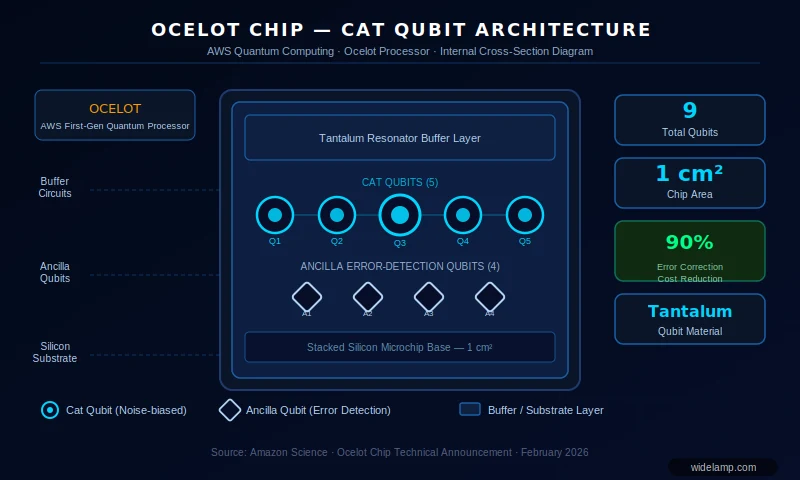
on a 1 cm² silicon chip to achieve 90% lower error correction costs than standard quantum approaches.
“It is no longer a matter of if — but when — practical, fault-tolerant quantum computers will be available for real-world applications.”
— Oskar Painter, Director of Quantum Hardware, AWS
AWS Quantum Computing Breakthrough: Meet the Ocelot Chip
If you only remember one thing from this article, make it this: the Ocelot chip is AWS’s most significant quantum computing achievement to date, and it was published in the prestigious journal Nature in early 2025.
Here is what makes it genuinely different from everything that came before it.
Most quantum computers today are built first, and then engineers try to retrofit error correction on top. That approach is like building a house and only deciding where to put the foundations after the walls are already up. AWS did the opposite. The Ocelot team, led by Oskar Painter at Caltech, designed error correction into the chip’s architecture from the very first circuit element.
[H3] What Are Cat Qubits — And Why Do They Matter for AWS Quantum Computing?
Cat qubits — named after the famous Schrödinger’s cat thought experiment — are a special type of qubit that naturally suppresses one entire category of quantum errors called bit-flip errors. Think of a bit-flip error like a coin landing on the wrong side: traditional qubits flip accidentally all the time under tiny disturbances like heat or vibration. A cat qubit, however, is engineered so that this class of mistake becomes exponentially less likely by design.
The Ocelot chip uses five cat qubits made from tiny hollow structures of tantalum that contain microwave radiation. Four additional qubits handle the remaining category of errors (phase-flip errors) using a simple repetition code. Together, the nine-qubit chip on a 1 cm² silicon chip achieves something remarkable: a distance-5 error correction code using fewer than one-fifth the qubits that a standard surface-code device would require for the same level of protection.
Scaling this to a full-sized fault-tolerant quantum computer would require as little as one-tenth the resources of conventional approaches. That could accelerate the arrival of practical quantum computing by up to five years.
How Does Amazon Braket Work — Your Gateway to AWS Quantum Computing Today?
You do not need your own quantum computer to use AWS quantum computing. That is the whole point of Amazon Braket.
Amazon Braket is a fully managed cloud service that gives you access to real quantum hardware from five different providers — right now, today — through a single unified API. It works exactly like any other AWS service: you open the console, choose your hardware, write your circuit, submit your job, and get results back. No cryogenic cooling required on your end.
Here is what is available on Braket right now:
AWS Quantum Computing Hardware Available on Amazon Braket
Braket currently offers three types of quantum hardware, each suited to different problem types:
Superconducting qubits are built with superconducting electric circuits cooled to near absolute zero. Braket provides access to superconducting machines from Rigetti (including the 84-qubit Ankaa-2 processor with improved two-qubit gate fidelity) and IQM (including the 54-qubit Emerald processor built on a 2D grid with native surface-code error correction support).
Trapped-ion qubits use electrically charged atoms suspended by electromagnetic fields — these machines tend to have lower error rates and very high connectivity between qubits. Braket gives you access to trapped-ion machines from IonQ (using ytterbium ions) and AQT (using calcium ions with a 12-qubit IBEX Q1 processor).
Neutral atom qubits use Rydberg atoms arranged in programmable arrays — ideal for quantum simulation and certain optimisation problems. QuEra Computing’s Aquila machine (256 qubits) is available on Braket for analogue quantum simulation.
Qubits: 84 (Ankaa-2)
Best for: Gate-based algorithms, VQE, QAOA
Qubits: 54 (Emerald)
Best for: Surface-code error correction experiments
Species: Ytterbium atoms
Best for: High-fidelity circuits, chemistry simulation
Qubits: 12 (IBEX Q1)
Best for: Universal gate-based quantum circuits
Qubits: 256 (Aquila)
Best for: Quantum simulation, combinatorial optimisation
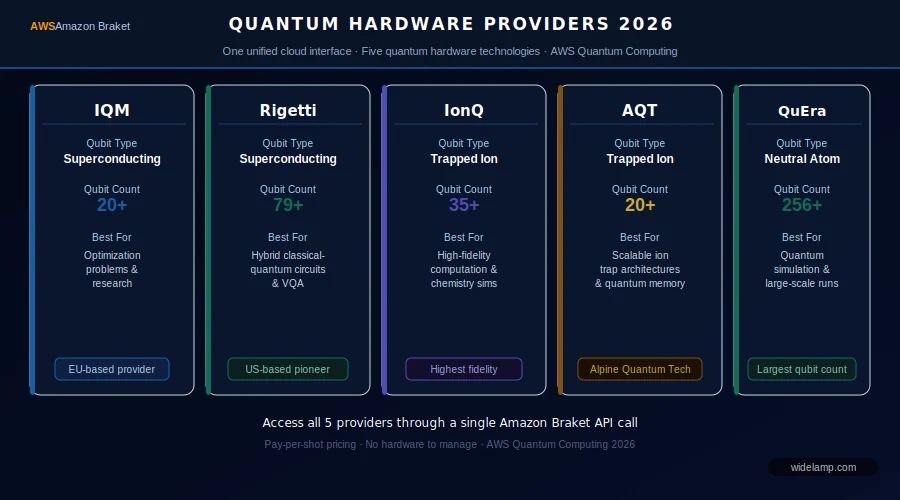
different quantum hardware providers — from superconducting to neutral atom technologies.
“Quantum computing is very much in line with AWS’s cloud business model — off-premise quantum resources, accessible through the cloud, on demand.”
— Oskar Painter, AWS Director of Quantum Hardware
How to Get Started with AWS Quantum Computing on Amazon Braket — Step by Step
Do not worry — the process is far simpler than the physics. If you have ever used any AWS service, you will feel right at home. Here are the 7 steps to run your first quantum circuit on real hardware through AWS quantum computing.
- Create or log into your AWS account at aws.amazon.com. If you are new, the free tier gives you access to Braket’s simulator without any charge — a perfect place to start.
- Open the Amazon Braket console from the AWS services menu. It lives under “Machine Learning” or you can simply search “Braket” in the top search bar.
- Choose your device. For beginners, start with the SV1 local simulator (free) to test your circuit logic. When you are ready, switch to real quantum hardware — Rigetti Ankaa-2 is a popular first choice for superconducting experiments.
- Install the Amazon Braket SDK on your local machine or open a managed Braket notebook directly in the console. Install command: pip install amazon-braket-sdk
- Write your first quantum circuit. The Braket SDK supports Python and integrates with popular quantum frameworks like Qiskit and PennyLane. A Bell state circuit — the quantum computing equivalent of “Hello World” — takes fewer than 10 lines of code.
- Submit your job. For real hardware runs, use Braket Hybrid Jobs if your algorithm mixes classical and quantum steps. For single circuit runs, submit directly. The SDK returns results through a unique Amazon Resource Name (ARN) so you can retrieve output even if there is a queue delay.
- Analyse your results. Braket returns measurement outcomes (shot counts across all possible qubit states) that you analyse in your notebook. Use the built-in visualisation tools or plug results into any Python data library.
What Is the AWS Quantum Computing Pricing on Amazon Braket?
Braket charges in two parts: a per-task fee each time you submit a job, plus a per-shot fee for each individual measurement taken during that run. The good news for researchers: the 2025 “program sets” update lets you bundle up to 100 circuit variants into a single task — meaning you pay one task fee instead of 100, cutting costs by up to 25% for batch experiments. You can also set spending limits directly in the Braket console to avoid surprises.
What Are the Real-World Applications of AWS Quantum Computing?
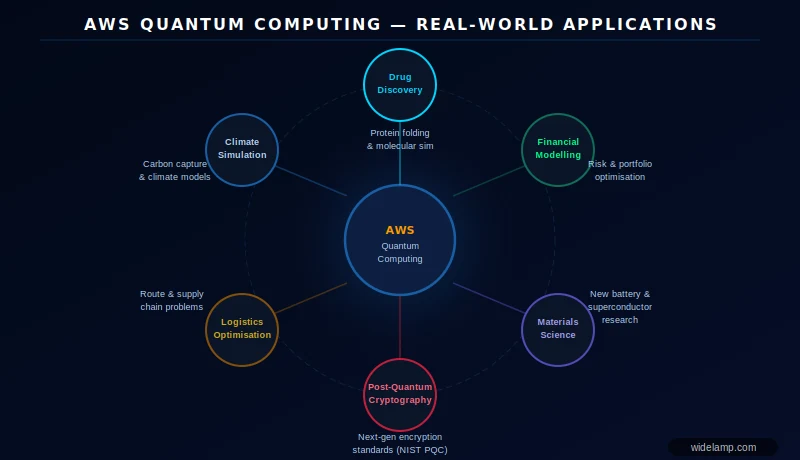
This is the part that should excite you — even if you will never write a single line of quantum code. The industries that AWS quantum computing will transform are the ones that affect everyone’s daily life.
Drug Discovery: The Most Promising AWS Quantum Computing Use Case
The average cost of bringing a new FDA-approved medicine to patients sits around $2.6 billion. Most of that cost comes from the failure rate — thousands of drug candidates tested, most discarded. The fundamental problem is molecular simulation: classical computers simply cannot accurately model quantum-level interactions between atoms at the scale needed for confident drug design.
AWS has built an open-source solution called Quantum Computing Exploration for Drug Discovery (QCEDD), accessible through Amazon Braket, which gives pharmaceutical researchers tools for molecular docking, protein folding, RNA folding, and retrosynthetic planning. When fault-tolerant quantum computers arrive — and Ocelot is a step on that road — these simulations will run with a precision that could cut drug discovery timelines from 12 years to a fraction of that.
Financial Services: Quantum algorithms like QAOA (Quantum Approximate Optimization Algorithm) can explore solution spaces for portfolio optimisation and risk modelling far more efficiently than classical methods. JPMorganChase is already partnering with the Amazon Advanced Solutions Lab on Braket for quantum financial research.
Materials Science: Designing better batteries, more efficient solar cells, and stronger aerospace materials all require simulating quantum-level atomic interactions — exactly the kind of workload quantum computers are built for.
Cryptography and Cybersecurity: Q-CTRL’s Fire Opal, running on Amazon Braket, is already being used for quantum network anomaly detection — with Accenture Federal Services reporting significant performance improvements. On the defensive side, post-quantum cryptography is a growing concern: organisations that handle sensitive data need to start preparing now.
Logistics and Optimisation: Complex routing and supply chain problems — the kind that even the best classical solvers struggle with — become natural candidates for quantum optimisation algorithms as hardware scales up.
“Every year, billions of dollars are spent on drug candidates that fail because we cannot simulate molecules accurately enough. AWS quantum computing is the technology that changes that equation.”
— WideLamp Editorial Insight
AWS Quantum Computing vs Google vs Microsoft — Who Is Winning the Race?
Every major cloud giant is in this race, and they are all betting on different physics. Here is the honest comparison you need in 2025.
AWS is betting on cat qubits and bosonic error correction through its Ocelot architecture — a fundamentally different approach that prioritises hardware efficiency from the ground up. Its cloud platform, Amazon Braket, offers the broadest hardware provider ecosystem of the three.
Google made headlines in December 2024 with its Willow chip — a superconducting processor that also demonstrated major improvements in quantum error correction. Google’s approach uses surface codes on transmon qubits, the most widely used architecture in the field. Its Quantum AI division operates through Google Cloud’s access offerings.
Microsoft is pursuing an entirely different physical approach: topological qubits, which theoretically offer even greater intrinsic error protection but have proven extraordinarily difficult to realise in hardware. Azure Quantum offers cloud access to IonQ and Quantinuum hardware while Microsoft’s own topological qubit research continues.
The honest answer to “who is winning” is: nobody has won yet. All three are at the prototype and early error-correction stage. The race will be decided not by who announces the biggest chip first, but by who achieves scalable fault-tolerant quantum computing with commercially useful qubit counts — likely somewhere in the range of hundreds of thousands of logical qubits. AWS’s Ocelot architecture, if it scales as designed, could require significantly fewer physical qubits to reach that milestone than competing approaches.
| Feature | AWS (Amazon) | Microsoft | |
|---|---|---|---|
| Qubit Type | Cat Qubits (Bosonic / Superconducting) | Transmon Superconducting Qubits | Topological Qubits (in research) |
| Key 2025 Chip | Ocelot (9 qubits, 90% QEC cost reduction) | Willow (advanced superconducting) | Topological qubit demonstrations ongoing |
| Cloud Platform | Amazon Braket | Google Quantum AI / Cloud | Azure Quantum |
| Hardware Providers | IQM, Rigetti, IonQ, AQT, QuEra | Own hardware only | IonQ, Quantinuum + own R&D |
| Error Correction Approach | Built-in from ground up (cat qubit architecture) | Surface code on transmons | Topological protection (theoretical) |
| Open Cloud Access Today | ✅ Yes — Amazon Braket (pay per use) | Limited — research partnerships | ✅ Yes — Azure Quantum (partner hardware) |
| Research Base | Caltech (AWS Center for Quantum Computing) | Google Quantum AI Labs | Microsoft Research (Station Q) |
AWS Quantum Computing Learning Path — How to Go from Zero to Running Your First Circuit
We know this technology can feel overwhelming if you are coming from a classical computing background. Here is an honest, practical learning path for three different types of reader.
AWS Quantum Computing for Beginners
Start with the free resources on the Amazon Braket documentation pages. The Braket GitHub repository contains dozens of example notebooks — start with the Bell state tutorial, which prepares a two-qubit entangled state in fewer than 10 lines of Python. Next, take the free “Quantum Computing for Computer Scientists” course on Microsoft Learn (yes, even though you are targeting AWS hardware — the fundamentals are hardware-agnostic). Then move to running circuits on Braket’s free SV1 simulator before spending a single dollar on real QPU time.
For Professionals and Developers: The Braket SDK integrates cleanly with Qiskit and PennyLane — if you already know either framework, you can be running circuits on real AWS hardware within an afternoon. Focus on Braket Hybrid Jobs, which let you mix classical AWS compute (EC2, Batch, ParallelCluster) with quantum QPU runs in a single managed workflow. The CMP304 hybrid architecture session from re:Invent 2025 is essential viewing.
For Researchers: Access the AWS Center for Quantum Computing publications on Amazon Science. The 2025 Nature paper (Putterman et al.) on the Ocelot chip is the most important primary source for anyone studying bosonic error correction. Braket Direct gives researchers dedicated QPU access and direct support from AWS quantum specialists — apply through the Braket console.
“The history of computing shows that scaling the right component can have massive consequences for cost, performance, and feasibility. The transistor replaced the vacuum tube. Cat qubits may replace transmons.”
— WideLamp Editorial Insight, drawing on AWS Science blog
The Ocelot chip achieves a distance-5 quantum error correction code using just 9 qubits — compared to the 49 qubits a standard surface-code device would need for equivalent protection. But cat qubits suppress bit-flip errors exponentially while phase-flip errors still require active correction via a repetition code.
Here is the challenge: If you were designing the next generation of the Ocelot architecture targeting a distance-7 code, what specific trade-offs would you face between increasing the number of cat qubits versus increasing ancilla qubit count for phase-flip correction? And what novel engineering approach — not currently implemented in Ocelot — might allow you to suppress phase-flip errors intrinsically at the hardware level, removing the need for active repetition codes entirely?
This requires genuine synthesis of quantum error correction theory and hardware architecture — it cannot be trivially Googled. We are looking for original reasoning, not copy-pasted definitions.
Subject line: “Ocelot Architecture Challenge — [Your Name]”
A guaranteed reward awaits the best answer. Open to students, researchers, and professionals worldwide. All entries acknowledged.
Frequently Asked Questions — AWS Quantum Computing
AWS quantum computing is not a technology to watch from the sidelines. Whether you are a developer who wants to run your first quantum circuit today, a researcher studying error-corrected logical qubits, or a business leader trying to understand what this technology will mean for your industry in the next five years — the time to start learning is now. The Ocelot chip proves that the most important breakthroughs in this field are not just theoretical anymore. They are being etched onto silicon, measured in a lab at Caltech, and published in Nature. The cloud service that delivers this technology to your laptop is already live. You have no reason to wait.
Have a question about AWS quantum computing that we did not answer here? Want to go deeper on any section of this article? Reach us directly at contact@widelamp.com — we read and respond to every message. And if you found this article useful, explore more deeply researched technology guides at widelamp.com
📚 Resources & References
The official Amazon Braket product page covering hardware providers, SDK tools, pricing, and getting started guides for AWS quantum computing.
The full official announcement of the Ocelot quantum chip from Amazon, including architecture details, cat qubit explanation, and commercial implications.
Technical deep-dive from Amazon Science covering Ocelot’s error correction results, bit-flip suppression performance, and the Nature paper (Putterman et al., 2025).
The official AWS quantum computing blog covering Braket updates, new hardware integrations, research highlights, and tutorials from the AWS quantum team.
Full listing of all quantum hardware available through Amazon Braket, including IQM, Rigetti, IonQ, AQT, and QuEra, with technical specifications for each processor.
MIT Technology Review’s independent analysis of the Ocelot chip announcement, covering cat qubit physics, 9-qubit architecture, and comparison to industry approaches.
Comprehensive timeline of AWS’s quantum hardware development from 2019 to 2025, including Braket hardware expansions and the Ocelot Nature paper milestone.
Official open-source repository of Amazon Braket tutorial notebooks covering Bell states, VQE, QAOA, CUDA-Q integration, Qiskit-Braket provider, and more.
CNBC analysis of the three-way quantum cloud computing race between AWS, Google, and Microsoft — including Oskar Painter’s comments on AWS’s cloud business model for quantum.
Detailed coverage of the 2025 Braket program sets batch processing feature — including the 24× speed improvement and 25% cost reduction for multi-circuit quantum experiments.