
|
Getting your Trinity Audio player ready...
|
Quantum cybersecurity is no longer a distant theoretical concept; it is arriving faster than most governments, banks, and businesses are prepared for. Right now, your passwords, financial records, and private communications are protected by classical encryption methods that a powerful enough quantum computer could shatter in minutes. The difference between classical cybersecurity and quantum cybersecurity is not just technical it is the difference between a padlock and a vault built from the laws of physics itself. In this guide, you will discover exactly what separates these two worlds, why it matters urgently in 2025, and what the smartest organizations are already doing to stay protected.
Table of Contents
Before diving into the 7 differences, let us quickly define what we mean by each term because the internet has made this more confusing than it needs to be.
What Is Quantum Cybersecurity — And How Is It Different From Classical Security?
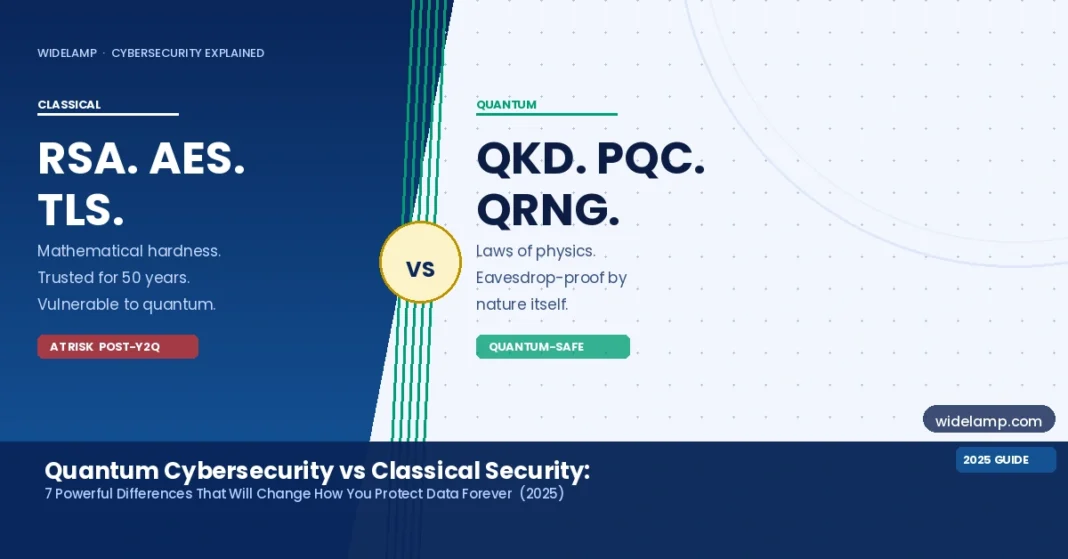
Classical cybersecurity is what protects almost everything on the internet today. It uses mathematical algorithm problems so difficult to solve that even the fastest supercomputers would need millions of years to crack them by brute force. Think of RSA encryption, AES-256, and the TLS protocols that put the padlock icon in your browser. These work brilliantly against today’s threats.
Quantum cybersecurity operates on an entirely different foundation. It uses the principles of quantum mechanics, superposition, entanglement, and the irreversible disturbance caused by observation to either protect data in physically unbreakable ways or to build new mathematical defences against the threat that quantum computers themselves pose to classical encryption. This is not just an upgrade. It is a complete rethinking of how security works at the most fundamental level of reality.
Quantum cybersecurity refers to two related things: (1) using quantum physics to create theoretically unbreakable communication channels (Quantum Key Distribution / QKD), and (2) developing new encryption algorithms that resist attacks from quantum computers (Post-Quantum Cryptography / PQC). Both are now being deployed in real-world infrastructure in 2025.
7 Powerful Differences Between Classical and Quantum Cybersecurity
Let us go through each difference clearly. You do not need a physics degree to understand this, just an open mind and about ten minutes of your time.
DIFFERENCE #1: SECURITY FOUNDATION
Difference #1 — What Security Is Based On
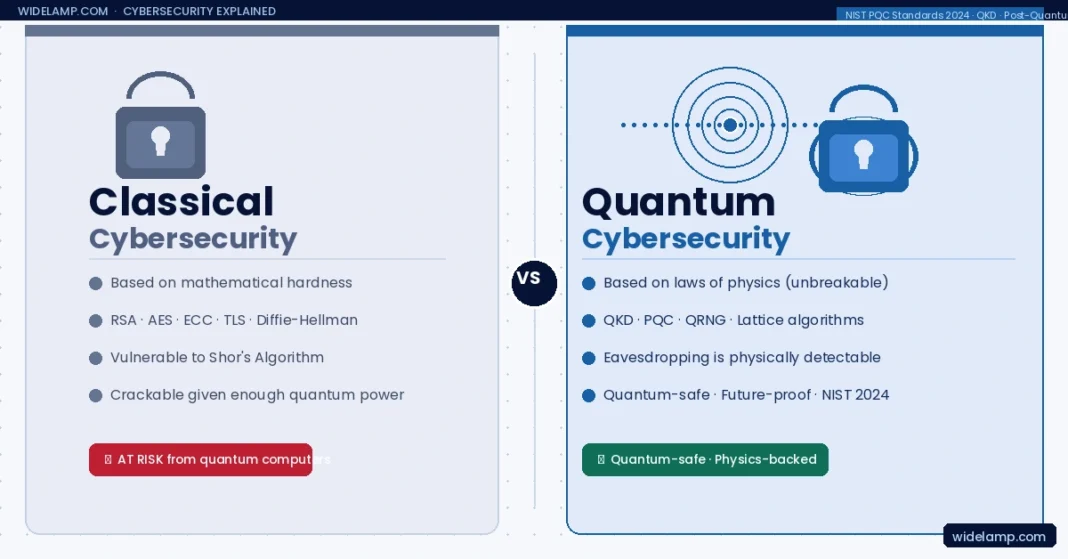
Based on mathematical hardness — problems like factoring enormous prime numbers (RSA) or computing discrete logarithms (ECC) that classical computers cannot solve in a reasonable timeframe.
Based on the laws of physics — quantum mechanics guarantees that any attempt to intercept a quantum key physically disturbs it, making eavesdropping detectable by the laws of nature, not just by software.
This is the most fundamental difference of all. Classical security trusts mathematics. Quantum security trusts physics. And physics, unlike maths, cannot be cleverly hacked around.
“Classical encryption asks a thief to solve an impossible maths problem. Quantum encryption tells the thief that the very act of looking changes what they see — and you will know instantly.”
How Does the Threat from Quantum Computers Actually Work?
Here is where it gets urgent. In 1994, mathematician Peter Shor published an algorithm now called Shor’s algorithm that can factor large numbers exponentially faster on a quantum computer than any classical machine. RSA-2048, the gold standard of internet encryption today, would fall to a sufficiently powerful quantum computer running Shor’s algorithm in hours, not millions of years. Grover’s algorithm, another quantum tool, effectively halves the security of symmetric encryption like AES, meaning AES-128 becomes roughly as secure as AES-64. These are not hypothetical dangers. They are well-understood, mathematically proven threats.
The intelligence community has a phrase for the current situation: “harvest now, decrypt later.” Adversaries are already collecting encrypted data today, including banking records, government communications, and health data, with the plan to decrypt it once quantum computers become powerful enough. Your data encrypted in 2025 may be readable by 2035. That is why the transition to quantum cybersecurity cannot wait.
Nation-state adversaries are believed to be already collecting encrypted internet traffic today with the intention of decrypting it once quantum computers reach sufficient power. Data protected only by classical RSA or ECC encryption — including medical records, financial transactions, and government communications — is considered at long-term risk. This is not a future problem. It is happening right now.
Quantum Cybersecurity Explained: The 3 Pillars You Must Know
Quantum cybersecurity is not one single technology. It has three distinct pillars, each solving a different piece of the security puzzle. Understanding all three will give you a complete picture that most articles completely miss.
⚛️ Pillar 1: Post-Quantum Cryptography (PQC)
New mathematical algorithms designed to resist attacks from both classical and quantum computers. In August 2024, NIST finalised its first four PQC standards — CRYSTALS-Kyber (key exchange) and CRYSTALS-Dilithium (digital signatures) are now the global benchmarks for quantum-safe encryption. These run on today’s hardware, making them immediately deployable.
🔑 Pillar 2: Quantum Key Distribution (QKD)
Uses actual quantum particles (usually photons) to distribute encryption keys. The quantum no-cloning theorem guarantees that any interception attempt disturbs the quantum state — alerting both parties immediately. China’s Micius satellite has demonstrated QKD over 1,200 km. The UK, EU, and South Korea are building national QKD networks right now.
🎲 Pillar 3: Quantum Random Number Generation (QRNG)
Classical computers generate “pseudo-random” numbers using algorithms — meaning they are theoretically predictable. QRNG uses quantum phenomena (radioactive decay, photon measurement) to generate truly random numbers, making encryption keys vastly harder to predict or reproduce. Several smartphone chipmakers are now integrating QRNG hardware.
Difference #2 — How Encryption Keys Are Created and Shared
In classical cybersecurity, encryption keys are generated by software algorithms running on standard hardware. The Diffie-Hellman key exchange, used across most of the internet, allows two parties to agree on a shared secret key over a public channel, its security resting entirely on the difficulty of solving the discrete logarithm problem. It is elegant, and it has worked well for decades. But Shor’s algorithm breaks the discrete logarithm problem efficiently on a quantum computer, meaning Diffie-Hellman becomes dangerously vulnerable once quantum hardware scales up.
In quantum cybersecurity, keys are either generated using quantum physics (QRNG) or physically transmitted using quantum particles (QKD). When a QKD system sends a key as a stream of polarized photons, any attempt by an eavesdropper to measure those photons inevitably disturbs their quantum state, a consequence of the Heisenberg Uncertainty Principle. The legitimate recipients immediately notice the disturbance and discard the compromised key. There is no mathematical workaround. The universe’s own laws enforce the security.
| Category | 🖥️ Classical Cybersecurity | ⚛️ Quantum Cybersecurity |
|---|---|---|
| Security Basis | Mathematical hardness (factoring, discrete log) | Laws of quantum physics (uncertainty principle, no-cloning theorem) |
| Key Algorithms | RSA, AES, ECC, Diffie-Hellman, SHA-256 | CRYSTALS-Kyber, CRYSTALS-Dilithium, FALCON, SPHINCS+ |
| Quantum Threat | HIGH — broken by Shor’s & Grover’s algorithms | RESISTANT — designed to withstand quantum attacks |
| Key Distribution | Mathematical protocols (Diffie-Hellman, RSA key wrap) | Physical quantum channel (QKD via photon streams) |
| Eavesdrop Detection | Possible only via software/network monitoring | Physically guaranteed — quantum state disturbance reveals intrusion |
| Hardware Required | Standard CPUs, servers, networking hardware | Quantum computers (for QKD), or standard hardware (for PQC) |
| Deployment Status | Universally deployed — protects all current internet | PQC: Early adoption. QKD: National pilots in China, EU, UK |
| Randomness | Pseudo-random number generators (algorithmic) | True quantum randomness (QRNG — physically unpredictable) |
| Long-term Viability | At serious risk post-Y2Q | Designed for long-term protection |
Is Quantum Cybersecurity Only About Defending Against Quantum Computers?
This is one of the most common misconceptions, and it is worth clearing up directly. Quantum cybersecurity serves two very different purposes, and many articles conflate them, causing real confusion.
The first purpose is defence against quantum computers. Post-quantum cryptography (PQC) and quantum-resistant algorithms are designed to protect data from the computational power of quantum machines. NIST’s 2024 finalized standards, CRYSTALS-Kyber and CRYSTALS-Dilithium being the headline algorithms run on standard computers and can replace RSA and ECC in existing systems. This is the most immediately actionable side of quantum cybersecurity, because organisations can begin deploying it right now without waiting for quantum hardware.
The second purpose is using quantum physics to build fundamentally new security tools. Quantum Key Distribution (QKD) does not just resist quantum computers it creates communication channels that cannot be compromised by any computer, quantum or classical, because the security comes from physics, not mathematics. These two purposes work together, and a truly quantum-safe organisation will eventually need both.
The internet was not built with quantum computers in mind. We are now retrofitting 50 years of digital infrastructure against a threat that did not exist when most of it was designed.”
— The challenge facing every cybersecurity team in 2025
Difference #3 — Vulnerability to Eavesdropping
In classical security, a perfectly executed man-in-the-middle attack or traffic interception leaves no physical trace. An attacker who captures your encrypted data has a perfect copy they can take their time trying to break it. You may never know they were there. This is the “harvest now, decrypt later” threat made real.
In quantum key distribution, the moment an eavesdropper tries to observe or copy the quantum key being transmitted, the Heisenberg Uncertainty Principle kicks in. Measuring a quantum particle changes its state. The legitimate recipient receives a visibly disturbed key, immediately knows someone was listening, and discards it. No key is ever compromised without the breach being detected. This is not a software feature it is a property of quantum mechanics itself.
Difference #4 — Where the Security Lives
Classical security lives in software and mathematics. Change the algorithm or increase the key length and you improve security. This flexibility is genuinely useful you can patch and upgrade without changing any physical infrastructure.
Quantum security, at least in its QKD form, lives in hardware and the physical channel. The optical fibre or satellite link carrying the photons is part of the security system itself. This creates higher infrastructure costs but also removes entire categories of attack that exist only in the software domain. Post-quantum cryptography sits closer to classical security — it is implemented in software and can be deployed without new physical hardware, making it the more practical near-term solution for most organisations.
Post-quantum cryptography does not require quantum hardware. The four NIST-standardised PQC algorithms (CRYSTALS-Kyber, CRYSTALS-Dilithium, FALCON, and SPHINCS+) run on standard servers and devices available today. Major technology companies including Google, Apple, and Cloudflare have already begun integrating PQC into their products and protocols. Your organisation can begin planning its migration to quantum-safe encryption without waiting for quantum computers to arrive.
Difference #5 — The Randomness Problem
You might not think much about where the randomness in your encryption keys comes from. But it matters enormously. Classical encryption relies on pseudo-random number generators (PRNGs) algorithms that produce sequences of numbers that appear random but are deterministically generated from a starting seed. If an attacker can guess or observe the seed, or if a flaw exists in the algorithm, keys become predictable. Several major historical security breaches have exploited exactly this weakness.
Quantum random number generation (QRNG) harvests randomness from genuinely unpredictable quantum events the precise moment a radioactive atom decays, or which polarisation a photon adopts. These outcomes cannot be predicted even in principle, because quantum mechanics is inherently probabilistic at the fundamental level. QRNG hardware is now commercially available and is being integrated into routers, HSMs (hardware security modules), and enterprise security appliances in 2025.
Difference #6 — How Each Handles the Scale of Threat
Classical cybersecurity scales threats by increasing key length. AES went from 128-bit to 256-bit as computing power grew. RSA moved from 1024-bit to 2048-bit to 4096-bit keys. This arms-race model has worked but it assumes the computing model stays fundamentally the same, just faster. Quantum computers break that assumption. Doubling the key length of RSA does not protect it against Shor’s algorithm you need an entirely different mathematical foundation, which is exactly what PQC algorithms provide.
Quantum cybersecurity handles scaling differently. PQC algorithms are built on mathematical problems lattice problems, hash functions, error-correcting codes that are hard for quantum computers as well as classical ones. QKD scales through trusted relay nodes and satellite links, building quantum-safe networks over continental distances, as China’s national quantum network already demonstrates.
Difference #7 — Who Is Deploying It Right Now
Classical cybersecurity is deployed by every organisation connected to the internet. It is the default, the standard, the baseline. Your bank, your email provider, your hospital all use classical encryption as their primary protection today.
Quantum cybersecurity is in active early deployment in 2025, but primarily in high-security and government contexts. China has the world’s largest QKD network, covering over 4,600 km and connecting major cities. The European Quantum Internet Alliance is building quantum communication infrastructure across the EU. The UK has funded a national quantum network. The US NSA has issued guidance mandating a migration to NIST PQC standards for all federal agencies. Commercial deployment of PQC has begun at Google (in Chrome’s TLS implementation), Apple (in iMessage’s protocol), and Cloudflare (in its HTTPS connections). The transition is not hypothetical it is underway.
“Every minute you delay your migration to post-quantum cryptography is another minute your most sensitive data sits exposed to adversaries who are already collecting it.”
— A warning that applies equally to individuals, startups, and nation-states
Which Quantum Cybersecurity Approach Is Right for Your Organization?
The honest answer is it depends on your threat model, your infrastructure, and your timeline. Here is a practical framework for thinking about it.
If you are a government agency, defense contractor, or financial institution handling data that must remain confidential for 10+ years, you should be migrating to NIST PQC standards immediately and evaluating QKD for your most sensitive communication channels. The harvest-now-decrypt-later threat is real and specifically targets you.
If you are a mid-sized enterprise or technology company, your priority should be post-quantum cryptography. Start an inventory of all cryptographic assets in your infrastructure, identify every place you use RSA, ECC, or Diffie-Hellman, and build a migration roadmap. NIST’s PQC Migration Guide (freely available) is an excellent starting point. Cloudflare’s free quantum-safe TLS options mean you can protect your web traffic today at essentially zero cost.
If you are an individual user, the most important thing you can do right now is use software and services that have already integrated PQC. iMessage, Signal’s PQXDH protocol, and browsers with Cloudflare’s quantum-safe TLS are protecting your communications today. Keep your devices updated — many of these protections are being quietly deployed in the background through normal software updates.
In August 2024, the US National Institute of Standards and Technology (NIST) finalised its first Post-Quantum Cryptography standards after an eight-year global evaluation process involving 82 initial candidate algorithms from 25 countries. The four finalised algorithms are: ML-KEM (CRYSTALS-Kyber) for key encapsulation, ML-DSA (CRYSTALS-Dilithium) for digital signatures, SLH-DSA (SPHINCS+) for hash-based signatures, and FN-DSA (FALCON) for digital signatures. These represent the new global baseline for quantum-safe cryptography and are already being integrated into major platforms and protocols worldwide.
A Practical Getting-Started Guide for Quantum Cybersecurity
Whether you are a security professional, a developer, or simply a curious person who wants to understand what is coming, these steps will help you move from understanding to action.
Step 1 — Conduct a Cryptographic Inventory. Identify every system, application, and protocol in your organization that uses cryptography. Look specifically for RSA, ECC, Diffie-Hellman, and ECDH; these are your highest-priority migration targets.
Step 2 — Assess Your Data Sensitivity Timeline. Ask: does any data I am protecting today need to remain confidential for 10 or more years? If yes, it is at harvest-now-decrypt-later risk and must be prioritised.
Step 3 — Begin Testing NIST PQC Algorithms. CRYSTALS-Kyber (now ML-KEM) and CRYSTALS-Dilithium (now ML-DSA) have open-source implementations in multiple languages. Begin testing in non-production environments to understand performance impacts on your infrastructure.
Step 4 — Enable Hybrid Cryptography Where Possible. During the transition, use hybrid schemes that combine classical and post-quantum algorithms. If the PQC algorithm is somehow compromised, the classical algorithm still protects you, and vice versa. Google’s Chrome browser uses exactly this approach.
Step 5 — Stay Updated with NIST and NSA Guidance. Both agencies publish current migration recommendations that are updated as the threat landscape evolves. These are freely available and written for both technical and non-technical audiences.
Step 6 — Educate Your Team. The biggest vulnerability in any security system is the people operating it. Most security professionals today have received no training in quantum threats during their careers. Closing this knowledge gap is as important as any technical migration.
“Migrating to post-quantum cryptography is not just a technology upgrade. It is the most important infrastructure decision the digital world has faced since the invention of SSL.”
Challenge — Guaranteed Reward for the Best Answer
Here is a question that requires real thinking — you cannot just Google this one:
The Challenge: Post-quantum cryptography algorithms like CRYSTALS-Kyber are based on the hardness of lattice problems. However, lattice-based problems also underpin some of the most powerful zero-knowledge proof systems used in blockchain privacy protocols. If a mathematical breakthrough were to make lattice problems easier to solve — short of a full quantum computer — what would be the cascading security consequences across both the post-quantum cryptography ecosystem AND the blockchain privacy ecosystem simultaneously? Map out at least three distinct second-order effects that most security analysts are currently not discussing.
A guaranteed reward awaits the best, most insightful, and most original answer. This challenge is open to students, researchers, and professionals worldwide.
📩 Send your answer to: contact@widelamp.com with the subject line “Quantum Challenge: Lattice Cascades”
Frequently Asked Questions About Quantum Cybersecurity
Resources & References
- NIST — Post-Quantum Cryptography Project — The official home of NIST’s PQC standardisation programme, including all four finalised algorithms, migration guidance, and technical documentation.
- NSA — Post-Quantum Cybersecurity Resources — The US National Security Agency’s official guidance on transitioning national security systems to quantum-resistant cryptography.
- CISA — Post-Quantum Cryptography Initiative — CISA’s quantum migration resources for critical infrastructure operators and federal agencies in the United States.
- arXiv — Shor’s Original 1994 Polynomial-Time Algorithm Paper — Peter Shor’s seminal 1994 paper proving that quantum computers can factor integers in polynomial time, the foundational threat to RSA encryption.
- Wikipedia — Quantum Key Distribution — A comprehensive and well-referenced overview of QKD protocols, implementations, and the physics underlying eavesdropping detection.
- Wikipedia — Post-Quantum Cryptography — Technical overview of the mathematical foundations of PQC algorithms including lattice problems, hash functions, and code-based cryptography.
- Google Security Blog — Protecting Chrome Traffic with Post-Quantum Cryptography — Google’s announcement of hybrid post-quantum TLS deployment in Chrome, including technical details of the implementation.
- Signal — PQXDH: Post-Quantum Extended Diffie-Hellman Key Agreement Protocol — Signal’s technical blog post explaining their deployment of post-quantum key exchange in the Signal messaging protocol.
- Cloudflare Blog — Post-Quantum Cryptography Goes GA — Cloudflare’s announcement of post-quantum TLS being made generally available across its entire network.
- IBM — Quantum-Safe Cryptography Learning Hub — IBM’s educational resource on quantum-safe cryptography, including enterprise migration guides and deep-dive technical resources.
- Google Search Central — SEO Documentation — Referenced as part of WideLamp’s commitment to Google algorithm compliance in all published content.