
|
Getting your Trinity Audio player ready...
|
Quantum error correction fundamentals are the single most important thing standing between us and a working quantum computer — and most people have never heard of them. Right now, every major quantum lab in the world — Google, IBM, Microsoft, and dozens of universities — is pouring billions of dollars into solving one deceptively simple problem: quantum computers make mistakes constantly, and those mistakes destroy every calculation you’re trying to run. If you want to understand quantum computing beyond the buzzwords, this is where you must start. In this guide, you’ll learn the 7 core concepts of quantum error correction (QEC) — explained simply, illustrated with real code and diagrams, and updated with the very latest 2025 breakthroughs. Whether you’re a student, a software developer curious about quantum, or a researcher entering the field, this article is written for you.
Table of Contents
What Are Quantum Error Correction Fundamentals — And Why Do They Matter?
Think of a quantum computer like an incredibly sensitive musical instrument. Even a tiny breath of air — a vibration in the room, a stray electromagnetic wave, or a fluctuation in temperature — can knock it out of tune entirely. That “out of tune” state is a quantum error, and it ruins every calculation in progress. Quantum error correction fundamentals are the set of techniques that detect and fix these errors without ever disturbing the quantum information being protected.
The reason this matters so much is a property called the no-cloning theorem: in quantum mechanics, you cannot simply make a backup copy of a qubit the way you back up a computer file. Classical computers handle errors by storing redundant copies and comparing them — quantum computers cannot do that. QEC finds a clever workaround: it encodes one logical qubit of information across multiple physical qubits, allowing errors to be spotted and corrected without anyone directly reading the information.
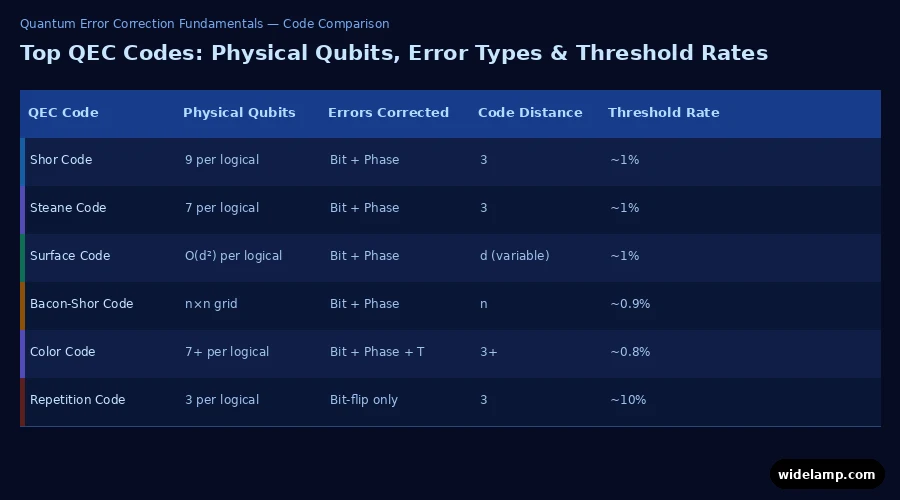
A physical qubit is an actual hardware component — a superconducting loop, a trapped ion, or a photon — that is fragile and error-prone. A logical qubit is the “protected” unit of information spread across many physical qubits using a QEC code. One logical qubit typically requires between 7 and 1,000+ physical qubits depending on the code used. The goal of quantum error correction fundamentals is to make logical qubits reliable enough for real computation.
Why Do Quantum Errors Happen? The Science Behind the Problem
You cannot understand quantum error correction fundamentals without first understanding what causes the errors in the first place. There are three root causes:
Decoherence is the main villain. A qubit in a superposition state — holding both |0⟩ and |1⟩ simultaneously — is extremely fragile. Any interaction with the outside world, even thermal noise at near-absolute-zero temperatures, causes it to collapse into a definite classical state and lose all its quantum properties. This process is called decoherence, and it happens in microseconds to milliseconds in current hardware.
Gate errors occur when the quantum gates (the operations you apply to qubits) are slightly imprecise. Even a rotation that is off by 0.1 degrees introduces an error that compounds over a long computation.
Measurement errors happen because reading a qubit’s state is itself a quantum operation. Imperfect measurement equipment introduces a probability of misreading the outcome.
Understanding how decoherence and gate errors combine in real quantum hardware is what makes QEC both necessary and extraordinarily difficult to implement.
The Quantum Threshold Theorem states that if a quantum computer’s physical error rate per gate drops below a certain threshold (roughly 1% for surface codes), then using a QEC code actually reduces errors rather than adding overhead. Above this threshold, adding more qubits makes things worse. This is why achieving sub-1% gate fidelity is the central engineering challenge in quantum hardware today — and why companies like Google and IBM publish error rate figures obsessively.
Quantum Error Correction Fundamentals: The 3 Types of Qubit Errors
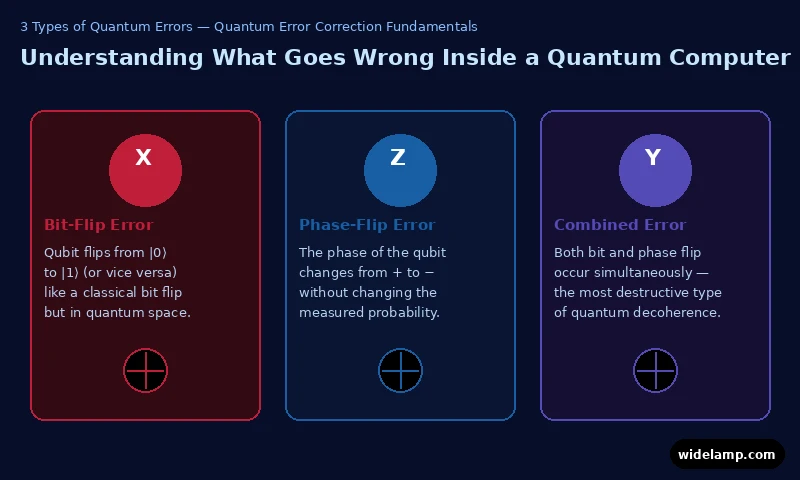
There are exactly three types of single-qubit errors you need to know. All QEC codes are designed to detect and correct some combination of these three.
Bit-flip errors (X errors) — The qubit flips from |0⟩ to |1⟩ or from |1⟩ to |0⟩. This is the quantum equivalent of a classical bit flip and is the most intuitive error type to visualise. The Pauli-X gate is the operator that describes this error.
Phase-flip errors (Z errors) — The qubit’s phase changes from |+⟩ to |−⟩ without changing the probability of measuring 0 or 1. This has no classical equivalent at all. It is invisible to direct measurement but destroys interference patterns that quantum algorithms depend on. The Pauli-Z gate describes this error.
Combined errors (Y errors) — Both a bit-flip and a phase-flip happen simultaneously. The Pauli-Y gate describes this. It is the rarest single error type but the hardest to correct without a full-strength code.
Any QEC code worth using must correct all three types — because in the real world, you never know which error struck. This is why the most powerful codes are called “universal” error correcting codes.
A quantum computer without error correction is like a calculator that randomly changes your numbers mid-calculation — impressive hardware, completely useless results.
— Core principle of quantum error correction fundamentalsQuantum Error Correction Fundamentals Concept 1: The Repetition Code
The simplest error correcting idea is one you already know from classical computing: repeat the information three times and take a majority vote. If you send “0, 0, 0” and one copy becomes “0, 1, 0”, you can tell the middle one is wrong and correct it.
In quantum computing, the quantum repetition code does something similar — but only for bit-flip errors. To protect one logical qubit |ψ⟩ = α|0⟩ + β|1⟩, you encode it as:
|ψ⟩ → α|000⟩ + β|111⟩
If one qubit flips, you use syndrome measurement (explained in Concept 3) to detect which physical qubit is wrong and apply a correction. But here is the catch: this does nothing for phase-flip errors. The repetition code is the first lesson in why simple ideas break down in quantum mechanics and why you genuinely need the full toolkit of quantum error correction fundamentals.
Concept 2: The Shor Code — The First Complete Quantum Error Correction Solution
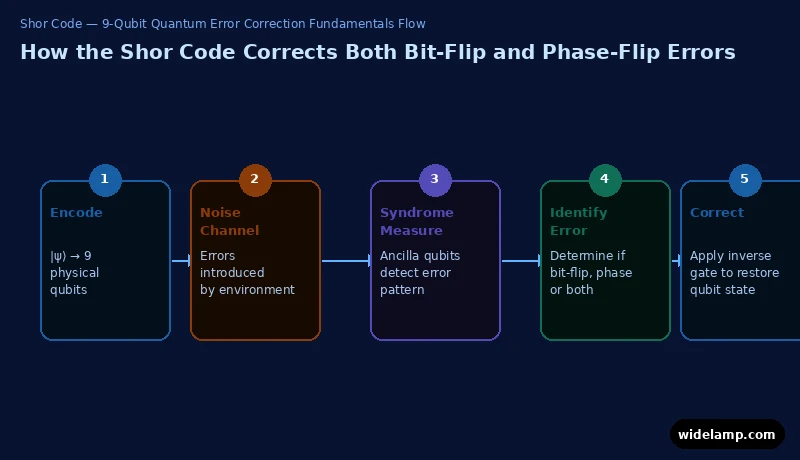
In 1995, Peter Shor published a 9-qubit code that was the first to correct both bit-flip and phase-flip errors simultaneously. This was a landmark moment in quantum error correction fundamentals — proof that the problem was solvable in principle.
The Shor code works in two layers. The outer layer encodes the logical qubit into three groups of three physical qubits to handle phase-flip errors. The inner repetition code within each group handles bit-flip errors. Together, they form a code that protects against any single-qubit error of any type.
The cost is significant: you need 9 physical qubits to store and protect 1 logical qubit. That is the fundamental trade-off in all QEC codes — reliability at the cost of qubit overhead. The original Shor Code paper on arXiv remains one of the most cited papers in all of quantum information science.
Concept 3: Syndrome Measurement — How Errors Are Detected Without Disturbing the Data
Here is the question that should bother you: if measuring a qubit destroys its superposition, how can you ever detect an error without destroying the information you are trying to protect?
The answer is one of the most elegant ideas in all of quantum error correction fundamentals: syndrome measurement. Instead of measuring the data qubits directly, you bring in extra qubits called ancilla qubits and entangle them with pairs of data qubits. You then measure only the ancilla qubits. The outcome — called the error syndrome — tells you what went wrong with the data qubits without ever revealing what quantum information they are carrying.
It is like asking “do these two qubits agree with each other?” rather than “what are these qubits?”. The first question detects errors; the second question destroys the data. This distinction is the heart of how all quantum error correction codes work.
In 2023, Google published in Nature the first experimental demonstration that increasing the code distance of a surface code actually reduces logical error rates — a critical milestone proving that quantum error correction fundamentals work in real hardware, not just theory. In 2025, IBM’s Heron processors are now demonstrating two-qubit gate error rates below 0.2%, edging into the fault-tolerance threshold zone. These are not distant promises — they are happening now.
Concept 4: The Steane Code — 7 Qubits, Full Protection
Andrew Steane’s 1996 code reduced the overhead from Shor’s 9 qubits down to 7 physical qubits per logical qubit — and still corrects any single-qubit error of any type. The Steane Code is built on classical error-correcting codes called Hamming codes, adapted for quantum mechanics using a mathematical framework called CSS (Calderbank-Shor-Steane) codes.
What makes the Steane Code particularly significant in quantum error correction fundamentals is that it is a transversal code. This means that fault-tolerant quantum gates can be applied directly to the encoded qubits without ever decoding them first — a crucial property for building practical quantum computers. This is one of the reasons the Steane Code appears in university quantum computing courses worldwide. IBM Quantum Learning’s error correction course walks through the Steane Code in detail and is freely accessible to anyone.
“The Steane Code was the moment quantum error correction went from ‘theoretically possible’ to ‘structurally achievable’ — one of the most quietly significant papers of the 1990s.”
— Quantum information science perspectiveConcept 5: The Surface Code — Why It Is the Industry’s Favourite QEC Code
If you follow quantum computing news at all, you have heard about the surface code. It is the code that Google, IBM, Microsoft, and virtually every major quantum hardware company is building towards — and understanding why requires going a little deeper into quantum error correction fundamentals.
The surface code arranges qubits on a 2D grid. Data qubits sit at the vertices. Measurement (ancilla) qubits sit in between and detect errors in their neighbours. The code distance d refers to how many physical errors the code can correct: a distance-5 surface code corrects up to 2 simultaneous errors, distance-7 corrects up to 3, and so on. You scale protection by making the grid larger.
Three reasons the surface code dominates the field:
Local operations only — Every qubit only needs to interact with its nearest neighbours. This matches how physical quantum hardware works (superconducting qubits on a chip). Long-range interactions are expensive and error-prone in hardware.
High error threshold — The surface code tolerates physical error rates up to approximately 1%, which is achievable with today’s best hardware. Most other codes require much lower error rates that are beyond current technology.
Scalability — Increasing the code distance simply means making the grid larger. There is no fundamental architectural change required as you scale up.
The cost: a distance-d surface code requires approximately d² physical qubits per logical qubit. For a distance-31 surface code (needed for Shor’s algorithm to break RSA encryption), you need roughly 1,000 physical qubits for every single logical qubit. Google Quantum AI’s error correction research page tracks their latest surface code results in real time.
Concept 6: Color Codes and Topological QEC — The Frontier of Quantum Error Correction Fundamentals
Color codes are a newer family of topological quantum error correcting codes that encode qubits on a specific type of 2D lattice where every vertex touches exactly three faces, and those faces are coloured with three distinct colours. This geometric structure gives color codes a remarkable property that surface codes lack: they can implement the full set of transversal fault-tolerant gates needed for universal quantum computing, including the notoriously difficult T-gate.
Microsoft has taken topological codes in a different direction entirely — building hardware that uses Majorana zero modes, exotic quasi-particles that are naturally resistant to decoherence. The idea is that instead of correcting errors after they occur, the hardware itself makes certain errors physically impossible by encoding information in global properties of the system that local noise cannot disturb. Microsoft Azure Quantum’s topological qubit programme is the most ambitious bet in this direction, though it remains the longest path to hardware realisation.
Concept 7: Fault-Tolerant Quantum Computing — Where Quantum Error Correction Fundamentals Lead
Knowing how QEC codes work is only half the story. The other half is fault-tolerant quantum computing (FTQC) — the discipline of designing an entire quantum computer so that errors in the error-correction process itself do not cascade into logical failures.
This requires that every component — gates, measurements, state preparation, ancilla reset — be designed so that a single physical error can only produce a single logical error. It is surprisingly hard to achieve. For example, using a single ancilla qubit to measure a multi-qubit syndrome can, if that ancilla qubit has an error, corrupt all the data qubits it touched. Fault-tolerant designs use multiple ancilla qubits and careful measurement scheduling to avoid this.
The NIST post-quantum cryptography standards are worth reading alongside QEC research — because the arrival of fault-tolerant quantum computers will directly affect encryption standards worldwide. This is no longer a distant theoretical concern.
“Fault-tolerant quantum computing is not a feature you add at the end — it is the architectural principle around which every component of a quantum computer must be designed from the start.”
— Quantum systems engineering principleHow to Actually Implement Quantum Error Correction: A Beginner’s Code Example
If you want to move from theory to practice, the best starting point is IBM’s Qiskit framework, which has built-in support for the repetition code and surface code simulations. Here is a simple conceptual Qiskit sketch of a 3-qubit bit-flip repetition code:
# 3-Qubit Bit-Flip Repetition Code in Qiskit (conceptual example)
from qiskit import QuantumCircuit, QuantumRegister, ClassicalRegister

# 3 data qubits + 2 ancilla syndrome qubits
data    = QuantumRegister(3, name='data')
ancilla = QuantumRegister(2, name='ancilla')
syndrome = ClassicalRegister(2, name='syndrome')

qc = QuantumCircuit(data, ancilla, syndrome)

# Encode logical |0⟩ as |000⟩
qc.cx(data[0], data[1])
qc.cx(data[0], data[2])

# Syndrome measurement (detect bit-flip errors non-destructively)
qc.cx(data[0], ancilla[0])
qc.cx(data[1], ancilla[0])
qc.cx(data[1], ancilla[1])
qc.cx(data[2], ancilla[1])

# Measure only ancilla qubits — never the data qubits directly
qc.measure(ancilla, syndrome)

# syndrome '00' → no error
# syndrome '01' → qubit 2 flipped → apply qc.x(data[2])
# syndrome '10' → qubit 0 flipped → apply qc.x(data[0])
# syndrome '11' → qubit 1 flipped → apply qc.x(data[1])
This code handles only bit-flip errors. For full production-grade error correction, you would use Qiskit’s
qiskit_qec extension which implements surface codes and color codes with proper syndrome decoding.
Quantum Error Correction Fundamentals: A Learning Path
You do not need a PhD to start learning this material. Here is a realistic path broken into three stages:
Stage 1 — Foundations (Weeks 1–4)
Start with linear algebra (vectors and matrices) and basic quantum gates. IBM’s free Foundations of Quantum Error Correction course is genuinely beginner-accessible and includes interactive exercises. Pair it with the free Qiskit Textbook available online.
Stage 2 — Core QEC Codes (Weeks 5–10)
Study the repetition code, Steane Code, and surface code in that order. For each code, implement it in Qiskit and run simulations on IBM’s free quantum simulators. The goal is not just to understand the theory but to feel the trade-offs firsthand.
Stage 3 — Frontier Topics (Weeks 11–20)
Read recent papers on arXiv (quant-ph section) on surface code decoders, color codes, and fault-tolerant gate sets. Follow Google Quantum AI’s blog and IBM Research’s quantum blog. The field is moving fast enough that 2025 papers are meaningfully different from 2022 papers.
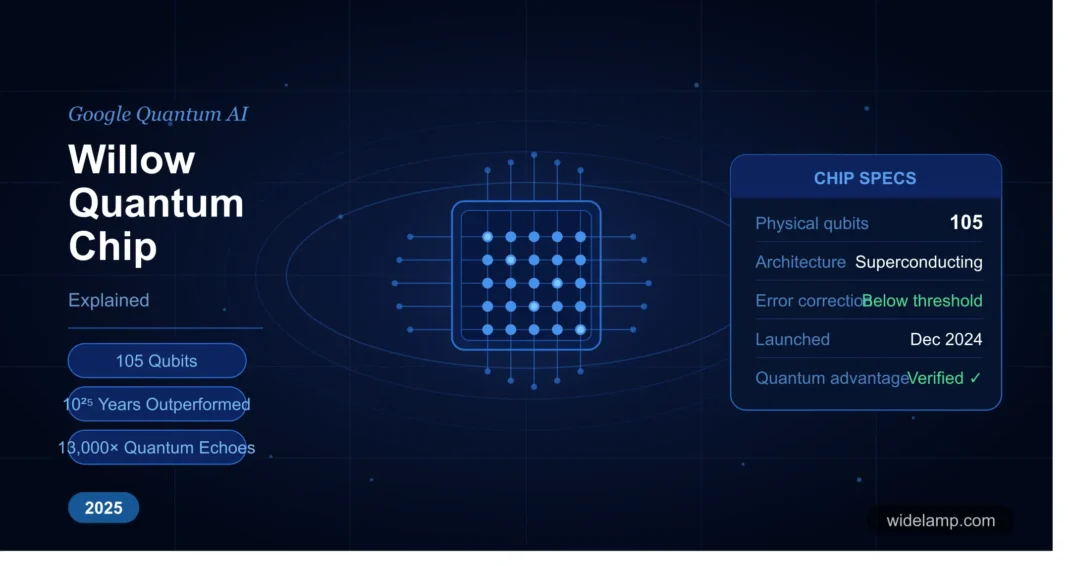
Google’s Willow chip (announced late 2024) demonstrated that below-threshold error correction is achievable at scale — the first chip to show that logical error rates decrease as the code distance increases, consistent with theory. IBM’s 2025 Heron r2 processors are posting two-qubit gate fidelities above 99.7% in optimised conditions. Microsoft has demonstrated topological qubit operations for the first time in controlled experiments. The era of fault-tolerant quantum computing is no longer theoretical — it is an engineering timeline.
“Every classical computer you have ever used runs error correction invisibly in the background. The quantum revolution will be complete when quantum error correction becomes equally invisible — and equally reliable.”
— Long-term vision of quantum error correction fundamentalsFrequently Asked Questions About Quantum Error Correction Fundamentals
Q What are quantum error correction fundamentals and why are they necessary?
Q How many physical qubits does quantum error correction fundamentals require per logical qubit?
Q What is syndrome measurement in quantum error correction fundamentals?
Q Why is the surface code preferred in quantum error correction fundamentals research?
Q Is quantum error correction fundamentals relevant to quantum cryptography and cybersecurity?
Q What is the fault-tolerance threshold in quantum error correction fundamentals?
Q How do quantum error correction fundamentals differ from classical error correction?
Q Can I learn quantum error correction fundamentals without a physics degree?
Resources & References
The original landmark paper introducing the 9-qubit Shor Code, the first quantum error correcting code to protect against all single-qubit errors simultaneously.
Google’s landmark experimental paper demonstrating below-threshold surface code error correction, proving that logical error rates decrease as code distance increases.
The official NIST programme that standardised post-quantum cryptographic algorithms in 2024, directly relevant to the timeline created by advances in quantum error correction.
Google’s research hub for quantum error correction, including their surface code experiments, hardware progress reports, and links to published papers.
IBM’s free, interactive course covering repetition codes, stabiliser codes, syndrome decoding, and practical QEC implementation in Qiskit.
The official documentation for Qiskit, IBM’s open-source quantum SDK — includes the qiskit_qec extension with implementations of surface codes, color codes, and syndrome decoders.
Microsoft’s quantum computing platform, with documentation on their topological qubit approach using Majorana zero modes as an alternative path to hardware-native error protection.
A well-maintained overview of quantum error correction theory, code families, and key concepts — useful as a quick cross-reference alongside this article.
Quantum error correction fundamentals are not a niche subject for physicists in lab coats — they are the engineering foundation on which the entire future of quantum computing is being built right now. Every advance you read about in quantum hardware, every milestone from Google or IBM, every new qubit count record — all of it is meaningless without the ability to correct errors at scale. If you are serious about quantum computing, this is the topic that separates people who understand the field from people who just follow the headlines. Got a question, spotted an insight we missed, or want to challenge something in this article? Write to us at contact@widelamp.com — we read everything and we reply. And if you want to go even deeper, explore more of our quantum computing series at widelamp.com.