
|
Getting your Trinity Audio player ready...
|
Data Breach Prevention: 11 Proven Methods to Protect Your Company
If your company stores even one customer email address, you are already a target. Every year, attackers test thousands of businesses just like yours, looking for the one weak door left open. This guide is for founders, IT managers, and security teams who want a clear data breach prevention plan, not just theory. You will get all 11 methods, real numbers from the latest industry research, and a simple way to apply each one this month, before the next attempt lands in your inbox.





Table of Contents
What Is a Data Breach and Why Should Every Company Worry?
A data breach happens the moment private company or customer information is seen, copied, or stolen by someone who should never have had access to it. That could be a hacked employee password, a misplaced laptop, or a cloud folder left open by mistake. We know that running a small or growing business already feels like a full time job, and adding cybersecurity to the list can feel unfair. But here is the encouraging part, most successful data breach prevention does not require a huge budget. It requires consistency, awareness, and the right habits built into daily work.
The Real Reasons Behind Most Data Breaches Today
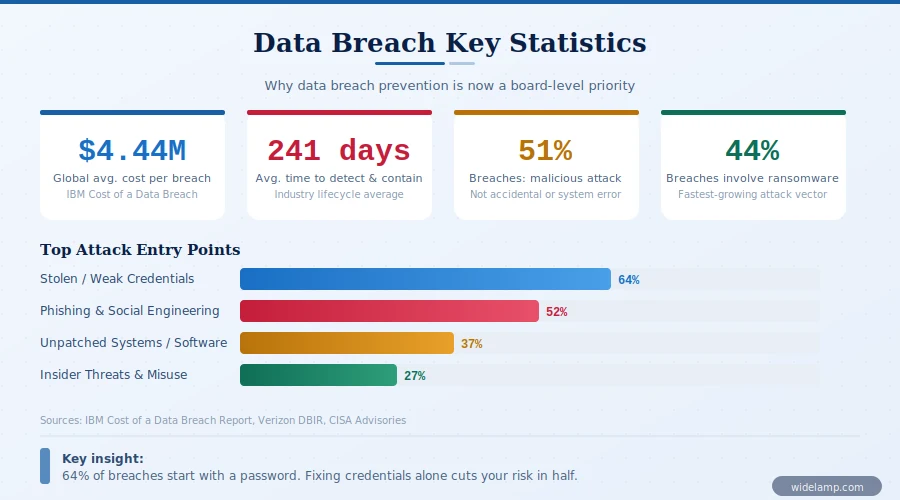
Most breaches are not the work of a genius hacker in a movie scene. They usually start with something small, an unpatched system, a reused password, or a vendor with weak access controls. Once you see the real pattern, the path to prevention becomes much less mysterious. Now that you understand why breaches happen, here are the 11 methods that actually stop them.
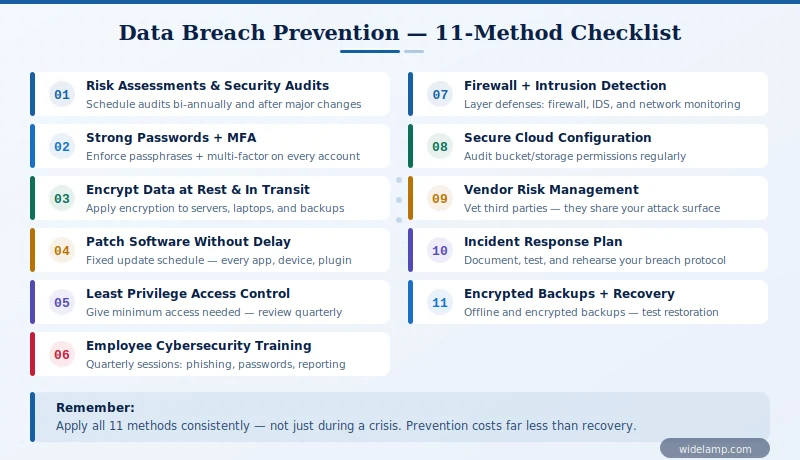
11 Proven Methods for Data Breach Prevention Every Company Needs
“A single weak password can undo years of careful security work.”
Method 1: Run Regular Risk Assessments and Security Audits
You cannot protect what you have not measured. A risk assessment maps every system, every database, and every login point so you know exactly where the soft spots are. Schedule a full audit at least twice a year, and after any major change such as a new vendor or new software tool. Unlike a one time checklist, an ongoing audit habit catches small misconfigurations long before an attacker finds them, and that early catch is the real difference between a near miss and a costly breach.
Method 2: Enforce Strong Passwords and Multi Factor Authentication
Weak, reused, or shared passwords remain one of the easiest doors into a company network. Require long passphrases instead of short complex passwords, since length is harder to crack than complexity alone. Pair this with multi factor authentication on every account that touches sensitive data. Even if a password leaks, a second verification step often stops the attacker cold, which is why this single method is considered one of the highest value parts of any data breach prevention strategy.
Method 3: Encrypt Sensitive Data at Rest and in Transit
Encryption turns readable information into scrambled code that is useless without the correct key. Apply it to stored data on servers and laptops, and to data moving between your systems and the internet. If a laptop is stolen or a connection is intercepted, encrypted data is far less valuable to whoever takes it. Many companies overlook encrypting internal backups, which is a mistake, since backups often contain the exact same sensitive records as the live system.
Method 4: Apply Software Patches and Updates Without Delay
Outdated software is one of the most common entry points attackers search for, because known weaknesses are public information once a patch is released. Set a fixed schedule for checking and applying updates across every device, app, and plugin your company uses, including ones that seem unimportant. A delayed update window of even a few weeks is often the exact gap an automated scanning tool needs to slip inside.
“Attackers rarely break in. Most of the time, they walk through a door someone forgot to close.”
Method 5: Limit Access With the Principle of Least Privilege
Not every employee needs access to every system. Give each person the smallest amount of access required to do their job, and review those permissions every quarter. This single habit dramatically reduces how much damage one stolen password can cause, because the attacker only inherits whatever that one account was allowed to see in the first place.
Method 6: Train Employees on Cybersecurity Awareness Regularly
Your team is either your strongest defense or your biggest risk, depending on how prepared they are. Run short, simple training sessions every quarter that cover phishing emails, suspicious links, and safe password habits. Yes, the training calendar will include yet another mandatory module everyone groans about, but a five minute session that stops one phishing click can save your company millions in breach costs, so it is worth the mild eye roll.
Method 7: Deploy Firewalls and Intrusion Detection Systems
A modern firewall filters traffic entering and leaving your network, while intrusion detection systems watch for unusual behavior inside it. Together they act like a guard at the gate and a guard walking the hallway. Configure both to send real time alerts, not just logs that nobody reviews until it is too late.
Method 8: Monitor Network Activity Continuously
Many breaches stay hidden for months simply because nobody is watching closely enough. Continuous monitoring tools flag strange login times, unusual download volumes, or access from unfamiliar locations. Do not worry if this sounds technical, most monitoring platforms today are built to send plain language alerts, so your team does not need to be security experts to react quickly.
Method 9: Secure Third-Party Vendor Access and Contracts
Every vendor connection is a potential side door into your network. Limit what each vendor can access, require them to follow your own security standards, and review that access whenever a contract renews. This is one of the most overlooked methods on this list, yet it is increasingly where modern breaches actually begin.
Method 10: Create and Test an Incident Response Plan
Even the best data breach prevention plan needs a backup plan for the day something still goes wrong. Write down exactly who does what within the first hour of a suspected breach, including who contacts legal, who contacts affected customers, and who isolates the affected system. Test this plan with a tabletop exercise twice a year, because a plan nobody has practiced often falls apart under real pressure.
Method 11: Back Up Data Regularly and Test Recovery
Backups protect you from ransomware and from human error alike. Follow a simple rule, keep at least three copies of important data, on two different types of storage, with one copy kept offline or fully isolated from your main network. A backup you have never tested is just a hope, so restore a sample file every month to confirm the process actually works when you need it.
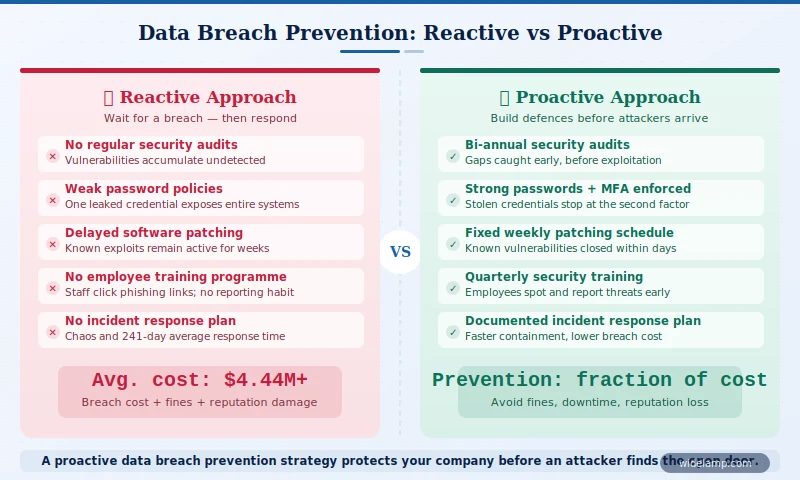
How Does a Proactive Approach Beat a Reactive One?
| Aspect | Reactive Approach | Proactive Data Breach Prevention |
|---|---|---|
| Detection time | Often weeks or months after the fact | Near real time alerts and monitoring |
| Typical cost | Full breach cost, fines, and reputation loss | Lower ongoing prevention budget |
| Employee role | Untrained, often the entry point | Trained, an active line of defense |
| Recovery | Slow, built under crisis pressure | Fast, follows a tested response plan |
Choosing the proactive column above is rarely about spending more money, it is about spending it earlier, on prevention rather than cleanup. Now that you can see the difference clearly, let us look at the kind of thinking this requires from your whole team.
Who Should Care About Data Breach Prevention, From Students to Security Researchers?
Students entering the cybersecurity field can use this article as a practical starting checklist before diving into deeper technical certifications. Working professionals managing IT for a growing company can treat these 11 methods as an audit list against their current setup. Researchers studying breach trends will notice that the shift toward AI assisted attacks mentioned earlier is changing which of these methods matters most this year, which is exactly the kind of evolving picture a good data breach prevention strategy has to keep adapting to.
QWhat is a data breach and how does it actually happen inside a company?
A data breach is any event where private company or customer information is accessed, copied, or stolen by someone without permission. It usually starts small, a stolen password, an unpatched system, or a careless click on a phishing email. From there, the attacker moves through the network until they reach valuable data. Most breaches are preventable with the right combination of training, technology, and ongoing monitoring.
QWhy is data breach prevention important for small businesses, not just large corporations?
Smaller companies are often targeted precisely because attackers expect weaker defenses and smaller security teams. A breach can be financially devastating for a small business in a way a large corporation might absorb more easily. Data breach prevention is not optional based on company size, it is a basic requirement for staying operational and trusted by customers.
QWhat are the most common causes of a data breach in 2026?
The most common causes remain phishing emails, stolen or weak credentials, unpatched software, and risky third party vendor access. Recent industry research also shows a growing share of breaches now involve attackers using AI tools to craft more convincing phishing attempts. Recognizing these patterns is the first step in building a focused data breach prevention plan.
QHow can multi factor authentication help with data breach prevention?
Multi factor authentication adds a second verification step beyond just a password, such as a code sent to a phone or an authenticator app. Even if a password is stolen or guessed, the attacker still cannot log in without that second step. It is one of the simplest and most effective tools available for everyday data breach prevention.
QWhat should a company do immediately after discovering a data breach?
The first step is to isolate the affected system to stop further data loss, then activate the incident response plan that names who handles legal notification, customer communication, and technical containment. Speed matters here, since breaches that stay unresolved for a long time tend to cost far more. This is exactly why testing the response plan ahead of time matters so much.
QHow often should a company test its data breach prevention plan?
A full security audit and a tabletop incident response exercise should both happen at least twice a year, with smaller checks such as backup restoration tests done monthly. Regular testing is what turns a written plan into something your team can actually execute under pressure. A plan that only exists on paper rarely performs well during a real event.
QCan employee training really reduce the risk of a data breach?
Yes, since human error and phishing remain among the leading entry points for attackers. Short, regular training sessions that simulate real phishing attempts have been shown to lower employee click rates significantly over time. Treating your team as part of your security strategy, not just users of it, is one of the highest value steps in any data breach prevention plan.
QWhat industries face the highest cost when a data breach occurs?
Healthcare consistently faces the highest average breach costs, followed by the financial services sector, largely because both industries handle highly sensitive regulated data. That said, every industry carries real financial and reputational risk from a breach, which is exactly why these prevention methods are written to apply across company size and sector.
Data breach prevention is not a one time project, it is an ongoing habit built from these 11 methods working together. Start with the one or two methods you have not implemented yet, then build toward the rest over the coming months. If your company wants a deeper review of where your current setup stands, reach out anytime at contact@widelamp.com, our team is always glad to talk through real world security questions.
Official and Legal Sources
- NIST Cybersecurity Framework official guide, the United States government framework for managing and reducing cybersecurity risk across organizations of any size.
- CISA cyber threats and advisories page, ongoing alerts and guidance from the United States Cybersecurity and Infrastructure Security Agency.
- GDPR.eu official compliance overview, a plain language explanation of European data protection law and breach notification rules.
Technical and Academic References
- OWASP Top 10 application security risks, the widely cited nonprofit reference for the most critical web application security risks.
- ISO IEC 27001 information security standard, the international standard for building and maintaining an information security management system.
Industry Reports and News
- IBM Cost of a Data Breach Report 2025, the annual research study tracking average breach costs, causes, and timelines across industries worldwide.
- Verizon Data Breach Investigations Report, a yearly analysis of confirmed breach patterns and attack vectors across thousands of incidents.
Learning Platforms and Resources
- Coursera cybersecurity course catalog, online courses covering foundational and advanced cybersecurity skills from various universities.
- SANS Institute cybersecurity training, paid professional training programs and certifications for security practitioners.
Further Reading
- Wikipedia, Data breach overview, a general background article covering the history and definitions related to data breaches.