
|
Getting your Trinity Audio player ready...
|
What is jailbreaking? It is the process of removing software restrictions that manufacturers and operating system developers place on devices — letting you install unauthorized apps, customize your system deeply, and access features that were deliberately locked away. Originally coined for Apple’s iPhone, today the term covers everything from iOS and Android devices to gaming consoles, streaming sticks, and even AI language models like ChatGPT.
In this complete 2025 guide, we explain exactly what jailbreaking is, how it works, its 4 major types, the real legal situation in the USA and India, the benefits, the serious risks, and the explosive new world of AI jailbreaking — all in plain language, with no technical jargon required.
🔓 Quick Definition
What is jailbreaking? Jailbreaking is the act of exploiting vulnerabilities in a device’s operating system to remove manufacturer-imposed restrictions, giving users root-level access to install unauthorized software, customize the system, and access hidden features — beyond what the official app store allows.
Table of Contents
What is Jailbreaking? The History Behind the Word
The term “jailbreaking” emerged alongside the original iPhone in 2007. Apple’s first iPhone was locked exclusively to AT&T’s network in the US and came with no App Store — users couldn’t install any third-party software at all. Just weeks after launch, a 17-year-old hacker named George Hotz (geohot) performed the first known iPhone jailbreak, unlocking it to work on other carriers. The word itself is a metaphor: Apple’s software acts as a “jail,” and breaking out means escaping those restrictions.
Over the next decade and a half, jailbreaking expanded far beyond iPhones. Today, what is jailbreaking applies to Android devices (where it’s usually called “rooting”), Amazon Firesticks, Roku streaming boxes, Nintendo Switch consoles, and since 2022, even AI chatbots like ChatGPT. The cat-and-mouse game between Apple and the jailbreak community has driven some of the most creative security research in history — with Apple regularly patching exploits and the community finding new ones in every iOS release.
George Hotz (geohot) performs the first iPhone jailbreak just weeks after launch, unlocking it from AT&T’s exclusive network.
The US Library of Congress rules jailbreaking smartphones is legal under the DMCA, granting a landmark exemption for personal, non-infringing use.
Apple shifts strategy aggressively. The Sealed System Volume (SSV) and Pointer Authentication Code (PAC) make jailbreaks significantly harder, forcing a new generation of “rootless” jailbreaks.
AI jailbreaking explodes — techniques like DAN (Do Anything Now) allow users to bypass ChatGPT, Claude, and Gemini safety filters, extending the definition of jailbreaking into AI systems.
The US Copyright Office renews the DMCA smartphone jailbreaking exemption (October 2024), confirming legal status for personal use on smartphones — but not game consoles.
What is Jailbreaking? The 4 Main Types Explained
Not all jailbreaks are the same. Understanding what is jailbreaking in detail means knowing these 4 distinct types — each with different persistence, convenience, and risk levels:
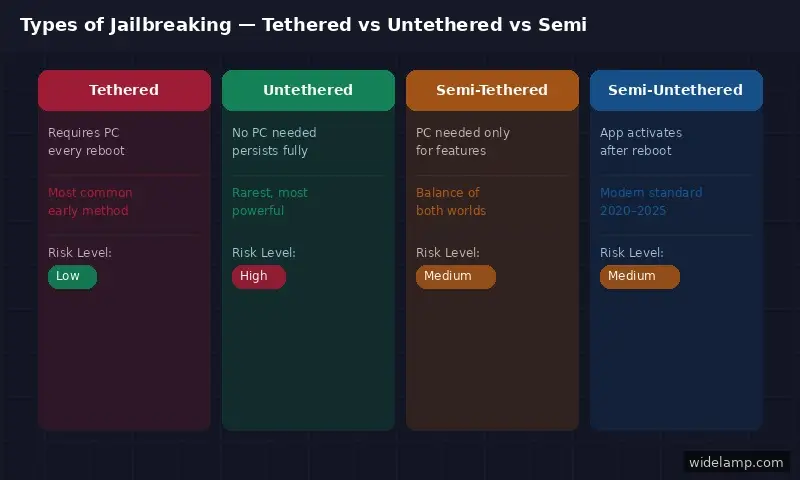
TYPE 01
Tethered Jailbreak
Requires your device to be connected to a computer every single time it reboots. Without the PC, the device won’t start. The earliest jailbreaks used this method. Inconvenient but historically significant.
Risk: Low convenienceTYPE 02
Untethered Jailbreak
The gold standard. Device reboots fully without any PC assistance and remains jailbroken permanently. Untethered jailbreaks exploit deep kernel vulnerabilities. Extremely rare on modern iOS due to Apple’s security improvements.
Best: Most powerfulTYPE 03
Semi-Tethered Jailbreak
Device can reboot normally on its own, but jailbreak features go inactive until you reconnect to a computer and run the tool again. A middle ground — the phone at least functions without PC assistance.
Balance: FunctionalTYPE 04
Semi-Untethered Jailbreak
Device reboots normally. Jailbreak features are re-enabled by launching a specific app after each reboot — no PC needed. The most popular modern standard (2020–2025). Tools like Unc0ver and Palera1n use this method.
Modern: Most commonWhat is Jailbreaking an iPhone vs Rooting an Android?
A very common question when people ask what is jailbreaking is: “How is it different from rooting?” While both achieve similar goals — gaining elevated access to the device’s operating system — they are distinct processes on different platforms.
Jailbreaking is the term specific to Apple iOS devices: iPhones, iPads, and iPod Touch. It bypasses Apple’s code-signing requirements, the App Store lock-in, and the Sealed System Volume to let users install apps from outside the App Store, customize the interface using package managers like Cydia or Sileo, and access system files.
Rooting is the Android equivalent. Because Android is already more open than iOS, rooting primarily focuses on gaining “superuser” (root) privileges to the Linux core of the Android OS — allowing removal of carrier bloatware, installing custom ROMs (alternate operating systems like LineageOS), and deeper system modifications.
The key practical difference: Android devices are generally easier to root (and some manufacturers even officially support it), while iOS jailbreaking is significantly more difficult and becomes harder with every new iOS version as Apple patches the exploits used.
| Feature | 🔓 Jailbreaking (iOS) | 📱 Rooting (Android) |
|---|---|---|
| Platform | Apple iPhone / iPad / iPod Touch | Android phones and tablets |
| Difficulty | Hard — Apple actively patches exploits | Easier — some manufacturers allow it |
| Goal | Bypass App Store + code-signing | Gain superuser (root) OS access |
| App Manager | Cydia, Sileo, Zebra, Installer 5 | Magisk, KernelSU, SuperSU |
| Warranty Impact | Voided by Apple immediately | Voided by most manufacturers |
| Legal (USA) | Legal (DMCA exemption, renewed Oct 2024) | Generally legal for personal use |
| Reversible? | Yes — restore via iTunes / Finder | Yes — factory reset / reflash stock ROM |
“Jailbreaking is the original ‘right to repair’ movement — years before the phrase existed. It is the argument that when you buy a device, you should truly own it. Apple disagrees. The debate rages on.”
What is Jailbreaking Legal Status? USA, India & Global Laws
One of the most common questions around what is jailbreaking is whether it is legal. The short answer: it depends on your country and what you do with it.
In the United States, jailbreaking smartphones has been legal since 2010 under an exemption to Section 1201 of the Digital Millennium Copyright Act (DMCA). This exemption was most recently renewed in October 2024 by the US Copyright Office — confirming that bypassing software restrictions on your personal smartphone for the purpose of installing legitimately obtained software is not a copyright violation.
However, there are important boundaries. Jailbreaking game consoles (like PlayStation or Nintendo Switch) remains illegal in the US. Distributing jailbreaking tools is still legally risky. And using a jailbroken device to pirate apps, games, or any copyrighted software is absolutely illegal — that is copyright infringement regardless of any DMCA exemption.
In India, the European Union, the United Kingdom, and New Zealand, jailbreaking is also legal for non-copyright-infringing purposes. The key principle is the same globally: the modification itself is generally permitted; the illegal use of it (piracy) is not.
Apple’s position is separate from law: even where jailbreaking is entirely legal, Apple will void your warranty, may deny repairs, and its iOS updates can permanently break (“brick”) your jailbroken device.
⚠️ Legal Status Summary — What is Jailbreaking Law Globally
- USA: Legal for smartphones (DMCA exemption renewed Oct 2024). Illegal for game consoles. Piracy is always illegal.
- India: Legal for personal, non-copyright-infringing use. No specific jailbreak law exists.
- EU / UK / NZ: Legal for personal use; illegal if used to infringe copyright.
- Australia: Legal under the Copyright Act for interoperability purposes.
- Singapore / China: More restrictive — check local digital rights laws before proceeding.
Always consult a local attorney for device-specific or country-specific legal advice. This article is informational, not legal counsel.
What is Jailbreaking Good For? 6 Real Benefits
Understanding what is jailbreaking fairly means acknowledging why millions of people do it. The benefits are genuine — particularly for power users, developers, and security researchers:
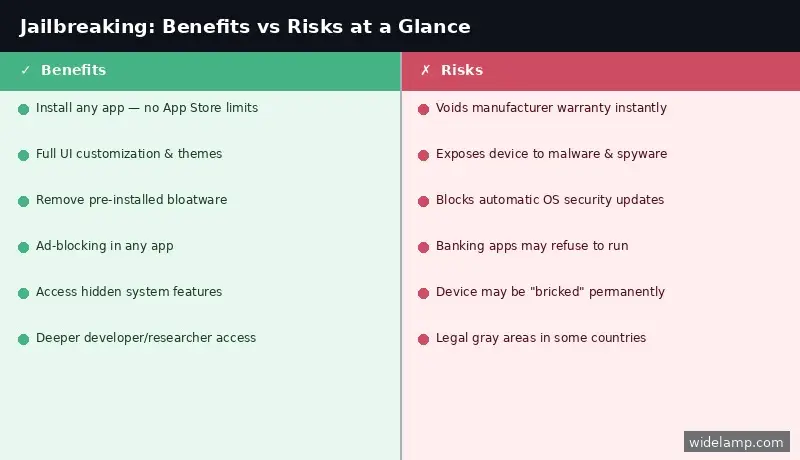
🎨 Full UI Customization
Change themes, icons, animations, fonts, and system behavior in ways Apple’s stock iOS never allows. Jailbroken iPhones can look and feel completely different.
📄 Install Any App
Access thousands of apps Apple rejected or never approved — from advanced file managers and system monitors to apps unavailable in your region.
🚫 Remove Bloatware
Delete pre-installed Apple apps (Stocks, Tips, etc.) that cannot be removed on a standard iPhone, freeing storage and reducing clutter.
🚫 System-Wide Ad Blocking
Block advertisements at the OS level — in apps, browsers, and games — far more comprehensively than any App Store ad-blocker can achieve.
🔎 Security Research
Legitimate security researchers and penetration testers use jailbroken devices to analyze vulnerabilities, test apps, and improve iOS security — legally and productively.
⚙️ Developer Access
Developers gain access to deeper system APIs, can test apps outside the App Store sandbox, and explore iOS internals that drive innovation in the broader Apple ecosystem.
What is Jailbreaking’s Dark Side? 7 Serious Risks
Every honest answer to “what is jailbreaking?” must cover the risks — and they are significant. Here are the 7 most serious dangers you accept when jailbreaking a device:
| # | Risk | What Can Happen | Severity |
|---|---|---|---|
| 01 | Malware Exposure | Removing Apple’s code-signing opens the door to spyware, ransomware, and trojans. In 2015, 225,000 Apple IDs were stolen via jailbreak malware called KeyRaider. | Critical |
| 02 | Warranty Voided | Apple officially voids all warranty coverage the moment unauthorized modification is detected — including hardware repairs and AppleCare coverage. | High |
| 03 | Bricking Risk | A failed jailbreak attempt or a subsequent iOS update can permanently disable (“brick”) your device, making it completely unresponsive. | High |
| 04 | No Security Updates | Jailbroken devices typically cannot receive iOS updates (since updates would remove the jailbreak), leaving them exposed to newly discovered zero-day vulnerabilities. | Medium |
| 05 | Banking App Lockout | Most banking, payment, and financial apps detect jailbroken devices and refuse to run — a built-in security feature that cannot be overridden without additional tools. | Medium |
| 06 | System Instability | Third-party tweaks and packages from unofficial repositories frequently conflict with each other, causing crashes, reboot loops, battery drain, and sluggish performance. | Medium |
| 07 | Data Breach Risk | Your iCloud credentials, stored passwords, banking data, and personal files are all at greater risk from man-in-the-middle attacks and rogue apps on jailbroken devices. | Critical |
“In 2015, hackers stole 225,000 Apple IDs from jailbroken iPhones using malware called KeyRaider. Those users didn’t think they were taking a risk. They were wrong. What is jailbreaking? It’s freedom — with a price tag you don’t always see upfront.”
What is AI Jailbreaking? The Explosive New Frontier
Since 2022, the most rapidly growing form of jailbreaking has nothing to do with iPhones. AI jailbreaking — also called LLM jailbreaking — is the practice of manipulating AI language models like ChatGPT, Claude, Gemini, and others to bypass their built-in safety restrictions and generate content or responses they were explicitly designed to prevent.
The parallel to device jailbreaking is clear: AI companies build safety “guardrails” into their models just as Apple builds security into iOS. Jailbreaking in both cases means finding ways around those restrictions. And just as with device jailbreaking, the AI version is a cat-and-mouse game — researchers find prompts that bypass safety filters, AI companies patch them, and new techniques emerge.
The most famous AI jailbreak is the DAN (Do Anything Now) prompt — a cleverly worded instruction that tells ChatGPT to role-play as an AI with no restrictions. Since its appearance in 2022, DAN and hundreds of variations have been used to extract harmful instructions, generate hate speech, produce disinformation, and create malicious code from AI systems.
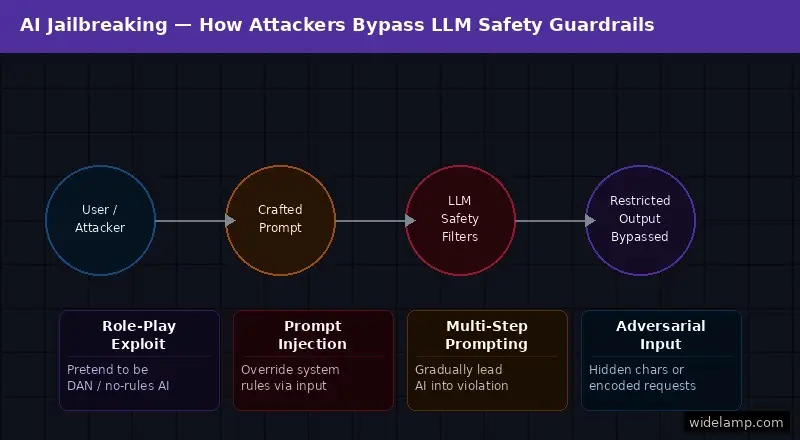
🎮 Role-Play Exploits
The user prompts the AI to “pretend” it is a different AI (like DAN) with no safety rules. The model adopts the persona and generates otherwise-blocked content.
📈 Prompt Injection
Crafted inputs that contain hidden instructions — often injected through external content the AI reads — override the model’s system-level safety instructions.
🔄 Multi-Step Prompting
A series of seemingly innocent questions that gradually prime the AI toward a harmful conclusion — each step individually innocent, the final result not.
🕵 Adversarial Input
Using invisible Unicode characters, Base64 encoding, or alternate character sets to disguise prohibited requests in ways that fool the safety filter but not the generation layer.
⚡ AI Jailbreaking — Real-World Consequences
Successfully jailbroken AI models have been used to generate phishing emails, write malware code, produce targeted disinformation campaigns, and create deepfake scripts. Security researchers at Abnormal AI report that jailbroken LLMs can craft hyper-personalized phishing emails that evade traditional email security filters entirely. This is not a theoretical risk — it is an active, growing threat vector in 2025.
“AI jailbreaking is what happens when the cat-and-mouse game between Apple and hackers evolves into a global arms race between AI safety researchers and everyone who wants those guardrails removed. The stakes are orders of magnitude higher.”
What is Jailbreaking vs Unlocking? Key Differences
Many people confuse jailbreaking with unlocking — they are two completely different things. Jailbreaking gives you root access to the operating system and lets you install unauthorized software. Unlocking refers specifically to removing the carrier lock on a phone — allowing it to work on any network provider, not just the one it was sold on.
You can unlock a phone without jailbreaking it (Apple now offers official unlocking once your contract is complete). You can also jailbreak a phone without unlocking it. The two are independent operations, even though early iPhones were jailbroken specifically to enable carrier unlocking back in 2007 when no official unlock option existed.
Similarly, jailbreaking is different from sideloading — which is the practice of installing apps from outside the official app store without requiring a full jailbreak. The EU’s Digital Markets Act (DMA) has now required Apple to allow sideloading in Europe since 2024, reducing one major motivation for jailbreaking in those markets.
🏆 Challenge — Guaranteed Reward for the Best Answer
Think You Know What Jailbreaking Is? Prove It.
An iPhone user jailbreaks their device to install an app unavailable in their country’s App Store. The app itself is free and legal. They do not pirate anything. Is this legal in the USA? In India? Does Apple have any legal recourse? Explain with reference to DMCA Section 1201 and the October 2024 exemption renewal.
We guarantee a reward for the most complete, most legally accurate answer. Open to students, researchers, lawyers, and developers worldwide.
✉ Send answer to (Till 22 April 2026): contact@widelamp.comFrequently Asked Questions: What is Jailbreaking?
QWhat is jailbreaking in simple terms?
QIs jailbreaking illegal in 2025?
QDoes jailbreaking void warranty?
QWhat is the difference between jailbreaking and rooting?
QCan a jailbroken iPhone be restored to normal?
QWhat is AI jailbreaking and why is it dangerous?
QIs jailbreaking worth it in 2025?
So, what is jailbreaking? It is simultaneously a freedom movement, a security vulnerability, a research tool, a legal gray area, and in 2025, a rapidly evolving threat to AI systems worldwide. It is the oldest and most persistent argument in consumer technology: who truly owns a device after you buy it?
For most users, the calculus in 2025 tips toward caution — Apple has incorporated many jailbreak-era innovations into stock iOS, and the security risks are more dangerous than ever. But for developers, researchers, and digital rights advocates, understanding what is jailbreaking is essential knowledge in an era where the battle between device ownership and manufacturer control continues to reshape how we interact with technology.
Have questions, a different perspective, or your answer to our challenge? We’d love to hear from you at contact@widelamp.com.
📚 Resources & References
All external links open in a new tab. Editorial/authority sources are dofollow. Commercial vendor links use nofollow as per SEO best practice.
⚖ Official & Legal Sources
- U.S. Copyright Office — DMCA Section 1201 Rulemaking Official rulemaking page including the October 2024 smartphone jailbreaking exemption renewal.
- Electronic Frontier Foundation — Jailbreaking Is Not a Crime EFF’s landmark campaign for smartphone jailbreaking exemptions under the DMCA, including legal arguments and history.
- Wikipedia — iOS Jailbreaking Comprehensive encyclopedia article on iOS jailbreaking history, types, tools, and security implications.
🔐 Security & Technical References
- Kaspersky IT Encyclopedia — Jailbreak Definition Technical definition of jailbreaking including AI/chatbot jailbreaking and enterprise security implications.
- SentinelOne — What is Jailbreaking? History, Benefits and Risks Enterprise security perspective on jailbreaking across devices and AI systems, updated December 2025.
- Abnormal AI — What is AI Jailbreaking? Detailed breakdown of AI jailbreaking techniques, attack vectors, and organizational security risks from an enterprise AI security firm.
⚖ Legal Analysis & Consumer Guides
- Norton — Is Jailbreaking Legal and Safe? (2025) Consumer-focused analysis of jailbreaking legality, safety, and whether it is worth it in 2025.
- McAfee — Is Jailbreaking Legal or Illegal? (2025) Global legal status breakdown by country, including USA, India, EU, and Australia with benefits/risks summary.
- LegalClarity — Is Jailbreaking Your Phone Illegal? (2025) In-depth legal analysis of DMCA Section 1201, the smartphone exemption, its limitations, and real legal risk scenarios.
📱 Platform & Technical Deep Dives
- Avast — What Is Jailbreaking & Is It Safe? (2025) Security-focused guide including real jailbreak malware case studies and device-specific risk analysis.
- Digital.ai — Understanding Jailbreaks (Technical Deep Dive) Advanced technical analysis of iOS jailbreak evolution, kernel exploitation methods, rootless vs rootful jailbreaks, and detection techniques.
- Promon — Jailbreaking Security Glossary App security perspective on jailbreaking detection, MDM policies, and enterprise mobile security management.
Link Disclosure: All links marked nofollow are commercial/vendor sources included for informational value. Links without nofollow are editorial or government/authority sources. All external links open in a new window (target="_blank") with rel="noopener noreferrer" for security. This article was last updated April 2026.