
|
Getting your Trinity Audio player ready...
|
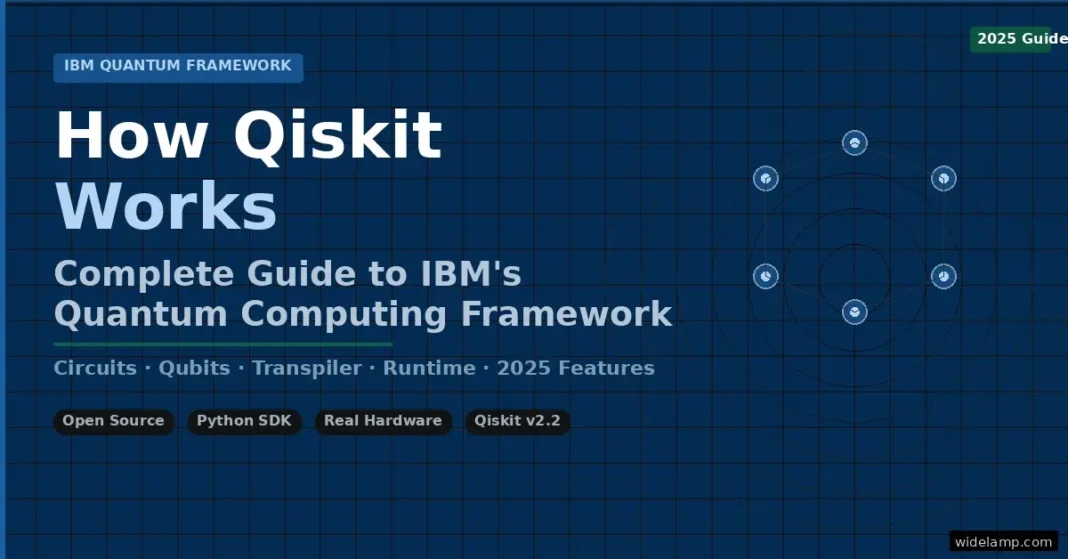
Understanding how Qiskit works is the single most important step you can take toward real quantum computing. Qiskit — IBM’s open-source Python quantum SDK — is how over 550,000 developers, students, and researchers worldwide write, simulate, and run actual quantum programs on real IBM quantum computers. Whether you’re brand new to quantum or a seasoned programmer looking to add the most in-demand skill of the decade to your toolkit, this complete 2025 guide walks you through everything: from what a qubit is, to executing a live quantum circuit on IBM’s 127-qubit hardware.
By the end of this article, you will understand exactly how Qiskit works, how to install it, how to build quantum circuits, how the transpiler optimizes your code for real hardware, and what’s new in Qiskit SDK v2.2 — including HPC integration, the AI Code Assistant, and the IBM Quantum Nighthawk processor.
Table of Contents
What is Qiskit? How Qiskit Works at Its Core
Qiskit (Quantum Information Software Kit) is an open-source, Python-based software stack for quantum computing, first released by IBM Research in 2017. At its core, how Qiskit works is straightforward: it lets you write quantum programs as sequences of instructions — called quantum circuits — and execute them on IBM quantum hardware via the cloud, or on local classical simulators for testing.
The name “Qiskit” now refers to the full quantum software ecosystem: the core Qiskit SDK, Qiskit Runtime (cloud execution), Qiskit Functions (pre-built algorithms), Qiskit Serverless (distributed hybrid workloads), and a rich add-on library. It is, simply, the world’s most complete open-source quantum computing platform.
IBM placed the first quantum computer on the cloud in 2016. Qiskit followed in 2017, and by 2024, Qiskit SDK v1.0 marked a milestone of 7 years, over 100 releases, and 550+ open-source contributors. In 2025, Qiskit SDK v2.2 arrived with even faster transpilation, a groundbreaking C API for HPC integration, and the new IBM Quantum Nighthawk 120-qubit processor — the most advanced IBM chip yet.
ⓘ Why Qiskit Leads the World
Qiskit SDK v2.2 is 83× faster at transpiling circuits than the next leading SDK (Tket). It also introduced a standalone C API transpiler function — meaning quantum workflows can now run natively in C and other compiled HPC languages. That’s a first in the industry. Explore official Qiskit documentation →
ⓘ Historical Milestone
IBM put the first quantum computer on the cloud in 2016. Qiskit launched in 2017 — one of the first open-source quantum SDKs ever. By 2024, Qiskit 1.0 represented 7 years, 100 releases, and contributions from over 550 open-source developers worldwide.
How Qiskit Works: The 4-Layer Architecture You Must Understand
To truly understand how Qiskit works, you need to understand its four-layer architecture. Each layer builds on the one below it, creating a complete stack from raw Python code all the way to real quantum hardware execution.
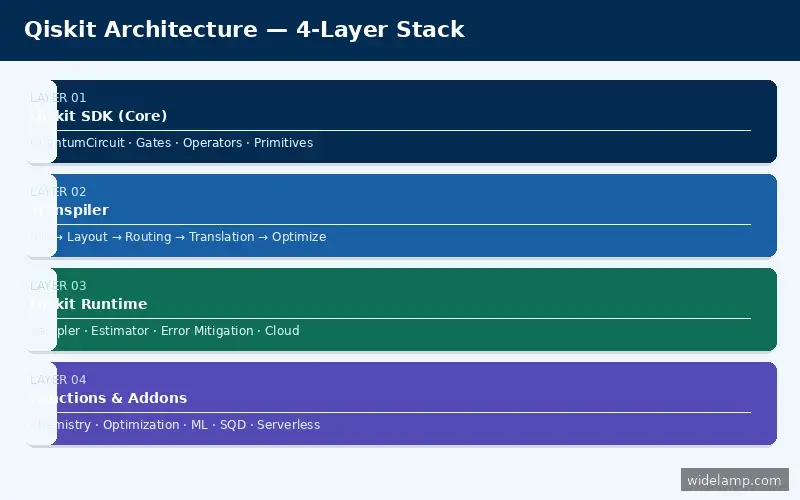
LAYER 01
Qiskit SDK (Core)
Python library for building quantum circuits, operators, and primitives. Write QuantumCircuit, apply gates, define measurements. This is where how Qiskit works begins.
LAYER 02
Qiskit Transpiler
Rewrites your abstract circuit to match real hardware topology, native gate sets, and timing. 6 optimization stages. Now 83× faster than competing SDKs.
LAYER 03
Qiskit Runtime
Cloud execution service co-located with IBM hardware. Provides Sampler & Estimator primitives with built-in error mitigation. Dramatically reduces latency.
LAYER 04
Functions & Addons
Pre-built, cloud-hosted algorithms for chemistry, optimization, ML, and PDEs. Use Qiskit without deep hardware knowledge. Scale in days, not months.
3 Quantum Concepts That Explain How Qiskit Works
Qubits — The Quantum Bit Behind Qiskit
Classical computers use bits — either 0 or 1. A qubit — the basic unit Qiskit operates on — can exist in a superposition of both 0 and 1 at the same time. This isn’t a metaphor; it’s a real physical property of superconducting circuits inside IBM’s quantum processors. When you measure a qubit using Qiskit, it collapses to either 0 or 1. But before that moment, it carries exponentially more information than any classical bit.
In Qiskit, you create qubits by instantiating a QuantumCircuit object and declaring the number of qubits you need: QuantumCircuit(3) creates a 3-qubit circuit.
Quantum Entanglement — Qiskit’s Secret Weapon
Entanglement is the quantum property that makes Qiskit circuits fundamentally different from classical programs. When two or more qubits become entangled, the state of one instantly determines the state of the others — regardless of physical distance. Qiskit creates entanglement using two-qubit gates like CNOT (cx). This is how Qiskit achieves the correlated processing across all qubits simultaneously that classical computers cannot replicate.
Read More: Quantum entanglement IIT Delhi Breakthrough: Secure Free‑Space Communication
Quantum Gates — How Qiskit Performs Computations
Quantum gates are the operations Qiskit applies to qubits — the quantum equivalent of classical logic gates. They rotate qubit states on the Bloch sphere, create superpositions, and entangle qubits. Unlike classical gates, all quantum gates are reversible. A sequence of gates in Qiskit forms a quantum circuit — the fundamental unit of any quantum program. Understanding gates is essential to understanding how Qiskit works.
💡 The Power of Superposition
A Qiskit circuit with n qubits can represent 2n states simultaneously. With just 300 qubits — far fewer than IBM’s newest chips — that number exceeds the count of atoms in the observable universe. This exponential scaling is the core of quantum advantage, and how Qiskit works at scale.
“What if your computer could explore every possible solution to a problem simultaneously — not sequentially? That’s not science fiction. That’s superposition. And how Qiskit works is exactly how you program it.”
How Qiskit Works: Building Your First Quantum Circuit Step by Step
Step 1 — Install Qiskit (2 Commands)
# Step 1: Install Qiskit SDK and IBM Runtime client
pip install qiskit qiskit-ibm-runtime

# Step 2: Verify installation
python -c "import qiskit; print(qiskit.__version__)"
Step 2 — Create a 3-Qubit Entangled (GHZ) Circuit
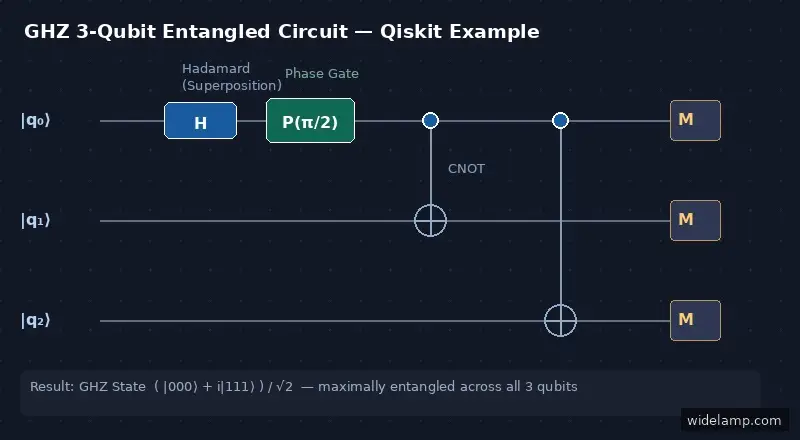
The GHZ (Greenberger–Horne–Zeilinger) state is a maximally entangled 3-qubit state used in quantum teleportation and quantum cryptography research. It is one of the classic “Hello World” examples of how Qiskit works in practice. Here’s how to build it:
import numpy as np
from qiskit import QuantumCircuit

# Create a 3-qubit quantum circuit
qc = QuantumCircuit(3)

# Hadamard gate — puts qubit 0 into superposition (|0⟩ + |1⟩)/√2
qc.h(0)

# Phase gate — adds quantum phase to the state
qc.p(np.pi / 2, 0)

# CNOT gates — entangle all 3 qubits together
qc.cx(0, 1)  # qubit 0 controls qubit 1
qc.cx(0, 2)  # qubit 0 controls qubit 2

# Add measurements to all qubits
qc.measure_all()

# Visualize the circuit
print(qc.draw(output='text'))
Step 3 — Run on Real IBM Quantum Hardware
from qiskit_ibm_runtime import QiskitRuntimeService, SamplerV2 as Sampler
from qiskit.transpiler.preset_passmanagers import generate_preset_pass_manager

# Connect to IBM Quantum Platform (free account at quantum.ibm.com)
service = QiskitRuntimeService()

# Auto-select the least-busy real IBM quantum computer
backend = service.least_busy(
    operational=True,
    simulator=False,
    min_num_qubits=127
)

# Transpile: optimize circuit for this specific chip (level 3 = best)
pm = generate_preset_pass_manager(optimization_level=3, backend=backend)
isa_circuit = pm.run(qc)

# Execute 8,000 shots via Qiskit Runtime Sampler primitive
sampler = Sampler(backend)
job = sampler.run([(isa_circuit,)], shots=8000)
result = job.result()
print(result)
✓ What Just Happened — How Qiskit Works in Real Life
In under 20 lines of Python, you wrote a quantum program, let Qiskit find the least-congested quantum computer on the planet, optimized your circuit specifically for that chip’s architecture, then ran it 8,000 times to build a real probability distribution. That is exactly how Qiskit works — from code to cloud to quanta.
How Qiskit Works: Essential Quantum Gates Every Developer Must Know
Knowing how Qiskit works means knowing its gate library. Every quantum operation in Qiskit is a gate applied to one or more qubits. Here are the 8 most important gates you will use:
| Gate Name | Qiskit Method | What It Does | Common Use |
|---|---|---|---|
| Hadamard (H) | qc.h(q) | Creates equal superposition: |0⟩ → (|0⟩+|1⟩)/√2 | Start of nearly every quantum algorithm |
| Pauli-X | qc.x(q) | Bit flip — quantum NOT gate: |0⟩↔|1⟩ | State preparation, error correction |
| Pauli-Z | qc.z(q) | Phase flip: |1⟩ → −|1⟩, |0⟩ unchanged | Phase kickback, quantum oracles |
| CNOT (CX) | qc.cx(c, t) | Flips target qubit only if control qubit is |1⟩ | Creating entanglement between 2 qubits |
| Toffoli (CCX) | qc.ccx(c1,c2,t) | Two-control NOT: flips target if both controls are |1⟩ | Classical logic within quantum circuits |
| Phase (P) | qc.p(θ, q) | Adds phase e^(iθ) to the |1⟩ state | Quantum Fourier Transform, QPE |
| RZ / RX / RY | qc.rz(θ, q) | Rotation around Z, X, or Y axis by arbitrary angle θ | Parameterized circuits, VQE, QAOA |
| SWAP | qc.swap(a, b) | Exchanges full quantum states of two qubits | Routing on limited-connectivity hardware |
How Qiskit Works: The Transpiler — Your Circuit’s Hardware Translator
A critical part of how Qiskit works is the transpiler. When you write a quantum circuit, you’re working at an abstract level. Real IBM quantum chips have hard physical constraints: limited qubit connectivity, specific native gate sets, and unique noise characteristics. The Qiskit transpiler bridges this gap — it rewrites your circuit into one that is physically executable on the target chip, and optimized to minimize noise and error.
According to IBM’s own benchmarks, the Qiskit SDK v2.2 transpiler is 83× faster at transpilation than the next leading SDK, and circuit transpilation is a further 10–20% faster within the v2.x series itself. Understanding the transpiler is central to understanding how Qiskit works for real hardware.
“Think of the Qiskit transpiler like a GPS navigator for your quantum circuit. You say where you want to go. The transpiler figures out every road, every detour around hardware limitations, and finds the fastest, cleanest route — on this specific chip, not some theoretical perfect machine.”
The 6 Stages of How Qiskit’s Transpiler Works
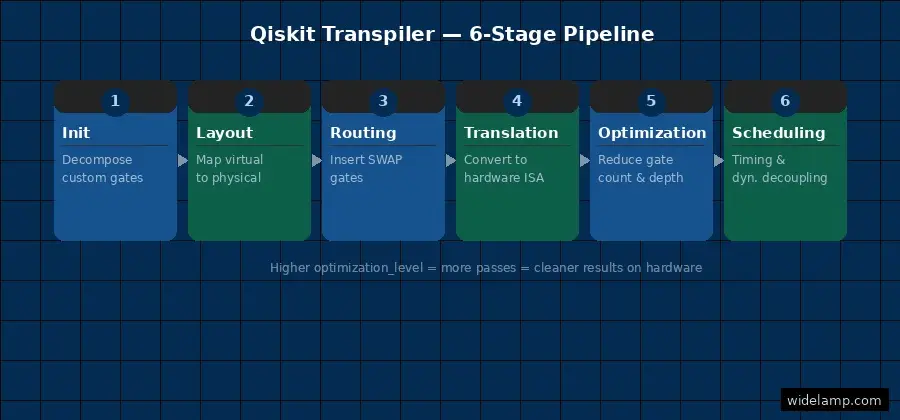
STAGE 1 — INIT
Decompose
Unrolls complex custom gates into basic 1- and 2-qubit operations. Clears the circuit for hardware-specific work.
STAGE 2 — LAYOUT
Map Qubits
Maps your virtual qubits to physical chip qubits. Poor layout = 10× more SWAP gates. Qiskit uses VF2Layout for optimal mapping.
STAGE 3 — ROUTING
Insert SWAPs
Inserts SWAP gates for non-adjacent qubit interactions. Uses SabreSwap heuristic — finding the true minimum is NP-hard.
STAGE 4 — TRANSLATION
Convert Gates
Rewrites all gates to the chip’s native Instruction Set Architecture. E.g., CX → ECR gate on IBM Heron & Nighthawk processors.
STAGE 5 — OPTIMIZE
Cut Gates
Cancels redundant gates, merges single-qubit sequences, minimizes depth. Level 3 can cut 2-qubit gate count by 30–60%.
STAGE 6 — SCHEDULE
Timing & DD
Assigns precise gate timing. Enables dynamical decoupling — inserting X-gate pairs to protect idle qubits from decoherence.
How Qiskit Runtime Works: Cloud Execution and Error Mitigation
Qiskit Runtime is the cloud-based execution layer — and understanding how it works is key to getting real results from quantum hardware. Rather than submitting jobs remotely and waiting, Runtime runs your transpiled circuits in a service co-located directly alongside IBM’s quantum processors. This slashes the classical-quantum communication latency that limits traditional quantum computing workflows.
Qiskit Runtime provides two core primitives that every developer must know:
📊 Sampler Primitive
Runs your quantum circuit many times (shots), measures qubits each time, and returns a probability distribution over all possible outcomes. Use this when you want to know which quantum states appear and how often.
Best for: Grover’s algorithm, Shor’s algorithm, state sampling
📈 Estimator Primitive
Computes expectation values of quantum observables — physical quantities like molecular ground-state energy or magnetization. Essential for VQE, QAOA, and quantum chemistry. Returns a single number.
Best for: VQE, QAOA, quantum chemistry, optimization
Built-In Error Mitigation — How Qiskit Works Around Noise
Real quantum hardware is noisy. One of Qiskit Runtime’s most powerful features is automatic error suppression and mitigation — built in, so developers don’t have to implement it manually. The 4 key techniques Qiskit uses are:
- Dynamical Decoupling — Pulse sequences applied to idle qubits to prevent decoherence drift during computation
- Pauli Twirling — Random gate insertion that converts coherent errors into stochastic (correctable) noise
- Zero-Noise Extrapolation (ZNE) — Runs circuits at amplified noise levels and extrapolates to the theoretical zero-noise result
- Probabilistic Error Amplification (PEA) — Advanced noise characterization for maximum accuracy on complex circuits
In 2025, dynamic circuits with Qiskit’s Gen3 engine stack deliver a 75× speedup in execution compared to previous implementations, with a 24% accuracy improvement at 100+ qubit scale.
“In 2023, IBM’s quantum utility experiment took hours to run. In 2025 — with Heron r3 processors, Qiskit SDK v2.2, and Qiskit Runtime — it takes under 60 minutes. That’s a 100× improvement. Understanding how Qiskit works today means you’re programming the future of computing.”
“In 2023, it took IBM hours to run a quantum utility experiment. By 2025, with upgraded Heron processors and optimized Qiskit software, it takes under 60 minutes — a 100× improvement. This is not incremental progress. This is exponential.”
How Qiskit Works in 2025: 7 New Features Every Developer Must Know
Knowing how Qiskit works in 2025 means knowing what’s new. Qiskit SDK v2.2 and IBM’s Quantum Developer Conference announcements have dramatically changed what’s possible. Here are the 7 most important updates:
| # | Feature | What Changed in 2025 | Who Benefits |
|---|---|---|---|
| 01 | C API & C++ Interface | Standalone transpiler callable from C. End-to-end quantum + HPC workflows in compiled languages. First in the industry. | HPC / Science |
| 02 | IBM Quantum Nighthawk | 120-qubit processor with 218 tunable couplers. 30% more circuit complexity vs Heron. Targets 5,000-gate circuits by end 2025. | All Users |
| 03 | Dynamic Circuits (Gen3) | 75× faster execution via Gen3 engine stack. 24% accuracy gain at 100+ qubits. Parallel branch execution now live. | Research |
| 04 | Qiskit Functions Catalog | Nearly a dozen pre-built cloud functions: chemistry, optimization, ML, PDEs, error handling. Submit classical inputs, get quantum results. | Applications |
| 05 | Samplomatic Package | Fine-grained circuit execution control. Reduces sampling overhead by up to 100× via probabilistic error cancellation techniques. | Developers |
| 06 | AI Qiskit Code Assistant | IBM watsonx-powered assistant writes and debugs Qiskit code from natural language. Built directly into IBM Quantum Platform. | Students |
| 07 | Fault-Tolerant Compilation | New LitinskiTransformation pass supports early fault-tolerant targets. IBM Quantum Loon processor shows all key fault-tolerant components. | Future-Proof |
⚡ Real Research — How Qiskit Works at Scale
Researchers at Yonsei University used Qunova’s HI-VQE Qiskit Function to run quantum chemistry experiments at 44 qubits and 96 CNOT gates. University of Tokyo used Qedma’s QESEM function to study quantum many-body scars at 25 qubits and 1,440 two-qubit gates. These experiments scaled in days using Qiskit Functions — experiments that would have taken months of manual circuit engineering just two years ago. Read the Qiskit research paper on arXiv →
How Qiskit Works for Students and Professionals: Your Learning Path
For Students: How to Start Learning Qiskit Today
🎓
IBM Quantum Learning
Free structured courses covering how Qiskit works from scratch. Quantum information basics, SDK labs, real hardware access. Now includes Qiskit in Classrooms modules for teachers.
learning.quantum.ibm.com →💻
IBM Quantum Challenge
Annual coding event (June) where thousands of learners globally solve Qiskit problems together. Completely free. The fastest way to understand how Qiskit works in practice.
quantum.ibm.com →🌐
Qiskit Advocates Program
Global community of quantum enthusiasts with mentorship, networking, and progression paths. One of the best ways to deepen your understanding of how Qiskit works in the field.
qiskit.org/advocates →For Professionals: Advanced Ways to Use Qiskit in 2025
⚙
Qiskit Functions Catalog
Pre-built cloud quantum algorithms for chemistry, optimization, ML, and PDEs. Submit classical inputs, receive quantum results. Premium & Flex Plan users get free trials.
🔗
HPC + Qiskit Integration
Qiskit’s C API and HPC workload plugins connect quantum circuits directly to SLURM, LSF, and PBS systems. Quantum becomes a native node in your HPC cluster.
🔬
Open-Source Contribution
Contribute to Qiskit on GitHub — 550+ contributors have shaped the platform. Add transpiler passes, gate definitions, or domain algorithms. Qiskit on GitHub →
“Quantum computing is where artificial intelligence was in 2012 — right before it changed everything. The developers who understand how Qiskit works today will be the architects of the quantum advantage era. The only question is whether you’ll have this skill when the moment arrives.”
🏆 Challenge — Guaranteed Reward for the Best Answer
Think You Understand How Qiskit Works? Prove It.
If you apply a Hadamard gate to a qubit in state |0⟩, then immediately apply another Hadamard gate — what is the final state? Explain why this property makes quantum computing powerful for algorithm design, and name one real-world quantum algorithm that exploits it.
We guarantee a reward for the most complete, clearest explanation. Open to students, researchers, and developers worldwide.
✉ Send answer to (till 21 April 2026): contact@widelamp.comFrequently Asked Questions: How Qiskit Works
QHow does Qiskit work, and is it free?
QDo I need to know quantum physics to use Qiskit?
QHow does the Qiskit transpiler work?
QWhat is Qiskit Runtime and how does it differ from the Qiskit SDK?
QCan Qiskit run on simulators without real quantum hardware?
QWhat quantum algorithms can I implement with Qiskit?
QIs Qiskit only for IBM hardware?
QWhat is the Qiskit Sampler vs Estimator primitive?
Now you know how Qiskit works — from the first qubit to real cloud hardware execution. Qiskit is not just a programming library. It is a gateway to a new paradigm of computing that will reshape chemistry, finance, logistics, artificial intelligence, and cryptography over the next decade.
Whether you’re a student writing your first quantum circuit, a developer building hybrid quantum-classical applications, or a researcher pushing the boundaries of what’s computationally possible — how Qiskit works is the skill that unlocks it all. The quantum advantage era is not a distant promise. It is being built right now, one quantum circuit at a time.
Start learning how Qiskit works today: run pip install qiskit, create your free account at quantum.ibm.com, and join the fastest-growing computing community in history.
Questions, feedback, or your best answer to our challenge? Email us at contact@widelamp.com — we read every message and guarantee a reward for the best answer.