
|
Getting your Trinity Audio player ready...
|
Are AI Coding Assistants Creating More Cybersecurity Problems?
AI coding assistants security risks have moved from a theoretical worry to a documented, measurable problem in 2026. If your team is one of the 97% of organizations now using tools like GitHub Copilot, Cursor, or Claude Code, this affects you directly – new industry testing shows nearly half of all AI-generated code still ships with a known OWASP Top 10 vulnerability. Developers, security leads, and engineering managers all need to understand why this keeps happening, not after the next incident lands on their plate. Below is what the latest 2026 data actually shows, where the real damage is happening, and seven concrete steps to close the gap.
What Exactly Counts as an “AI Coding Assistant” in 2026?
An AI coding assistant is any tool that uses a large language model to write, complete, or review code on a developer’s behalf from inline autocomplete in an IDE to fully autonomous coding agents that open pull requests on their own. The category now spans GitHub Copilot, Cursor, Claude Code, Amazon Q Developer, Google Antigravity, Windsurf, and a fast-growing list of newer entrants. Some developers go further and “vibe code” describing what they want in plain language and letting the model generate the software nearly wholesale, sometimes without fully understanding the resulting code. That distinction matters for AI coding assistants security risks, because a developer who can read and challenge the output is a very different risk profile than one who cannot.
I f you’re new to this space: think of an AI coding assistant less like a spell-checker and more like a very fast, very confident junior developer who has read almost every public codebase on earth including the insecure parts.
Quick Fact: Adoption Has Outrun Governance
According to GitLab’s 2026 AI Accountability Report, 91% of organizations already use two or more AI coding tools, and 54% use three or more. Separately, Black Duck’s industry survey puts enterprise AI code adoption at 97%, while the Futurum Group found 76.6% of organizations actively using AI in software development workflows and another 20.4% evaluating it. Governance and review processes, in most organizations, have not scaled at the same pace.
“Every AI-generated function that compiles on the first try is a promise. Not every promise gets checked before it ships.”
How Insecure Is AI-Generated Code, Really?
This is the question Veracode has been testing since 2025, running more than 100 large language models through 80 coding tasks across Java, Python, C#, and JavaScript. The Spring 2026 update to that research, titled “Despite Claims, AI Models Are Still Failing Security,” found the overall pass rate holding at roughly 55% – essentially unchanged since the original 2025 report, even as raw coding benchmarks kept improving. In plain terms: 45% of AI-generated code samples still introduce a known OWASP Top 10 vulnerability, and newer, more hyped model releases have not moved that number in any meaningful way.
The uncomfortable detail is which vulnerability types are failing. Models catch the majority of SQL injection and weak-cryptography attempts, but they miss cross-site scripting and log injection flaws the vast majority of the time. That gap exists because dataflow reasoning tracking how untrusted input moves through an application – is a much harder problem for a language model than matching a familiar syntax pattern, and it’s exactly the kind of judgment call a rushed human reviewer is also likely to skip.
| Vulnerability Type (CWE) | AI Model Pass Rate | Risk Level |
|---|---|---|
| SQL Injection (CWE-89) | 82-86% | Moderate |
| Insecure Cryptography (CWE-327) | ~82% | Moderate |
| Cross-Site Scripting (CWE-80) | ~15% | Critical |
| Log Injection (CWE-117) | ~13% | Critical |
| Java (all types combined) | 28-30% (72% fail) | Highest-risk language |
Source: Veracode Spring 2026 GenAI Code Security Report update.
For professionals already running an AppSec program: this data is useful precisely because it tells you where to point your limited review hours. If your team is shipping Java, or handling anything that logs user input or renders it back to a browser, that’s where an AI coding assistants security risks review should start not a uniform, spread-thin scan of everything at once. Knowing the code has a problem is only half the picture. The other half is why so few developers catch it before it ships.
Why Do Developers Trust AI Code They Shouldn’t? (The Confidence Gap)
Stanford researchers Neil Perry, Megha Srivastava, Deepak Kumar, and Dan Boneh ran a controlled study asking a direct question: do developers write more insecure code with an AI assistant? The answer was yes – participants with access to an AI coding assistant produced notably more vulnerabilities, especially around string encryption and SQL injection, than participants working without one. The more troubling finding sat right next to it: those same developers were more likely to believe their code was secure than the developers who had no AI help at all.
A more recent analysis of that same pattern, cited in a 2026 War on the Rocks piece by NATO Communications and Information Agency AI lead Markus Sandelin, found the relationship was almost perfectly inverted. Developers whose code turned out to have the least security flaws rated their trust in the AI assistant at just 1.5 out of 5. Developers whose code had the most flaws rated their trust at 4 out of 5. The system, in other words, seems to reward the exact combination of overconfidence and under-review that leads to breaches.
Warning: Confidence Is Not a Security Control
If a policy, review checklist, or CI gate depends on a developer “feeling confident” about AI-generated code, treat that as a gap, not a safeguard. Research consistently shows AI assistance raises confidence faster than it raises actual code security – which is exactly the combination that lets vulnerabilities reach production unreviewed.
“The more confident a developer feels about AI-written code, the less likely anyone actually checked it.”
Confidence alone won’t fix the review gap. The next problem is one that doesn’t even require a developer to make a mistake – it just requires the tool itself to be tricked.
Secrets, Slopsquatting, and Sandbox Escapes: The New Attack Surface
Beyond ordinary code vulnerabilities, 2026 has surfaced a set of risks that are specific to how AI coding assistants actually work. The first is “slopsquatting.” Because language models occasionally hallucinate plausible-sounding package names, and roughly one in five AI-generated code samples references a dependency that doesn’t actually exist, attackers now monitor for these hallucinated names and register them on npm or PyPI ahead of time, filled with malicious code. A developer who accepts an AI suggestion without checking the package registry can pull an attacker’s code straight into a build.
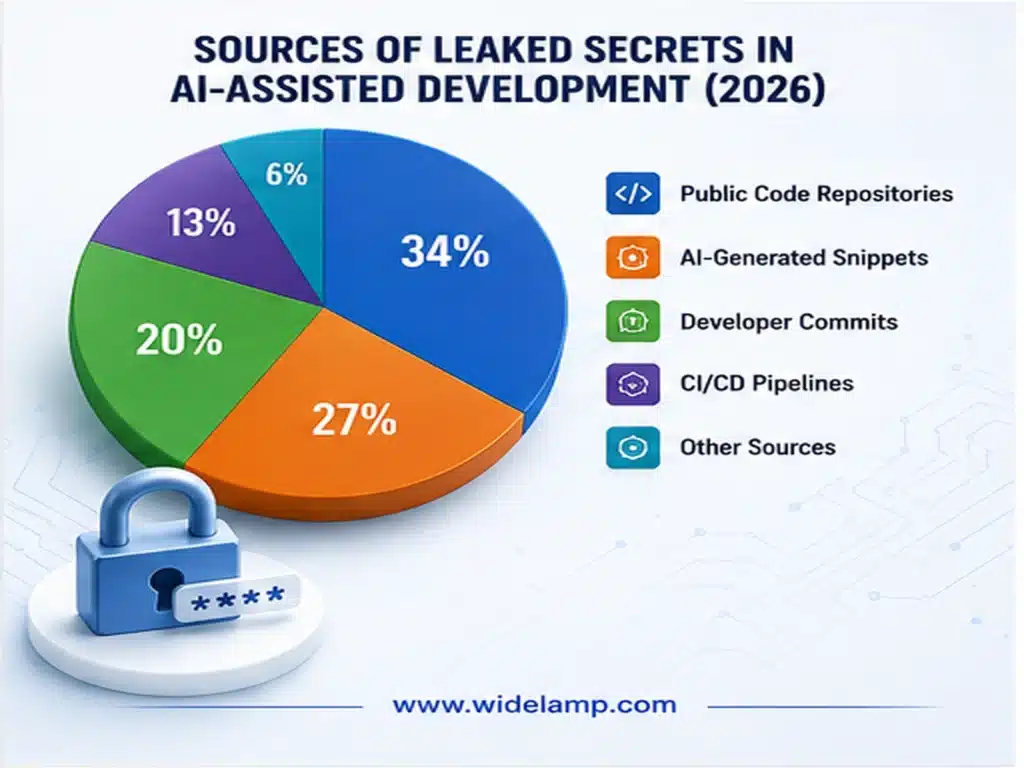
The second is secrets leakage. Ben MartinMooney, product marketing manager at GitGuardian, told Dark Reading that AI coding assistants have measurably worsened this problem – the vendor’s research puts the increase in secrets incidence at roughly 40% compared to traditional workflows, with AI-assisted commits leaking credentials at more than double the public GitHub baseline. Worse, GitGuardian’s 2026 research found that 64% of credentials confirmed valid in 2022 were still valid when retested in January 2026 – meaning they were never rotated at all.
The third is a structural flaw researchers at Wiz called “GhostApproval” – a trust-boundary gap found across six major AI coding assistants, including Amazon Q Developer, Claude Code, Augment, Cursor, Google Antigravity, and Windsurf. In the affected tools, a malicious repository could trick the coding agent into reading files outside its intended workspace sandbox, in some cases opening a path to remote code execution on the developer’s own machine. Some vendors patched the issue quickly after disclosure; others had not as of publication.
For researchers tracking this space: Georgia Tech’s Vibe Security Radar project is worth following directly, since it traces individual CVEs back through Git history to determine whether AI tooling introduced the vulnerable code in the first place – a rare piece of hard attribution data in a field that runs mostly on survey estimates.
Research Spotlight: How OWASP Is Formalizing These Risks
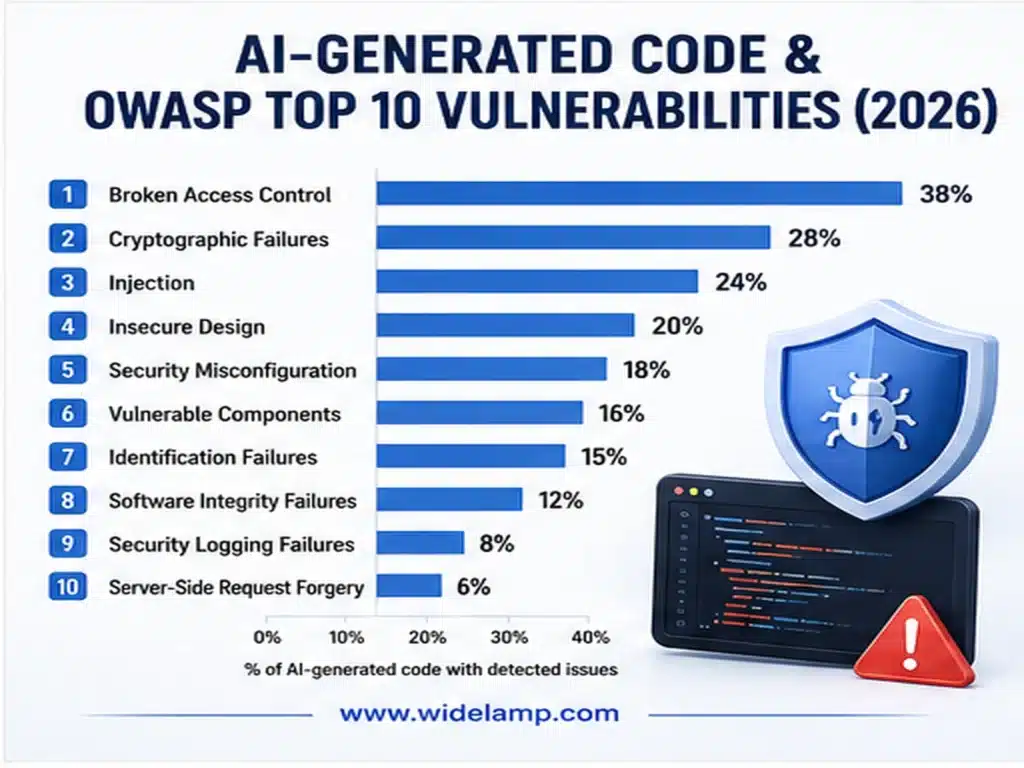
The OWASP Top 10 for LLM Applications (2025) now ranks Prompt Injection (LLM01) as its single highest risk, with Supply Chain failures (LLM03) covering hallucinated dependencies and Excessive Agency (LLM06) covering coding agents that operate with more permission than any one task requires.
A newer OWASP Top 10 for Agentic Applications (2026) goes further, adding ASI01 (Agent Goal Hijack) and ASI03 (Overly Permissive Tool Access) – categories written specifically for autonomous coding agents like the ones behind the GhostApproval findings.
Is the Cost of Securing AI Code Worth the Productivity Gains?
Here’s where the ROI question gets genuinely complicated. SonarSource’s 2026 State of Code Developer Survey, covering 1,149 developers worldwide, found 72% of developers who tried AI coding tools now use them daily, with an average self-reported productivity gain of 35%. But the same survey found 96% of developers do not fully trust AI-generated code to be functionally correct as-is, and only 48% said they always check AI-generated code before committing it. The productivity is real. So is the gap in verification.
Cost is the other half of the equation Dark Reading’s reporting surfaced clearly. Base AI coding tools generally run $19 to $40 per user per month, with premium tiers reaching $60 to $200 per user per month before token overages. A Gartner analysis cited by CIO Dive projects that rising token costs could make AI coding more expensive than the average developer’s salary by 2028. Layer security scanning on top, and the bill grows further: Chao Cheng-Shorland, CEO of Shelter Zoom, told Dark Reading that security teams she’s worked with report spending up to 40% of their time triaging AI-related findings that turn out to be non-exploitable – and that every new scanning tool added to catch AI-specific issues brings 40 to 200 hours of integration work plus 20 to 80 hours of initial false-positive tuning.
| Cost Factor | Traditional Dev | AI-Assisted Dev |
|---|---|---|
| Base tooling cost | Included in existing stack | $19-$200 / user / month |
| New scanner integration | One-time, established | 40-200 hours per tool |
| False-positive triage | Established baseline | Up to 40% of security team time |
| Credential leak remediation | Baseline incidence rate | ~40% higher incidence, 2+ hrs/incident |
Source: Dark Reading, “AI Coding: Do Security Risks Outweigh Productivity Gains?” (July 2026); GitGuardian State of Secrets Sprawl 2026.
“Speed without a security budget isn’t velocity. It’s debt with a very short grace period.”
None of this means the answer is to abandon AI coding assistants it means treating the security overhead as a real, budgeted cost from day one. The next section covers exactly how to do that.
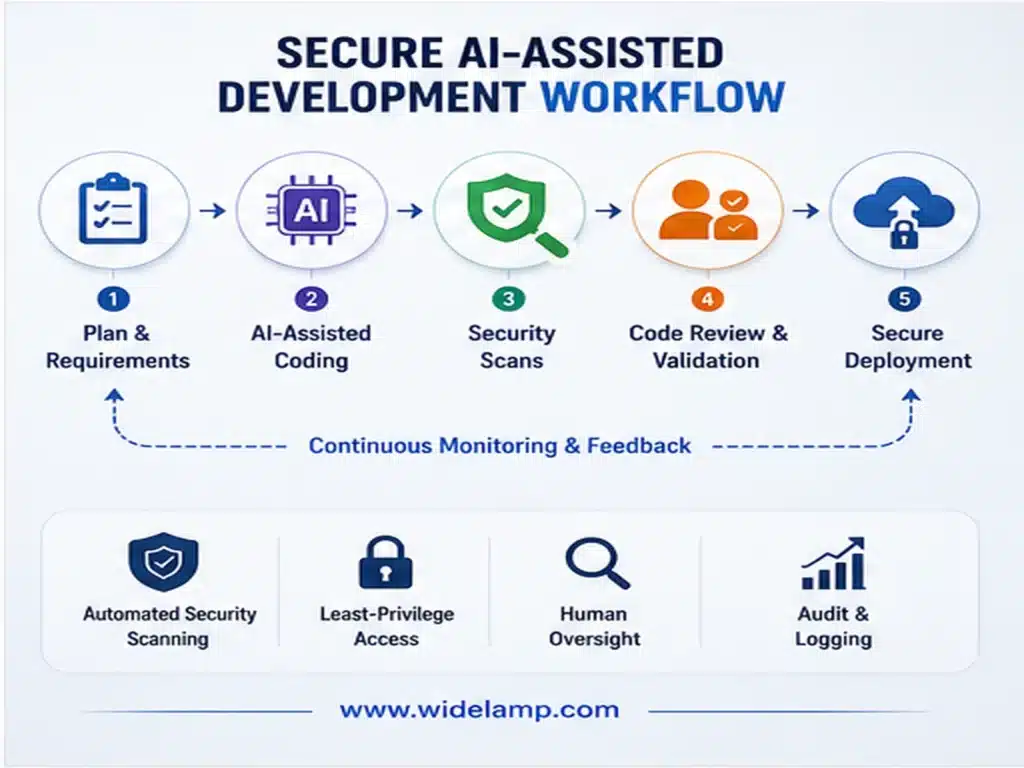
How Do You Actually Secure an AI-Assisted Development Pipeline? (7 Steps)
- Treat AI-assisted development as its own budget line, not a bolt-on to existing code review – security firms describe it as a distinct category of technical debt that needs dedicated funding.
- Enforce a dependency allowlist so hallucinated, “slopsquatted” packages can never reach a build, regardless of what the model suggests.
- Scan for hardcoded secrets at three separate points: prompt submission, file reads, and tool calls not only at the final commit, since agents can leak a credential before it’s ever committed.
- Keep a skilled human reviewer in the loop for any AI-generated code touching authentication, payments, or personal data – the two categories every recent AI coding assistants security risks study flags as the most consequential to get wrong.
- Apply least-privilege, sandboxed permissions to any coding agent that can read or write files autonomously, closing the exact trust- boundary gap behind the GhostApproval findings.
- Prioritize cross-site scripting and log injection review first the two vulnerability classes AI models catch least reliably, according to Veracode’s testing.
- Rotate every credential an AI coding session ever touched, and verify the rotation actually happened – don’t assume it, since a majority of old leaked keys tested in 2026 were found never rotated at all.
Quick Wins: 3 Guardrails You Can Set Up This Week
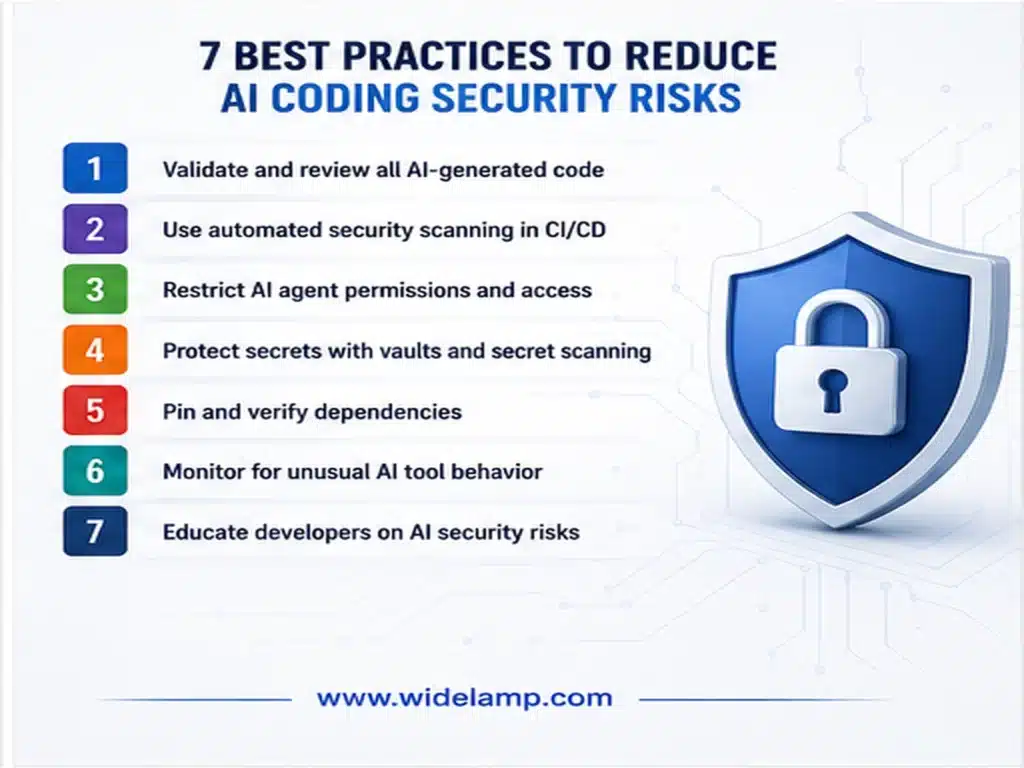
Start small: (1) turn on a dependency allowlist in your package manager config, (2) add a pre-commit secret-scanning hook to every repository an AI agent can touch, and (3) require a named human reviewer – not just an approval bot – on any pull request touching auth or data-access code. All three are low-effort and address the highest-frequency AI coding assistants security risks covered above.
Is AI Coding Still Worth It for Your Organization?
The honest answer, echoed by Omdia chief cybersecurity analyst Rik Turner in Dark Reading’s reporting, is that the industry is still “only at the outset” of understanding this problem – and the right call depends heavily on what kind of business is asking. Consumer facing organizations such as retailers, e-tailers, and banks tend to benefit the most from AI coding assistants, since faster iteration on customer facing apps translates directly into competitive advantage, even though the cost of securing that code will eat into the revenue gain. Slower-moving, less customer-facing industries – oil and gas or heavy machinery, for example often struggle to justify the added security spend against a smaller productivity payoff.
For engineering leaders weighing this decision: the deciding factor isn’t the AI tool itself. It’s whether your organization’s security hygiene access controls, secret rotation, code review discipline is strong enough to absorb the new risk before adoption, not scrambled together after the first incident.
“AI isn’t breaking application security – it’s exposing exactly where your process was already thin.”
Challenge – Guaranteed Reward for the Best Answer
A mid-size fintech company has 40 developers using a mix of Cursor, GitHub Copilot, and Claude Code across three codebases (Java, Python, and JavaScript). Based on the vulnerability pass-rate data in this article, which single vulnerability class should their AppSec team prioritize scanning for first – and why, weighing both the statistical failure rate and the realistic exploitability of that flaw class in a live fintech environment? A reward is guaranteed for the most well-reasoned answer – we want your logic, not just a one-word guess.
Send your answer to contact@widelamp.com.
Open to students, researchers, and professionals worldwide.
AI coding assistants aren’t going away, and for most teams, they shouldn’t. The data above simply makes the trade-off explicit: real productivity gains, sitting next to a real and measurable rise in AI coding assistants security risks that won’t fix itself with the next model release. Treat the security work as a first-class part of adopting these tools, not an afterthought bolted on once something breaks. Got a question about your own team’s setup, or a story about an AI-related close call worth sharing? Reach the WideLamp editorial team any time at contact@widelamp.com.
Resources & References
Industry Reports & News
Dark Reading – “AI Coding: Do Security Risks Outweigh Productivity Gains?”
The original reporting behind this article, covering enterprise adoption data, cost figures, and vendor commentary on AI coding risk.
GitLab – 2026 AI Accountability Report
Survey data on how many organizations use multiple AI coding tools and how governance is (or isn’t) keeping pace.
Technical & Academic References
Stanford University – “Do Users Write More Insecure Code with AI Assistants?”
The peer-reviewed study behind the AI “confidence gap” findings referenced throughout this article.
Security Vendor Research
Veracode – Spring 2026 GenAI Code Security Report Update
Testing data across 100+ LLMs showing vulnerability pass rates by CWE type and programming language.
GitGuardian – State of Secrets Sprawl 2026
Research on secrets leakage rates tied specifically to AI-assisted coding commits.
Wiz – “GhostApproval: A Trust Boundary Gap in AI Coding Assistants”
Disclosure research on the sandbox-escape vulnerability pattern affecting six major AI coding tools.
Further Reading & Guardrail Guides
Bishop Fox – 15 Security Guardrails for AI-Assisted Development
A practical checklist for constraining AI-generated code before it reaches production.