
|
Getting your Trinity Audio player ready...
|
A question that ticks in every mind when I try to learn cybersecurity is, Am I actually hired in cybersecurity because of the complexity of the job? If you’ve been asking whether it’s actually possible to get hired in cybersecurity right now, you’ve probably run into two completely different stories. One says the industry is desperate for people, with millions of unfilled jobs worldwide. The other says entry-level job posts ask for years of experience and certifications you’ve never even heard of. Both stories are true at the same time, and that contradiction is exactly why so many career changers and recent graduates feel stuck before they even apply. Here’s the honest picture, based on current 2026 workforce data.
Let’s Hired in Cybersecurity
Table of Contents
We know how confusing this feels. You keep hearing the field “needs people,” but every listing you open wants a background you don’t have yet. That frustration is valid, and it’s also exactly the gap this article is written to close. Once you see where the real bottleneck sits, you can stop applying blind and start moving toward roles that are genuinely reachable.
What Does Getting Hired in Cybersecurity Actually Involve in 2026?
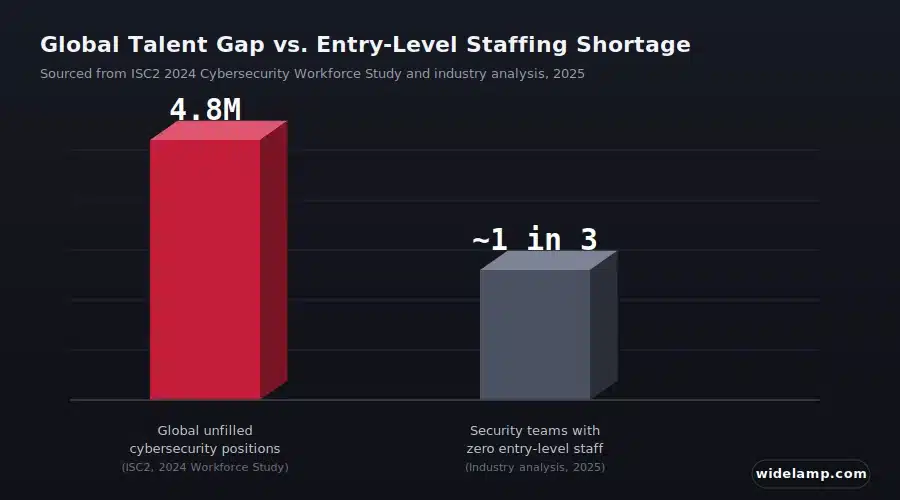
Getting hired in cybersecurity does not mean qualifying for any open role in the field it means qualifying for one specific tier: entry level. According to the 2024 ISC2 Cybersecurity Workforce Study, the global gap sits at roughly 4.8 million unfilled positions, but that figure blends every level, from junior analyst to CISO. The 2025 ISC2 study went further and stopped publishing a single gap number altogether, explaining that the more urgent problem for most organizations is now a mismatch in skills, not raw headcount. So the truthful answer is cybersecurity is not “easy” to break into, but it’s also not closed. It’s competitive, and it rewards a narrow, focused strategy far more than a broad one.
Industry analysis built on that same ISC2 and ISACA research puts the entry-level shortage in sharper focus: roughly a third of cybersecurity teams currently have no early-career professionals at all, even though demand across the field keeps rising. That’s the real tension behind “is cybersecurity hard to break into” the industry-wide gap is genuine, and the entry-level door is smaller, more selective, and shaped by hiring habits that don’t always match the industry’s stated need.
Cybersecurity hiring headlines usually combine every unfilled role junior analyst through CISO into one large number. ISACA’s 2025–2026 State of Cybersecurity report found that 58% of teams call themselves understaffed and 66% report unfilled positions overall, which is a real and separate signal from the entry-level picture covered in this guide.
The industry isn’t short on cybersecurity jobs. It’s short on cybersecurity jobs willing to train the people who could fill them.
Why Does Getting Hired in Cybersecurity Feel Harder Than the Headlines Suggest?
A few structural habits inside hiring teams explain most of the gap between “millions of open jobs” and “I can’t get an interview.”
1. Job postings ask for experience-level credentials at entry level
A few hiring habits explain most of the mismatch between “millions of open jobs” and “I can’t get an interview.” First, a lot of entry-level job posts list certifications like CISSP, which technically require years of prior experience just to qualify for the exam. This usually isn’t intentional gatekeeping; it’s often a copy-pasted job template, but it discourages qualified beginners from applying at all.
2. Budget has overtaken talent as the top hiring blocker
For the first time in ISC2’s tracking, budget constraints not a lack of qualified people became the leading reason organizations gave for unfilled security seats, and ISC2’s 2025 data shows 36% of teams reported budget cuts and 24% reported layoffs that year. Teams often want to hire a junior analyst; the headcount approval simply doesn’t come through in time.
3. Skills gaps, not people gaps, dominate hiring conversations now
ISC2’s 2025 workforce research found that professionals increasingly rank the need for specific skills above the need for more headcount, and a related 2024 SANS/GIAC survey found 52% of organizations cited “not having the right staff” as their top challenge, versus 48% who
cited “not having enough staff.” That shift changes what getting hired in cybersecurity rewards: a demonstrated skill beats a longer resume
4. AI is compressing the easiest entry-level tasks
A 2025 ISC2 survey on AI adoption found 52% of respondents believe AI security tools will significantly or somewhat reduce the need for
junior staff, and roughly 30% of teams have already integrated AI tools into daily operations. That doesn’t remove entry-level cybersecurity jobs, but it is changing what a junior role expects a new hire to already understand on day one.
Don’t rule yourself out because a junior listing reads like a senior one. Many postings are wish lists written by a hiring manager, not hard requirements. If you meet roughly 60–70% of a junior listing’s stated qualifications, applying is still a reasonable, worthwhile move.
We know how hard you’ve been preparing, and opening an “entry-level” posting that reads like it wants five years of experience can feel discouraging. You’re not imagining the mismatch. It’s a documented, industry-wide pattern, not a sign that you’re underqualified for the field itself.
How Hard Is Getting Hired in Cybersecurity, Really? Signal vs. Noise
Strip away the noise and three sourced signals give an honest read on the actual difficulty level.
- Signal 1 — Time to fill an entry-level seat: ISACA’s 2025–2026 State of Cybersecurity report found that 45% of organizations say it takes three to six months to hire for entry-level roles. That’s slower than a lot of tech hiring, but it also means the seat doesn’t vanish after one rejection cycle.
- Signal 2 — Non-traditional pathways are already working: the same ISACA report found 49% of current cybersecurity professionals transitioned in from another field, and ISC2’s 2025 Hiring Trends Study found 90% of hiring managers would consider a candidate with IT experience alone, and 89% would accept an entry-level certification in place of a degree.
- Signal 3 — Demand keeps growing structurally: the World Economic Forum’s Future of Jobs Report 2025 lists information security analyst among the fifteen fastest-growing professions globally through 2030, which keeps pressure on organizations to keep the entry-level pipeline open rather than close it.
Put together, the honest answer is that getting hired in cybersecurity is competitive, not closed. It rewards a specific, narrow strategy far more than a broad one.
You don’t need to out-qualify the market. You need to out-focus it.
Unlike a general “learn to code” pitch, cybersecurity hiring managers consistently say something specific: a demonstrated, hands-on project outweighs a stack of unrelated coursework. Many candidates overlook that one well-documented home-lab project can carry more weight than a full semester of theory on paper don’t make that mistake going into your applications.
What Is the Fastest Realistic Path to Getting Hired in Cybersecurity?
Now that you understand why the door feels narrow, here’s exactly how candidates are walking through it in 2026.
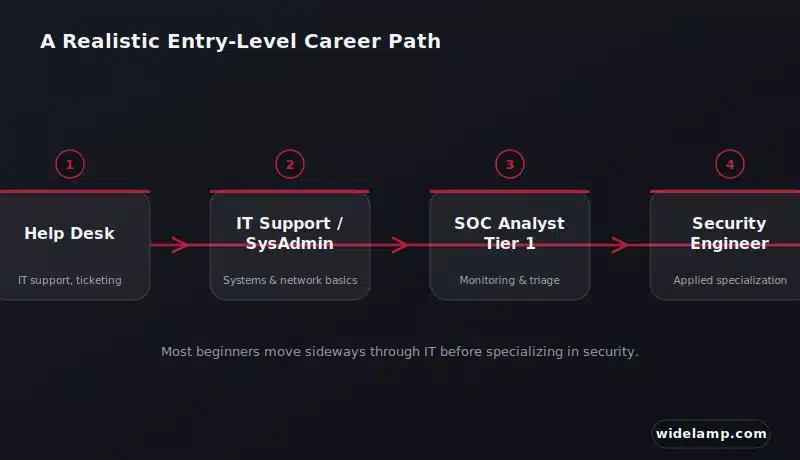
- Start adjacent, not head-on. Help desk, network administration, or general sysadmin roles remain the most common launchpad, because they build systems knowledge that security work assumes you already have.
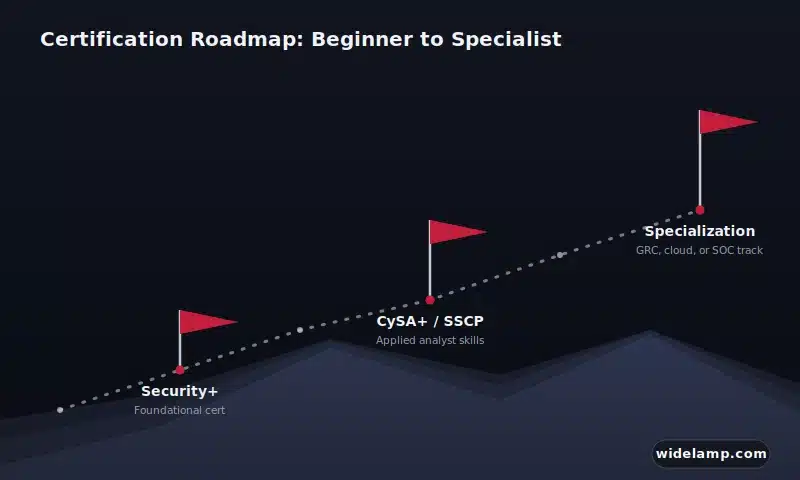
- Pick one foundational certification and finish it. CompTIA Security+ remains the most widely recognized entry credential across the postings referenced in this guide. Depth on one certificate beats breadth across five unfinished ones.
- Build a visible, documented home lab. Set up a small virtual SOC environment, analyze sample network traffic, or complete a beginner Capture the Flag challenge, then write up what you did. This is the single highest-leverage item you can put on a resume with zero prior job history.
- Target the roles actually built for beginners. SOC Analyst Tier 1, junior GRC (governance, risk, compliance) analyst, vulnerability management analyst, and security-focused help desk are the realistic first rung, not penetration tester or security architect.
- Use internships and apprenticeships deliberately. ISC2’s 2025 Hiring Trends Study found 55% of hiring managers value internships and 46% value apprenticeships as ways to identify early-career talent. Treat these as a real front door, not a fallback.
- Network inside one specific community. Local security meetups, CTF teams, and online communities routinely turn into referrals, and referred candidates often skip much of the resume filter entirely.
- Interview on judgment, not memorized definitions. Hiring managers in this field consistently favor candidates who can reason through an unfamiliar scenario out loud over candidates who recite textbook answers.
Describe your home-lab project the way you’d describe a job, not a class. “Analyzed simulated network traffic in a virtual SOC lab using Wireshark and flagged three suspicious traffic patterns” reads completely differently than “completed cybersecurity coursework.”
Don’t worry the application process itself is simpler than it looks once you know which roles to target. Follow the seven steps above in order, apply consistently, and you’re no longer gambling on luck. You’re running a repeatable process.
What Getting Hired in Cybersecurity Looks Like in Practice?
These are composite, illustrative scenarios built from common patterns reported in the hiring research above, not individual case studies, since every real hiring path looks a little different.
Two years on an IT help desk, then Security+, then a home-lab project analyzing phishing samples. Applied to Tier 1 SOC roles at mid-size companies and was hired within roughly four months — consistent with ISACA’s reported entry-level hiring window.
Ten years in operations management, no technical background. Moved into a junior GRC analyst role by leaning on documentation and process skills, then added Security+ afterward to round out technical credibility — a path ISACA data shows nearly half of current professionals share.
Cybersecurity degree, no work experience. Landed a security engineering internship by leading with CTF competition results and a documented capstone project, since ISC2’s research shows internships remain a top channel hiring managers use to find early-career talent.
Career-Changer vs. Fresh Graduate: Who Has an Easier Time Getting Hired in Cybersecurity?
| Factor | Career-Changer (e.g., IT, military, teaching) | Fresh Graduate (cybersecurity degree) |
|---|---|---|
| Biggest advantage | Real workplace context, communication skills, existing professional network | Structured technical foundation, campus recruiting access |
| Biggest gap to close | Hands-on technical proof (labs, certs) | Real-world judgment and workplace maturity signals |
| Fastest first cert | CompTIA Security+ | CompTIA Security+ or CySA+ |
| Typical entry role | SOC Analyst Tier 1, junior GRC analyst | SOC Analyst Tier 1, security engineering intern |
Neither path is objectively easier each is solving a different gap. ISACA’s data shows both paths are common: 39% of current professionals started directly in the field, while 49% transitioned from somewhere else.
Every year, huge numbers of candidates compete for a small number of true entry-level seats. The ones who get through aren’t necessarily the most certified — they’re the most specific.
What If You’ve Already Been Rejected, Is Getting Hired in Cybersecurity Still Realistic?
If a recruiter passed on you last time, that’s not a verdict on whether you belong in this field. It’s usually a sign your resume didn’t map cleanly onto the role’s exact keywords, or a stronger internal candidate applied that cycle. Rejections in a field where ISACA reports 66% of organizations still have unfilled positions are rarely final. Revisit your home-lab project, tighten it around one specific skill like log analysis or phishing triage, and apply again with a more targeted resume.
Workforce researchers increasingly separate a “headcount gap” (unfilled seats) from a “skills gap” (staffed but under-skilled teams). The 2025 ISC2 Workforce Study found the field is now prioritizing critical skills over adding headcount, which is exactly why a focused, demonstrable skill set outperforms a long list of loosely related qualifications when you’re trying to get noticed.
Is Getting Hired in Cybersecurity Realistic Without a Technical Background?
Yes, with the right entry point. Cybersecurity isn’t only penetration testing and coding. Governance, risk, and compliance roles, security awareness training, and policy-focused positions rely heavily on communication, writing, and process skills strengths that people coming from teaching, law, administration, or customer-facing careers often already have. These roles still expect basic technical literacy, but they don’t require writing exploit code on day one.
Yes, almost every application will ask for yet another updated resume and another round of screening questions. Keep a clean, reusable template ready you’re going to need it more than once before the right fit comes through.
What Does a Realistic 6-Month Plan for Getting Hired in Cybersecurity Look Like?
Study for and pass CompTIA Security+; join one CTF or security community.
Build and document one home-lab project end to end.
Rewrite resume around the project and cert; start applying to Tier 1 SOC and GRC roles.
Apply consistently, attend meetups, and follow up on internship and apprenticeship programs.
Now that you have a sequence instead of a vague goal, here’s what matters most once you get to the interview stage.
QWhat does it actually take to get hired in cybersecurity right now?
Getting hired in cybersecurity today usually takes one foundational certification like Security+, one documented hands-on project such as a home SOC lab, and a resume targeted at the correct entry tier — SOC Analyst Tier 1, junior GRC analyst, or a security-focused help desk role rather than a mid-level position. ISC2’s 2025 Hiring Trends Study found that 90% of hiring managers will consider a candidate with IT experience alone, and 89% will accept an entry-level certification instead of a degree. Beginners who target the correct tier and show real hands-on work consistently do better than beginners who apply broadly with a generic resume.
QDo you need a degree for getting hired in cybersecurity?
No, a degree is not strictly required. ISC2’s 2025 Hiring Trends Study found that 89% of security hiring managers would consider a candidate who holds only an entry-level cybersecurity certification over one with education alone, and 90% would consider a candidate with only IT work experience. Certifications and documented hands-on lab work can carry real weight for entry-level and junior analyst roles, though a degree can still help at some larger or more traditional employers.
QWhat is the easiest first job for getting hired in cybersecurity?
SOC Analyst Tier 1, security-focused help desk, vulnerability management analyst, and junior GRC analyst roles are consistently the most accessible entry points. They value monitoring, documentation, and structured troubleshooting over advanced offensive security expertise, and industry guides on entry-level hiring consistently list them as the roles that actually take candidates fresh from a certification or an adjacent IT role.
QWhich certification helps most when getting hired in cybersecurity for the first time?
CompTIA Security+ is the most widely recognized starting certification and appears across the largest share of entry-level job listings referenced by industry hiring guides. Unlike CISSP, which formally requires several years of prior experience to sit the exam, Security+ is designed for people entering the field, which is why it’s the most common first certification recommended by career changers and fresh graduates alike.
QWhy do entry-level cybersecurity jobs ask for years of experience?
This usually happens because job postings get copied from templates written for more senior roles, or because a company wants a lower-risk hire even for a junior title. It reflects inconsistent hiring practices rather than a hard rule, and many candidates who don’t meet every listed requirement still get interviews, especially if they can show hands-on lab work or a relevant certification.
QIs career-changing into cybersecurity realistic in your 30s or 40s?
Yes. ISACA’s 2025–2026 State of Cybersecurity report found that 49% of current cybersecurity professionals transitioned in from another field, meaning career-changers already make up close to half of the workforce. Prior professional experience in IT, the military, compliance, teaching, or customer-facing roles often translates directly into skills hiring managers value, such as communication, documentation, and process discipline.
QHow long does getting hired in cybersecurity usually take once you start applying?
ISACA’s 2025–2026 research found that 45% of organizations report taking three to six months to hire for entry-level security roles specifically. That’s slower than some other tech hiring cycles, but it also means a multi-month, consistent application effort is normal and expected, not a sign that something is wrong with your approach or resume.
QDoes AI make getting hired in cybersecurity harder in 2026?
AI is changing what entry-level work looks like more than it’s eliminating the work itself. A 2025 ISC2 survey found 52% of respondents believe AI security tools will reduce the need for junior staff to some degree, while roughly 30% of teams have already integrated AI into daily operations. The practical takeaway is that candidates comfortable working alongside AI-assisted detection and scanning tools have an edge over candidates who aren’t.
Now that you know the real shape of the problem, the path forward is simpler than the headlines make it feel: target the correct tier, finish one certification, build one strong project, and apply consistently for months, not days. Getting hired in cybersecurity in 2026 is not about beating impossible odds it’s about matching your effort to where the actual doors are open. If you want feedback on your resume, your home-lab project, or your certification plan, reach out any time at contact@widelamp.com, we read every message.
Resources & References
Official & Authority Sources
- ISC2 — 2025 Cybersecurity Workforce Study: Annual global research on staffing levels, skills priorities, and hiring conditions.
- ISC2 — 2025 Cybersecurity Hiring Trends Study: Survey data on how hiring managers evaluate entry- and junior-level candidates.
- U.S. Bureau of Labor Statistics — Information Security Analysts: Official government data on job outlook, education paths, and median pay.
- World Economic Forum — Future of Jobs Report 2025: Global research ranking the fastest-growing professions through 2030.
Technical & Industry Research
- ISACA — State of Cybersecurity 2025–2026: Survey of thousands of practitioners on staffing, hiring timelines, and career pathways.
- CompTIA — Security+ Certification Overview: Official details on the most common entry-level cybersecurity certification.
Learning Platforms & Practice
- TryHackMe — Guided Cybersecurity Labs: Beginner-friendly hands-on labs for building a documented home-lab portfolio.
- Hack The Box — Practical Security Challenges: Capture-the-flag style exercises widely used to demonstrate applied skill.
Further Reading
- Help Net Security — AI’s Effect on Entry-Level Cybersecurity Jobs: Coverage of ISC2’s 2025 survey on AI adoption and its impact on junior hiring.