
|
Getting your Trinity Audio player ready...
|
Right now, in laboratories cooled to temperatures colder than outer space, a new kind of processor is being built — one that doesn’t just run faster than your laptop, but computes in ways your laptop literally cannot. The quantum processor is the engine behind one of the most exciting and disruptive technologies of our time: quantum computing. This isn’t science fiction. By the end of 2025, IBM, Google, Microsoft, and several other companies have already crossed milestones that experts once thought were decades away. If you’ve been hearing the words “quantum processor” everywhere and wondering what the fuss is actually about — this article is written for you.
Table of Contents
QUANTUM PROCESSOR — 2025 AT A GLANCE
What Is a Quantum Processor and How Does It Actually Work?
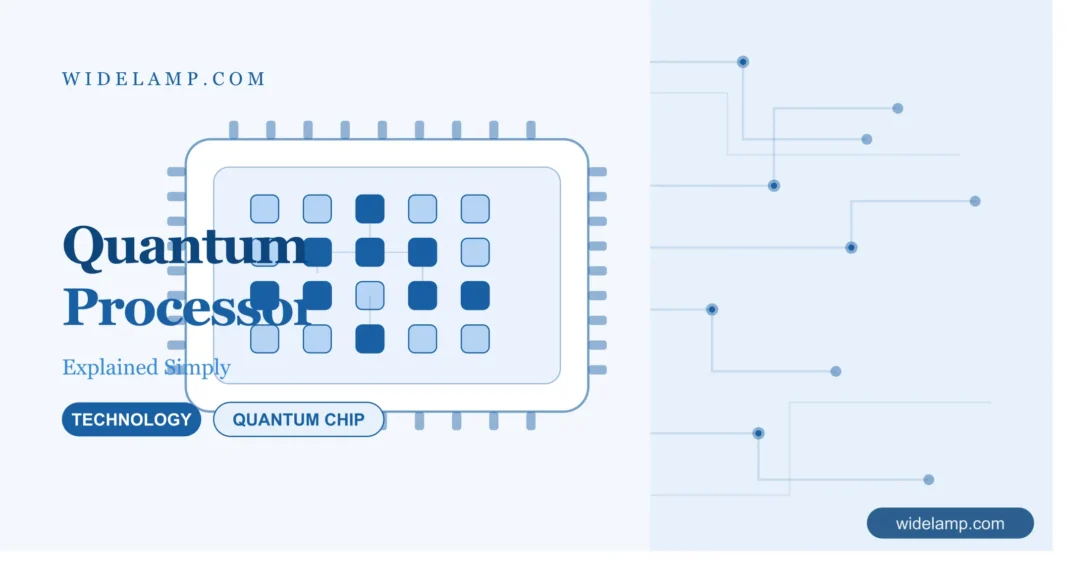
A quantum processor is the brain of a quantum computer — the physical chip that performs calculations using the strange and counterintuitive rules of quantum physics. Your regular computer chip processes information as bits: tiny switches that are either ON (1) or OFF (0). A quantum processor uses qubits — quantum bits — which can be both 0 and 1 at the same time, thanks to a property called superposition.
Think of it this way. If you flip a coin, it lands on heads or tails. That’s a normal bit — one or the other. But while the coin is spinning in the air, it’s somehow both. A qubit is like that spinning coin. This lets a quantum processor explore millions of possible answers to a problem simultaneously, instead of trying them one by one like a classical computer does.
Beyond superposition, quantum processors also exploit two other quantum phenomena: entanglement and interference. Entanglement links two qubits so that the state of one instantly affects the other, no matter how far apart they are. Interference is used to amplify the right answers and cancel out the wrong ones — like noise-cancelling headphones for calculations.
Here’s what makes a quantum processor genuinely different from a classical chip: it doesn’t just run programs faster. It solves entire categories of problems that a classical processor fundamentally cannot handle in any reasonable amount of time — even with unlimited memory and speed. Drug molecule simulation, climate modelling, financial risk analysis, and breaking modern encryption are examples of problems that a quantum processor could tackle in hours where classical computers would need millions of years.
🔵 Key Concept: The Quantum Processor Trio
- Superposition — A qubit can be 0, 1, or both simultaneously. This lets the processor evaluate many outcomes at once.
- Entanglement — Two qubits share a linked state. Change one, and the other responds instantly — enabling coordinated, parallel computation.
- Interference — Quantum algorithms use wave-like interference to amplify correct answers and suppress wrong ones — like a mathematical noise filter.
Quantum Processor vs Classical Processor: 7 Critical Differences
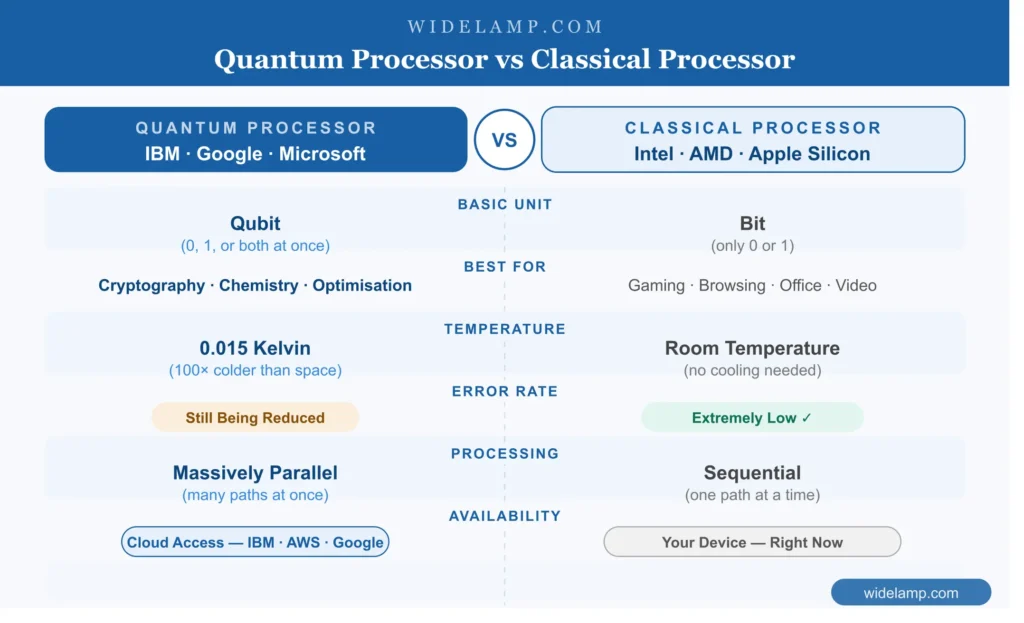
Understanding a quantum processor is much easier when you compare it directly to what you already know. Your laptop’s processor and a quantum processor are built on completely different physics — and they solve completely different types of problems. Here’s a clear side-by-side breakdown.
| Feature | Quantum Processor | Classical Processor |
|---|---|---|
| Basic Unit | Qubit (0, 1, or both) | Bit (0 or 1 only) |
| Operating Temp. | ~0.015 Kelvin (near absolute zero) | Room temperature |
| Processing Style | Massively parallel (many paths at once) | Sequential (one path at a time) |
| Best For | Optimization, chemistry, cryptography | Word processing, gaming, browsing |
| Error Rate | Still being reduced (major challenge) | Extremely low — highly reliable |
| Speed vs Classical | Exponentially faster for specific tasks | Faster for general everyday tasks |
| Physical Size | Requires large cryogenic systems | Fits on a fingernail |
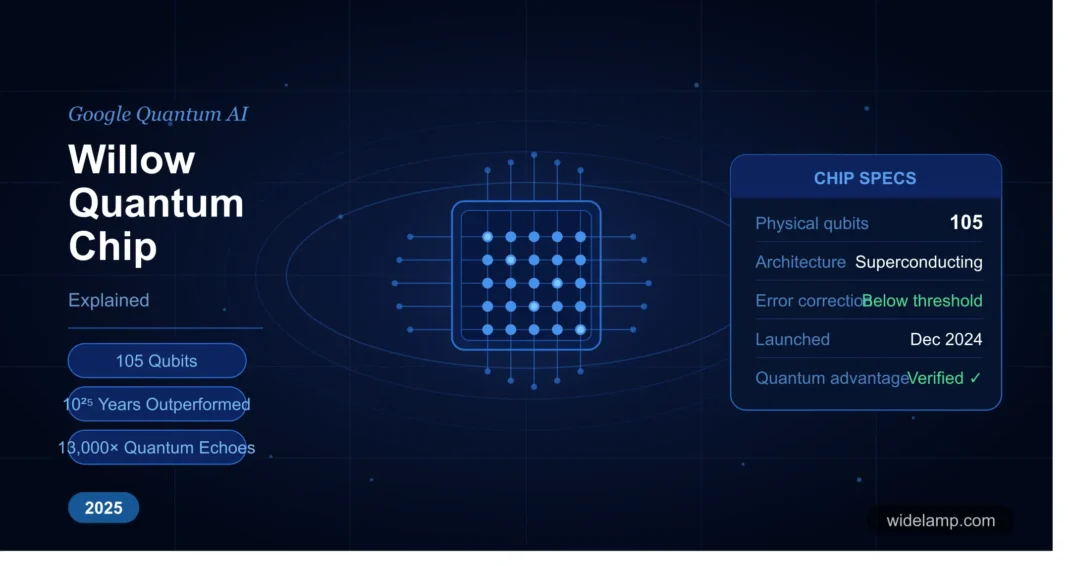
“Google’s Willow quantum processor solved in five minutes a benchmark calculation that the world’s fastest classical supercomputer would take 1025 years to complete.”
— Google Quantum AI, December 2024
How Is a Quantum Processor Built? The Technology Inside the Chip
Building a quantum processor is one of the most demanding engineering challenges humans have ever attempted. Your smartphone’s chip is made at temperatures a machine can handle. A quantum processor, by contrast, must operate at around 0.015 Kelvin — roughly 100 times colder than outer space. The slightest vibration, heat, or stray photon of light will destroy the delicate quantum state of the qubits.
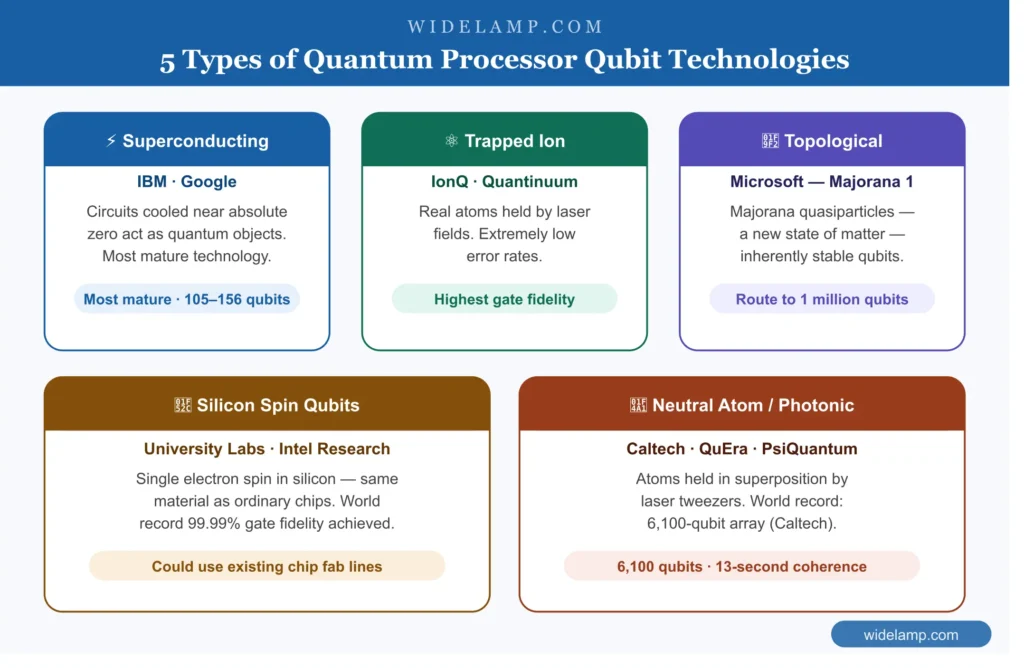
There are currently five main technologies used to build qubits inside a quantum processor, and each has its own trade-offs.
5 Types of Quantum Processor Technologies
⚡ Superconducting Qubits
Used by IBM and Google. Tiny electrical circuits cooled to near absolute zero behave like quantum objects. Currently the most mature technology, with IBM’s Heron and Nighthawk processors leading the field. Best known for speed of gate operations.
⚛️ Trapped Ion Qubits
Used by IonQ and Quantinuum. Real atoms — ytterbium or barium — are held in place by laser or microwave fields and used as qubits. Extremely low error rates make these chips among the most accurate, though gate speeds are slower than superconducting chips.
🧲 Topological Qubits
Microsoft’s approach with the Majorana 1 chip (launched Feb 2025). Uses exotic Majorana quasiparticles — a new state of matter — to create inherently stable qubits that need far less error correction. Potentially scalable to 1 million qubits on a single chip.
🔬 Silicon Spin Qubits
Use the spin of single electrons in silicon — the same material as ordinary chips. In 2025, researchers built the world’s most accurate quantum chip using this approach, achieving 99.99% fidelity. Silicon qubits could eventually be mass-produced using existing chip fabrication lines.
💡 Neutral Atom / Photonic
Caltech set a world record in 2025 with a 6,100-qubit neutral atom array, where caesium atoms held in superposition for 13 seconds — ten times longer than previous records. Photonic qubits use particles of light and show promise for quantum networking between processors.
One thing worth knowing — and this is something many beginners overlook a bigger qubit count doesn’t automatically mean a better quantum processor. What matters most is qubit quality: how long the qubits maintain their quantum state (called coherence time), how accurately they perform operations (called gate fidelity), and how well errors are corrected. IBM’s Nighthawk chip, for example, deliberately stepped back from 156 qubits to 120 qubits in order to achieve significantly higher accuracy and better connectivity between qubits. Quality over quantity is the defining philosophy of quantum processor design.
Who Are the Leading Quantum Processor Companies Racing Ahead?
The quantum processor race in 2025 is genuinely competitive, with billions of dollars and the future of computing at stake. Here are the major players and what each brings to the table — along with where they stand on their roadmap right now.
| Company | Technology | Latest Processor | 2025 Milestone | Fault-Tolerance Target |
|---|---|---|---|---|
| IBM | Superconducting | Nighthawk (120 qubits) | Loon experimental chip; 300mm wafer fab | 2029 (Starling) |
| Superconducting | Willow (105 qubits) | Quantum Echoes algorithm breakthrough | Milestone 3 of 6 (in progress) | |
| Microsoft | Topological | Majorana 1 | First topological qubit chip; new state of matter | Route to 1 million qubits |
| IonQ | Trapped Ion | Tempo (100 qubits) | Delivered 3 months early; Oxford Ionics acquired | 256 qubits by 2026 |
| Fujitsu/RIKEN | Superconducting | 256-qubit system | 4× scale vs 2023; partnered with IBM on Fugaku | 1,000 qubits by 2026 |
| Caltech | Neutral Atom | 6,100-qubit array | World record; 13-second coherence time | Research stage |
🟢 Expert Insight: Why 2025 Is Different
In March 2025, IonQ and Ansys ran a real medical device simulation on a 36-qubit quantum processor and outperformed classical high-performance computing by 12% — one of the first documented cases of a quantum processor delivering genuine practical advantage over classical computers in a real-world task. This isn’t a benchmark. It’s a working result. The era of “quantum for experiments only” is ending.
Quantum Processor Error Correction: The Single Biggest Challenge
Here’s the part of quantum processor technology that most articles skip over — and it’s the part that actually determines everything. Raw qubit count is almost meaningless without error correction. Qubits are extraordinarily fragile. Even the smallest magnetic fluctuation, temperature change, or vibration can cause a qubit to “decohere” — to collapse out of its quantum state and give you a wrong answer.
This is called quantum noise, and it’s why, in 2025, the biggest advances aren’t just in adding more qubits — they’re in keeping existing qubits reliable.
How Are Quantum Processors Solving the Error Problem?
IBM’s approach uses something called qLDPC (quantum low-density parity-check) error-correcting codes, which slash the number of physical qubits needed to produce one reliable “logical” qubit by approximately 90%. This is a massive efficiency gain. Previously, you might need thousands of physical qubits just to produce a single error-corrected logical qubit. With qLDPC, that number drops dramatically.
Google’s Willow chip demonstrated “below threshold” error correction — a historic milestone where adding more qubits to the system actually reduces the overall error rate rather than increasing it. This is exactly what quantum computing theorists predicted must happen before fault-tolerant quantum processors become possible — and in 2024, Google proved it works.
Meanwhile, researchers at QuEra published techniques in 2025 that reduce quantum error correction overhead by up to 100 times, potentially moving the timelines for practical quantum computing significantly closer. And IBM achieved real-time error decoding in under 480 nanoseconds — fast enough to correct errors on the fly while a quantum processor is actually running a calculation.
“The race in quantum processor development isn’t about who has the most qubits. It’s about who can keep those qubits working long enough to do something useful.”
What Can a Quantum Processor Actually Do? Real-World Applications
You might be wondering: even if this technology works, what does it actually change for the real world? The answer is — a lot. A functional quantum processor changes the game in several industries where classical computers hit a hard wall. Let’s look at the areas where quantum processor applications are already being tested and where the most significant breakthroughs are expected.
💊 Drug Discovery
Simulating how molecules interact at the quantum level — impossible for classical computers at useful scale. BMW, Airbus, Biogen, and Accenture are already running early experiments. A quantum processor can model molecules far larger than any classical computer can handle.
🔐 Cryptography
A powerful quantum processor could break many forms of current encryption — a serious national security concern. NIST published its first post-quantum encryption standards in 2024 specifically to prepare. This is why quantum processor progress is monitored by every government on Earth.
📈 Finance
Portfolio optimisation, risk modelling, and derivative pricing all involve searching through enormous numbers of combinations — exactly what a quantum processor excels at. Major banks are already experimenting with quantum algorithms on cloud-accessible quantum processors.
🌍 Climate Modelling
Modelling the Earth’s atmosphere and climate systems requires computing interactions between millions of variables simultaneously. A quantum processor could dramatically improve the accuracy and speed of climate predictions — potentially changing how we respond to environmental crises.
🚚 Logistics & Supply Chain
Finding the optimal route for thousands of vehicles, packages, or manufacturing steps is a classic combinatorial problem that quantum processors handle more naturally than classical systems. Volkswagen has already tested quantum route optimisation for city traffic management.
⚡ Energy & Materials
Designing new battery materials, solar cells, and superconductors requires simulating quantum-level interactions. IBM and RIKEN already used a quantum processor alongside the Fugaku supercomputer in 2025 to simulate molecules beyond the reach of classical computers alone.
How Can You Access a Quantum Processor Today? A Beginner’s Guide
You don’t need to work at IBM or Google to run code on a real quantum processor. Believe it or not, you can access one from your laptop right now — for free. Here’s how to get started, step by step.
How to Run Your First Program on a Quantum Processor
Don’t worry — the first steps are simpler than they look. Follow this guide and you’ll be running your first quantum circuit within an hour.
Visit quantum.ibm.com and create a free account. IBM offers free access to real quantum processors with up to 127 qubits — no credit card needed.
Open your terminal and run:
pip install qiskit. Qiskit is IBM’s open-source Python library for writing quantum programs. No prior quantum knowledge is needed to start.A quantum circuit is the sequence of operations (called gates) your quantum processor will perform. Start with a simple 2-qubit circuit that creates an entangled pair — the “hello world” of quantum computing.
Qiskit includes a local simulator so you can test your circuit on your own machine before submitting it to a real quantum processor. This saves your free usage credits and lets you debug quickly.
Once satisfied, submit your circuit to one of IBM’s real quantum processors. Your job joins a queue and typically runs within minutes. IBM’s Heron r2 and r3 processors (156 qubits) are available to free-tier users.
IBM isn’t the only option. Google’s Cirq framework lets you write quantum programs for Google’s hardware, and Amazon Braket gives you cloud access to multiple quantum processors from IonQ, Rigetti, and others — all from one platform.
IBM Quantum Learning (learning.quantum.ibm.com) offers completely free structured courses from zero experience to advanced quantum algorithms. MIT OpenCourseWare and edX also have excellent quantum computing courses at no cost.
“You don’t need a PhD to use a quantum processor today. IBM’s free cloud platform has put real quantum hardware in the hands of students, researchers, and curious minds worldwide — and that’s exactly how revolutions begin.”
What Does the Quantum Processor Roadmap Look Like Through 2033?
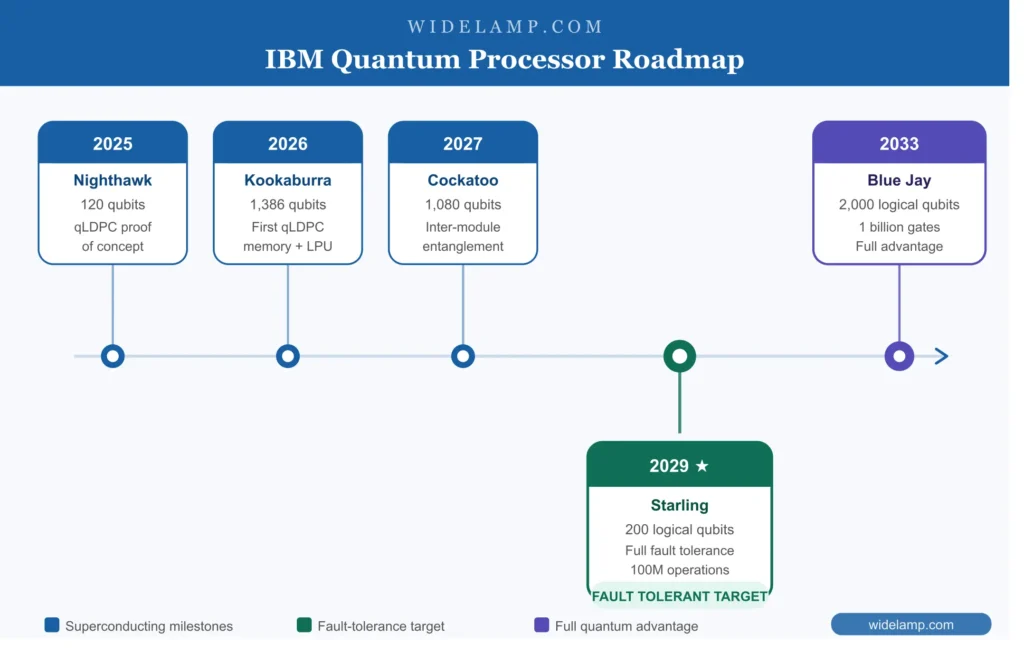
If you want to understand where quantum processor technology is headed, the IBM roadmap is the most detailed and publicly transparent in the industry. IBM has delivered on its milestones consistently since 2016, making its projections worth taking seriously. Here’s what the next eight years look like.
| Year | Processor / Milestone | Key Capability |
|---|---|---|
| 2025 | Nighthawk + Loon (experimental) | 120 qubits; 5,000 two-qubit gates; proof-of-concept qLDPC error correction |
| 2026 | Kookaburra (1,386 qubits multi-chip) | First qLDPC memory + LPU; Quantum Advantage targeted; 4,158 total qubits in 3-chip system |
| 2027 | Cockatoo | Inter-module entanglement; up to 9 linked Nighthawk chips; 1,080 connected qubits |
| 2029 | Starling (fault-tolerant) | 200 logical qubits; 100 million error-corrected operations; full fault tolerance |
| 2033 | Blue Jay | 2,000 logical qubits; 1 billion gates; full quantum advantage across key problem classes |
⚠️ Important Caution: Quantum Hype vs. Reality
Nobel laureate Frank Wilczek noted in mid-2025 that quantum processors remain in the research stage and “classical computers will remain superior for the foreseeable future” for most everyday tasks. Quantum processors will not replace your laptop or smartphone. They are powerful tools for a specific category of hard problems — not general-purpose replacements for classical computing. Timelines have also shifted before. IBM’s 2029 fault-tolerance target is ambitious but plausible — if engineering challenges remain on schedule.
Quantum Processor and the 2025 Nobel Prize: Why Scientists Are Celebrating
In October 2025, the Nobel Prize in Physics was awarded to three scientists for their foundational work on superconducting quantum circuits — the technology that underpins most of today’s leading quantum processors, including those from IBM and Google. The work itself was done in the 1980s, but the Nobel Committee recognized it now because it has become central to one of the most important engineering challenges of our time.
The award is a powerful signal: the world’s most prestigious scientific institution is telling us that quantum processor technology is not speculative. It is built on real, validated, prize-worthy science. If you’ve ever doubted whether quantum computers are real or just vaporware — the Nobel Committee begs to differ.
🔬 Research Spotlight: The 2025 Nobel Prize in Physics
The Royal Swedish Academy of Sciences awarded the 2025 Nobel Prize in Physics for the discovery that quantum effects can appear in large-scale superconducting circuits — effectively treating a cold, centimetre-scale circuit as a single quantum object, like an atom. This underpins the entire superconducting qubit approach used by IBM, Google, and others.
The prize was awarded for “achievements that have conferred the greatest benefit to humankind” — a statement that places quantum processor research alongside medicine, vaccines, and communication technologies in its potential impact.
“Every year, over 1 crore people train in technology fields around the world. Only a fraction will understand quantum processors well enough to build with them. The question is — will you be one of them?”
Quantum Processor Careers and Learning Path: How to Get Started
If reading this article has sparked your curiosity, you’re in the right place at the right time. The quantum computing workforce is one of the most in-demand and undersupplied in all of technology. Companies like IBM, Google, IonQ, and hundreds of quantum startups are hiring — and they’re not just looking for physicists. They need software developers, hardware engineers, algorithm designers, and quantum-aware business strategists.
Here’s an honest learning path that works whether you’re a student, a working professional, or simply a curious person who wants to understand this technology deeply.
🟦 Beginner (0–3 Months)
- IBM Quantum Learning — free structured path
- MIT OpenCourseWare: Quantum Computation
- Book: Quantum Computing: An Applied Approach by Jack Hidary
- YouTube: PBS Space Time quantum series
🟩 Intermediate (3–12 Months)
- Build real circuits on IBM Quantum Platform
- edX: Quantum Computing Fundamentals (MIT)
- Qiskit Textbook (free, online)
- Google Cirq documentation and tutorials
🟪 Advanced (1–2 Years)
- arXiv.org — read and follow latest quantum processor research papers
- IBM Quantum Network membership
- Contribute to Qiskit open source
- Target roles: Quantum Software Engineer, Quantum Algorithm Researcher
⚡ WIDELAMP CHALLENGE
Challenge — Guaranteed Reward for the Best Answer
IBM’s Nighthawk quantum processor deliberately reduced its qubit count from 156 (Heron r2/r3) down to 120 qubits — yet IBM describes this as a significant improvement, not a step back. Here is the challenge: Explain in your own words why reducing the qubit count of a quantum processor can actually make it more powerful, with reference to gate fidelity, error rates, coherence time, and connectivity architecture. Bonus points if you can connect your answer to why Google’s Willow chip prioritised error correction over raw qubit numbers.
A reward is GUARANTEED for the best answer. This challenge is open to students, researchers, and professionals worldwide. Send your response before 25 May 2026 to:
📧 contact@widelamp.comFrequently Asked Questions About Quantum Processors
QWhat is a quantum processor and how does it differ from a regular processor?
A quantum processor is the core chip of a quantum computer, using quantum bits (qubits) rather than classical bits to process information. Unlike a regular processor — which handles bits that are either 0 or 1 — a quantum processor exploits superposition to allow qubits to be both 0 and 1 simultaneously, enabling it to evaluate many possible solutions at once. It also uses entanglement and interference to solve problems that would take classical processors millions of years. Quantum processors are not faster for everyday tasks like browsing — they are exponentially more capable for specific problem categories like molecular simulation, cryptography, and optimisation.
QHow many qubits does a quantum processor need to be useful?
There is no single answer, because it depends on the type of task and how well the qubits are connected and corrected for errors. IBM demonstrated “utility-scale” quantum computing with as few as 127 qubits in 2023. In 2025, IonQ’s 36-qubit processor outperformed classical HPC on a medical device simulation — showing that qubit quality matters far more than raw count. For full fault-tolerant computing that can handle the most demanding tasks, IBM’s Starling processor (targeting 200 logical qubits by 2029) represents the current gold standard goal.
QWhy does a quantum processor need to be kept so cold?
Superconducting quantum processors — the type used by IBM and Google — need to operate at approximately 0.015 Kelvin, which is about 100 times colder than outer space. At this temperature, the electrical circuits lose all resistance and behave quantum mechanically, allowing them to function as qubits. Any heat, vibration, or stray electromagnetic radiation destroys the fragile quantum state — a problem called decoherence. This is why quantum processors are housed inside enormous cryogenic refrigerators called dilution refrigerators, which look like giant metallic chandeliers and can cost millions of dollars.
QCan I access a real quantum processor for free today?
Yes — IBM Quantum Platform (quantum.ibm.com) offers free cloud access to real quantum processors including the 127-qubit Eagle and 156-qubit Heron r2 and r3 chips. All you need is a free account and basic Python skills to use Qiskit, IBM’s open-source quantum programming library. Google also offers access through its Quantum AI program, and Amazon Braket provides a cloud platform that connects to multiple quantum processor providers including IonQ and Rigetti — with a free tier for new users.
QWhat is the biggest challenge in building a quantum processor?
Error correction is universally acknowledged as the single biggest challenge. Qubits lose their quantum state rapidly due to environmental noise — a process called decoherence — and every quantum gate operation introduces small errors that accumulate quickly. To produce one reliable “logical” qubit suitable for serious computation, you currently need many physical qubits working together to detect and correct errors. IBM’s qLDPC error-correcting codes aim to reduce this overhead by 90%, while Google’s Willow chip demonstrated the historic milestone of error rates decreasing as more qubits are added — both are major steps toward practical, fault-tolerant quantum processors.
QWill a quantum processor replace the computer chips in my phone or laptop?
No — not in any foreseeable future. Quantum processors require extreme cold (near absolute zero), massive supporting infrastructure, and are designed to solve very specific classes of problems. Your smartphone chip excels at video, gaming, communication, and apps — tasks that quantum processors are not suited for. The likely future is a hybrid model: classical processors handle everyday computation while quantum processors are accessed via the cloud for specialised tasks in drug discovery, financial modelling, cryptography, and scientific research. Think of it less like “replacement” and more like a very powerful specialist tool working alongside your regular computer.
QIs quantum processor technology a threat to internet security?
Yes — eventually. A sufficiently powerful quantum processor running Shor’s algorithm could break RSA encryption, which protects most of today’s internet traffic, banking, and communications. This threat is serious enough that the US National Institute of Standards and Technology (NIST) published its first post-quantum encryption standards in 2024 to prepare global systems before fault-tolerant quantum processors arrive. The good news: a quantum processor capable of breaking current encryption doesn’t exist yet, and moving to post-quantum cryptographic standards is already underway. The problem is being solved before it fully arrives.
QWhen will quantum processors be commercially available for businesses?
In a limited cloud-access sense, quantum processors are already commercially available right now — IBM, Google, Amazon Braket, and IonQ all offer paid cloud access to real quantum hardware for businesses. For meaningful, fault-tolerant quantum advantage on complex commercial problems, industry analysts and IBM itself point to 2026–2029 as the window when the first genuine quantum advantages over classical computing will emerge in specific domains. The global quantum market was valued at up to $3.5 billion in 2025 and is projected to reach $20 billion by 2030, reflecting growing commercial confidence in near-term quantum processor applications.
📚 Resources & References
Official & Primary Sources
- 🔗 IBM Newsroom — IBM Nighthawk and Loon Quantum Processor Announcement (2025) — IBM’s official announcement covering the Nighthawk chip architecture, Loon experimental processor, and the 300mm wafer fabrication shift for fault-tolerant computing.
- 🔗 IBM Quantum — Hardware & Roadmap (Official) — Full overview of IBM’s current quantum processor lineup, qubit specifications, and the complete roadmap to fault-tolerant quantum computing by 2029.
- 🔗 IBM Quantum Blog — Path to Fault-Tolerant Quantum Computing — Deep-dive into IBM’s qLDPC error correction strategy, Loon processor architecture, and the technical roadmap through Starling (2029) and Blue Jay (2033).
- 🔗 NIST — Post-Quantum Cryptography Standards — The US National Institute of Standards and Technology’s official post-quantum encryption standards, published 2024, designed to protect global systems from future quantum processor threats.
Technical & Research References
- 🔗 Network World — Top Quantum Computing Breakthroughs of 2025 — Comprehensive overview of 2025’s milestone achievements including the Nobel Prize, Caltech’s 6,100-qubit record, Microsoft’s Majorana 1, and investment trends.
- 🔗 arXiv.org — Quantum Processor Research Papers — The world’s largest repository of free academic preprints covering quantum processor architecture, error correction, qubit technologies, and algorithm research.
- 🔗 SpinQ — Quantum Computing Industry Trends 2025 — Detailed analysis of quantum processor market size, investment figures, commercial transition milestones, and IonQ’s medical device simulation breakthrough.
- 🔗 Tom’s Hardware — The Future of Quantum Computing: Company Roadmaps — In-depth technical comparison of IBM, Google, IonQ, and Microsoft quantum processor roadmaps with analysis of qubit architectures and gate count evolution.
Learning Platforms
- 🔗 IBM Quantum Learning — Free Structured Quantum Computing Courses — IBM’s official free learning platform for quantum computing, from absolute beginner to advanced quantum algorithm design. Includes hands-on access to real quantum processors.
- 🔗 MIT OpenCourseWare — Quantum Computation (Free) — MIT’s free online course covering the mathematical foundations and practical algorithms behind quantum processors and quantum computing.
- 🔗 Qiskit — Official Open-Source Quantum Computing SDK (Free) — IBM’s open-source quantum programming framework for writing and running circuits on real quantum processors. Includes a free textbook and interactive tutorials.
The quantum processor story is still being written — and the chapters coming in the next five years are going to be extraordinary. What began as a theoretical idea about the quirks of quantum physics is now a multi-billion-dollar global race, backed by the world’s largest technology companies, governments, and the Nobel Committee itself. Whether you’re a student, a working professional, or simply someone who wants to understand the technology rewriting the future of computing, the best time to learn about quantum processors is right now — before the transformation arrives. If you have questions, ideas, or a challenge answer to submit, reach us at contact@widelamp.com. We’d love to hear from you.