
|
Getting your Trinity Audio player ready...
|
The Google Willow Quantum Chip isn’t just a faster computer — it’s a computer that does things no other machine on Earth can do. In December 2024, Google announced that its 105-qubit Willow processor had completed a standard benchmark calculation in under five minutes. The same task would take the world’s fastest classical supercomputer longer than the age of the universe — roughly 10 septillion years. If that number means nothing to you right now, don’t worry. By the end of this article, you’ll understand exactly why it matters, what it really means, and — most importantly — how it could affect your life.
Whether you’re a student hearing the word “quantum” for the first time, a professional wondering if your industry will be disrupted, or a researcher tracking the frontier of physics, this guide covers all seven of Willow’s landmark breakthroughs in plain, honest language. No jargon. No hype. Just the facts — and why they’re genuinely exciting.
Google Willow Quantum Chip — At a Glance
Sources: Google Quantum AI blog, Nature (Dec 2024), Google Quantum Echoes announcement (Oct 2025)
Table of Contents
What Is the Google Willow Quantum Chip — and Why Should You Care?
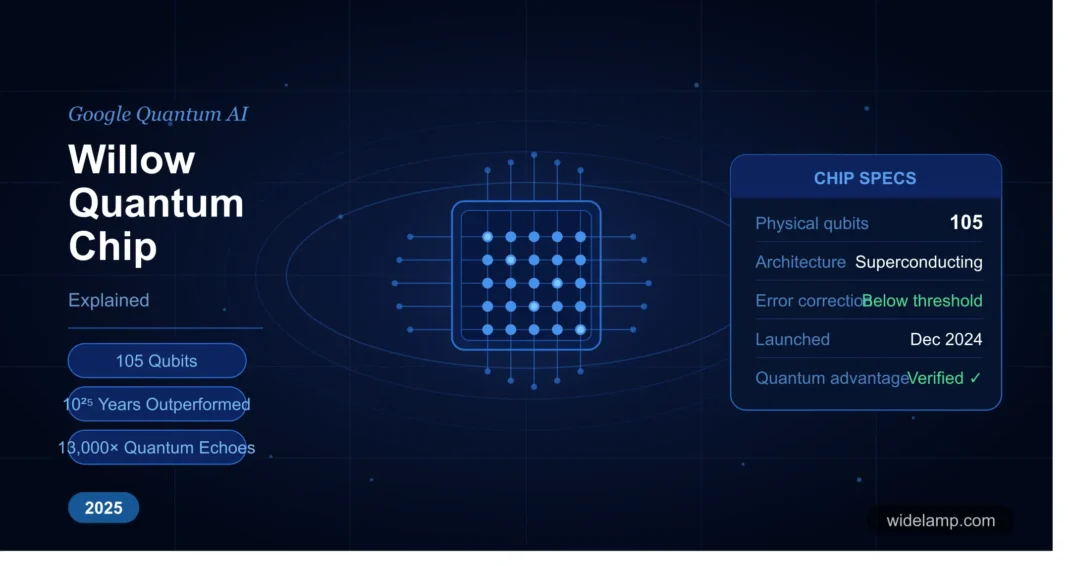
The Google Willow Quantum Chip is a 105-qubit superconducting quantum processor built by Google’s Quantum AI team and officially unveiled on December 9, 2024. A qubit (quantum bit) is the quantum computing equivalent of the “bit” in your laptop — except that while a regular bit is either 0 or 1, a qubit can be both at the same time thanks to a quantum effect called superposition. Add entanglement (where qubits are instantaneously linked across distance), and you have a machine that can explore millions of possible solutions to a problem simultaneously, rather than one at a time like a classical computer.
Willow runs on superconducting qubits cooled inside a custom dilution refrigerator to temperatures colder than outer space — about 15 millikelvin, or roughly 273 degrees below zero Celsius. That extreme chill is essential: it keeps the qubits in a delicate quantum state long enough to actually perform calculations.
So why does this matter to you? Because the problems quantum computers can eventually solve — from designing life-saving medicines to securing the internet of the future — are problems that today’s computers simply cannot crack, no matter how many of them you connect together.
🔵 Key Definition — What Is a Qubit?
A qubit (quantum bit) is the basic unit of information in a quantum computer. Unlike a regular bit — which is either 0 or 1 — a qubit can exist in a superposition of both 0 and 1 simultaneously. This, combined with entanglement (the ability of two qubits to be instantly linked no matter how far apart they are), gives quantum computers their extraordinary power. Google’s Willow chip uses 105 superconducting qubits, each cooled to near absolute zero inside a dilution refrigerator.
Google Willow Quantum Chip Breakthrough #1 — It Solved the 30-Year Error Problem
Why Quantum Errors Were the Biggest Obstacle in Computing History
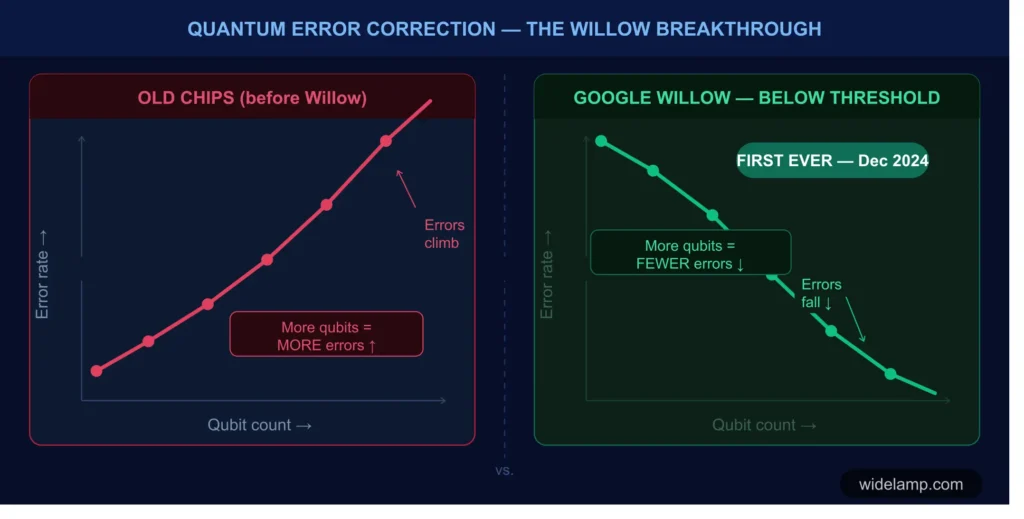
Here is the single biggest problem with every quantum computer ever built before Willow: the more qubits you add, the more errors you get. Qubits are incredibly fragile. They get disturbed by heat, vibration, stray magnetic fields — even cosmic rays passing through the chip. Every disturbance causes an error. And in old quantum chips, adding more qubits to make the computer more powerful also meant adding more noise, more interference, and more errors. It was a wall that researchers had been trying to break through since 1995.
Willow broke it. For the first time in the history of quantum computing, Google’s engineers demonstrated that as they scaled Willow up — adding more qubits — the error rate actually went down, not up. The technical term for this is achieving “below threshold” quantum error correction (QEC). It means the error-correcting machinery on the chip is more powerful than the errors being created. Every time Google roughly doubled the number of qubits, the performance of the error-corrected logical qubit improved by over an order of magnitude.
This is not a minor engineering improvement. It is the foundational breakthrough that every major quantum computing roadmap has been waiting for. Without it, scaling quantum computers to useful sizes was essentially impossible. Now, the path is open.
Now that the error problem has a solution, here’s where that path could lead — and how fast.
Google Willow Quantum Chip Breakthrough #2 — It Outperformed All Supercomputers by 10 Septillion Years
The number that made headlines around the world: Willow completed a standard quantum benchmark task — called Random Circuit Sampling (RCS) — in under five minutes. The same computation would take the world’s fastest classical supercomputer 10²⁵ years to finish. That is ten septillion years. The current age of the universe is roughly 14 billion years. So Willow finished, before a supercomputer could even theoretically begin.
To be completely honest with you: this particular benchmark doesn’t have a known real-world use yet. It was specifically designed to stress-test quantum processors. But the reason it matters is what it proves — Willow’s qubits, its connectivity, its gate operations, and its error-correction are all working together at a level that simply has no classical equivalent. It’s proof of raw, unprecedented quantum power.
Back in 2019, Google’s previous chip Sycamore set a record of 10,000 years for the same class of problem. By 2024, Willow pushed that to 10²⁵ years. The trajectory is staggering — and it’s only going to accelerate.
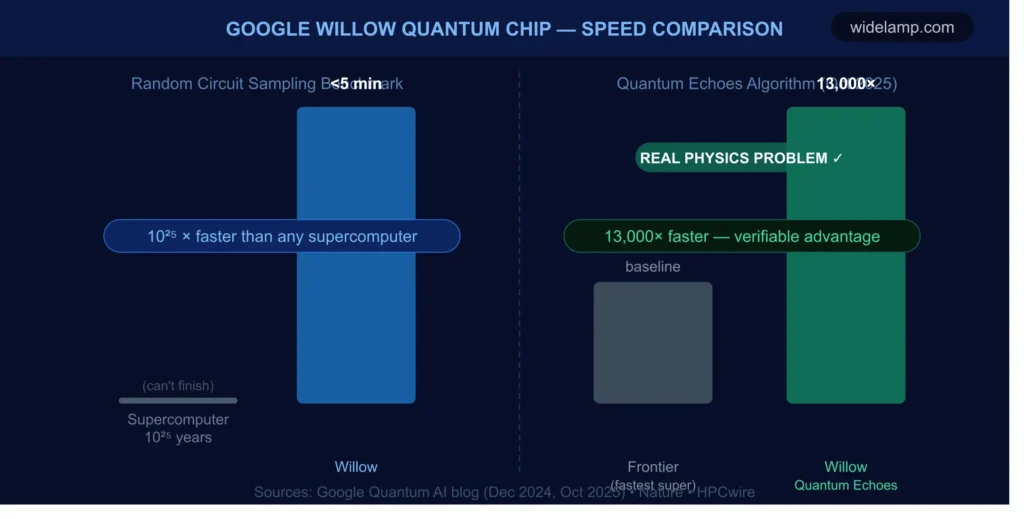
“In 2019, it would have taken a supercomputer 10,000 years. By 2024, that number became 10 septillion years. The Google Willow Quantum Chip isn’t catching up to classical computers — it’s leaving them in an entirely different universe.”
Google Willow Quantum Chip Breakthrough #3 — The Quantum Echoes Algorithm (October 2025)
The First Verifiable Quantum Advantage in History
This is the breakthrough that experts had been waiting for, even more than the RCS benchmark—because it involves a real problem, not a stress-test.
In October 2025, Google announced that Willow had successfully run the Quantum Echoes algorithm — the first verifiable quantum advantage ever demonstrated on hardware. The algorithm ran 13,000 times faster on Willow than the fastest available classical supercomputer (including Frontier, the USA’s most powerful machine). And critically, the results were verifiable: scientists could independently confirm the quantum computer’s output was correct.
In a partnership with the University of California, Berkeley, the team ran Quantum Echoes on Willow to study two real molecules — one with 15 atoms and another with 28 atoms. The results matched those from traditional Nuclear Magnetic Resonance (NMR) techniques but revealed additional molecular detail that NMR cannot normally detect. Think of it as a new kind of “quantum microscope” — one that can see the structure of matter in ways no instrument before it could.
This matters enormously for drug discovery. Understanding exactly how a molecule is shaped, and how it might bind to a target in the human body, is the core challenge in designing new medicines. With Willow, that process could eventually be accelerated from years to weeks.
✅ Milestone — Quantum Echoes (October 2025)
13,000× faster than the world’s best supercomputer. For the first time in history, a quantum computer ran a verifiable algorithm on real hardware that classical computers cannot match. It successfully determined the molecular structure of two real molecules — with results independently confirmed by NMR. This is the first step from “quantum curiosity” into quantum utility.
How Does the Google Willow Quantum Chip Actually Work?
You don’t need a physics PhD to understand the key ideas. Here’s how Willow works, step by step.
Willow’s 105 qubits are made from tiny loops of superconducting material — a special type of metal that conducts electricity perfectly when cooled to near absolute zero. Each qubit is a tiny quantum circuit that can be put into a quantum state using precisely timed microwave pulses (yes, like the microwave in your kitchen, but far more controlled).
Once the qubits are in their quantum states, they can be linked together through entanglement — a connection so tight that measuring one qubit instantly affects its partner, even if they’re on opposite sides of the chip. This linking is what gives quantum computers their ability to explore many answers at once.
The chip uses a process called surface code quantum error correction, where groups of physical qubits work together to represent a single “logical qubit” — a more reliable unit of computation. Willow’s breakthrough was making this error-correcting layer efficient enough that adding more physical qubits actually made the logical qubit more reliable, not less. That’s the “below threshold” achievement described earlier.
All of this happens inside a dilution refrigerator — a machine that looks like a chandelier of copper tubing and costs millions of dollars to build — cooled to temperatures colder than the vacuum of outer space.
How Google Willow Quantum Chip Works — 5 Core Steps
① Cool Down
The chip is cooled inside a dilution refrigerator to ~15 millikelvin — colder than outer space — to enable superconductivity in the qubits.
② Set Qubits
Precisely timed microwave pulses put each of the 105 qubits into a superposition state — holding both 0 and 1 simultaneously.
③ Entangle
Qubits are linked through quantum gates, creating entanglement — where the state of one qubit instantly influences another across the chip.
④ Correct Errors
Surface code QEC monitors groups of physical qubits and repairs errors in real time — the first chip to do this below the error threshold as qubits scale up.
⑤ Read Output
After computation, qubits are measured and collapse into classical 0s and 1s. The answer emerges from the probabilistic quantum outcome — repeated and averaged for accuracy.
Google Willow Quantum Chip Breakthroughs #4 and #5 — UK Partnership and Open Research Access
One of the most significant — and underreported — developments around Willow is what Google is doing with it beyond its own labs.
In late 2025, Google partnered with the UK government and the National Quantum Computing Centre to give external researchers access to the Willow chip. Scientists from British universities and research institutions can now submit proposals, design experiments, and run them on Willow hardware. This is a meaningful shift: moving quantum computing from a closed research project to an open scientific instrument — much like telescopes and particle accelerators that entire research communities share.
This also signals something broader: the global race for quantum dominance is now also a race for quantum talent and quantum applications. The country (or company) that first identifies real-world problems where quantum offers a decisive edge will hold extraordinary power in the industries of the 2030s.
The UK investment in quantum follows similar moves from the USA, China, Germany, and India — all of which have multi-billion-dollar national quantum programmes. Google’s Willow isn’t just a chip. It’s a geopolitical milestone.
| Feature | Google Willow (2024) | Google Sycamore (2019) | IBM Heron (2023) |
|---|---|---|---|
| Physical Qubits | 105 | 53 | 133 |
| Below-Threshold QEC | ✅ Yes (first ever) | ❌ No | ❌ No (NISQ territory) |
| RCS Benchmark vs Classical | 10²⁵ years | 10,000 years | Not demonstrated |
| Verifiable Quantum Advantage | ✅ Yes (Oct 2025) | ❌ No | ❌ No |
| Access for Researchers | UK NQCC partnership | Limited / internal | IBM Quantum Network |
| Error Correction Approach | Surface code (below threshold) | Surface code (above threshold) | Gate fidelity / NISQ |
Google Willow Quantum Chip Breakthrough #6 — Real-World Applications That Could Change Your Industry
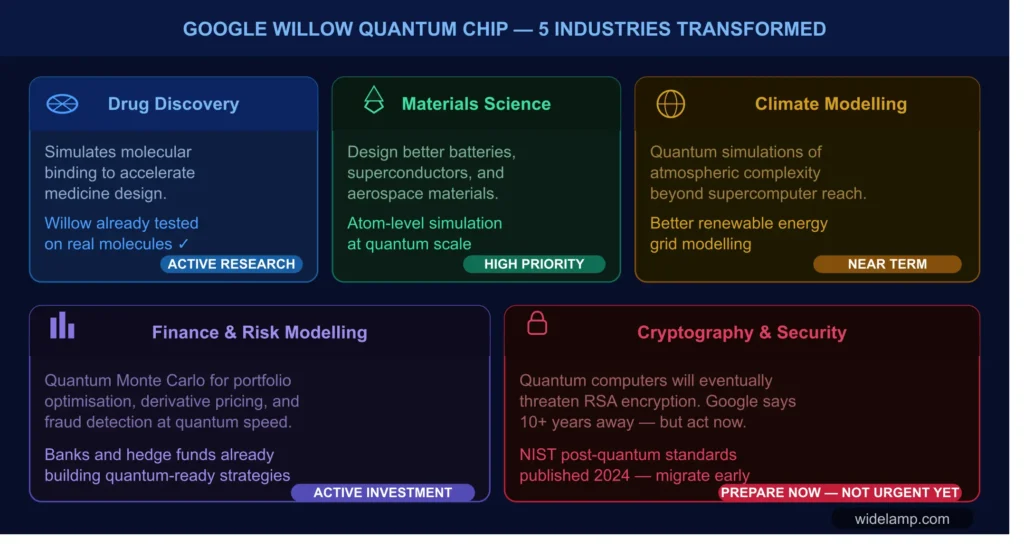
Let’s be clear about the timeline: Willow won’t replace your laptop tomorrow. Or next year. But the industries below are already preparing for the moment when quantum computers become powerful enough to deliver decisive advantages — and experts say that moment is now measurably closer because of Willow’s breakthroughs.
Here are the five sectors where the impact will be felt first, and why each one matters.
💊 Drug Discovery
Willow’s Quantum Echoes algorithm already mapped molecular structures invisible to NMR. Future versions could simulate how new drugs bind to proteins — a process that currently takes years in lab trials — potentially reducing drug development from a decade to a few years.
⚡ Materials Science
Designing new superconductors, more efficient batteries, hydrogen storage materials, and lighter-yet-stronger aerospace composites all require modelling atoms and electrons — exactly what quantum simulation excels at. Willow is already being pointed in this direction.
🌍 Climate Modelling
Atmospheric and climate systems involve staggering complexity — billions of interacting variables. Quantum computers could run simulations at resolutions impossible for today’s supercomputers, leading to better climate predictions and faster identification of effective solutions.
💹 Finance & Risk
Quantum algorithms can explore vastly more portfolio scenarios simultaneously than classical Monte Carlo methods. Banks and investment firms are already researching quantum-enhanced risk simulation, derivative pricing, and fraud detection — a multi-billion-dollar prize.
🔐 Cryptography
A sufficiently large quantum computer running Shor’s algorithm could break RSA encryption — the backbone of internet security. Google itself said this threat is still at least 10 years away. But governments, banks, and tech companies are already building post-quantum cryptography standards right now. Willow makes that urgency real.
⚠️ Important — What About Encryption?
Willow’s 105 qubits are nowhere near enough to break RSA encryption — that would require millions of error-corrected logical qubits, far beyond today’s hardware. Google has stated that practical cryptographic threats are at least 10 years away. However, the threat is taken seriously enough that NIST finalised its first post-quantum cryptography standards in 2024. If you manage sensitive long-term data, start exploring post-quantum encryption now — because “harvest now, decrypt later” attacks are already happening.
“The Google Willow Quantum Chip doesn’t just compute faster — it computes in ways that are fundamentally impossible for any classical machine. That’s not a performance upgrade. That’s a new category of tool.”
Google Willow Quantum Chip Breakthrough #7 — The Roadmap to a Fault-Tolerant Quantum Computer
Where Does Google Go From Here? Google Quantum AI’s Published Milestones
Google Quantum AI has publicly shared a roadmap with specific engineering milestones. Willow represents approximately Milestone 2 — demonstrating below-threshold error correction. Milestone 3 is a long-lived logical qubit, which the team says is achievable by making “another step up” in qubit count and performance. Beyond that, the goal is thousands of logical qubits — the level needed for commercially relevant, fault-tolerant quantum computation.
The trajectory is genuinely breathtaking. In 2019, Sycamore’s RCS benchmark sat at 10,000 years. In 2024, Willow pushed it to 10²⁵ years. That’s a double-exponential growth in quantum power — because each improvement in the physical chip is amplified by the error-correction layer. Once you’re past the threshold, small hardware improvements produce enormous gains in logical performance.
The honest reality: a fully fault-tolerant quantum computer — one that could run Shor’s algorithm on large real-world data sets — is likely still a decade or more away. Willow’s 105 physical qubits represent a handful of logical qubits, and you’d need thousands. The infrastructure challenges are also enormous: dilution refrigerators are expensive, slow to build, and difficult to scale.
But the pace of progress is faster than most experts predicted five years ago. And with Willow, we now know the fundamental physics works. The rest is engineering.
🔬 Research Spotlight — The Multiverse Claim
Hartmut Neven, founder of Google Quantum AI, sparked controversy when he claimed Willow’s results “lend credence to the notion that quantum computation occurs in many parallel universes.” Most mainstream physicists were skeptical — the results are consistent with standard quantum mechanics and do not require a multiverse interpretation. This is a reminder that quantum computing is scientifically extraordinary without needing multiverse hype. The actual breakthroughs are remarkable enough on their own.
Is the Google Willow Quantum Chip a Threat to Bitcoin and Online Banking?
This is the question that set social media on fire when Willow launched — and the answer is both reassuring and sobering.
Right now: No, Willow is not a threat to Bitcoin or your bank account. Breaking RSA-2048 encryption — the standard used by most internet security today — would require a quantum computer running millions of fully error-corrected logical qubits. Willow has 105 physical qubits representing only a small number of logical qubits. A Google spokesperson confirmed that cracking RSA is still at least a decade away, even with Willow’s improvements.
In the future: Yes, quantum computers will eventually threaten current encryption — which is exactly why NIST finalised its first set of post-quantum cryptography standards in 2024. Organisations that handle sensitive long-term data (governments, banks, hospitals, defence) need to begin migrating to post-quantum encryption now, because adversaries may already be harvesting encrypted data today, planning to decrypt it when quantum computers mature. This “harvest now, decrypt later” strategy is real and documented.
The bottom line: Willow is not a cryptographic emergency today. But it makes the quantum cryptographic future measurably closer, and preparation should start immediately in high-stakes industries.
The question isn’t whether quantum computing will change cryptography, finance, and medicine. The question is whether your organisation will be ready when it does — or left scrambling.”
How to Learn Quantum Computing: Your Starter Path Using Google Willow Quantum Chip Resources
Free and Paid Resources to Understand Quantum Computing in 2025
You don’t need to be a physicist to start understanding quantum computing. Here are the best resources, organised by level:
Absolute beginners: Start with Google Quantum AI’s own blog (quantumai.google). Their explainer articles are written for non-experts and cover superposition, entanglement, and error correction with clear analogies. Completely free.
Intermediate learners: IBM’s Qiskit open-source platform offers hands-on quantum programming courses. You can write and run actual quantum circuits on simulated hardware — again, for free. Google’s Cirq library offers a similar path if you want to work with Google’s own software stack.
Advanced learners and researchers: The original Willow paper was published in Nature (December 2024). The Quantum Echoes paper is available on arXiv. Both are peer-reviewed, technically rigorous, and freely accessible.
Professionals seeking business relevance: The World Economic Forum, McKinsey Global Institute, and PwC have all published reports (several free) on the business impact of quantum computing. These are excellent for decision-makers who need to understand the strategic — not just technical — implications.
🏆 WideLamp Open Challenge
Challenge — Guaranteed Reward for the Best Answer
The Challenge Question:
Google’s Willow chip achieves “below-threshold” quantum error correction using the surface code — where errors fall exponentially as qubits scale up. But the surface code requires a large overhead of physical qubits per logical qubit (currently dozens to hundreds per logical qubit). If Willow’s physical qubit count doubled to 210, and error rates improved by a further factor of two across the board, roughly how many fully error-corrected logical qubits do you estimate could be maintained simultaneously — and which single real-world application would you prioritise running on them first, and why? Your answer must show your reasoning, not just a number.
A guaranteed reward awaits the most insightful, well-reasoned answer. Open to students, researchers, and professionals worldwide.
Frequently Asked Questions — Google Willow Quantum Chip
Q What is the Google Willow Quantum Chip?
The Google Willow Quantum Chip is a 105-qubit superconducting quantum processor unveiled by Google Quantum AI in December 2024. It represents two historic firsts: it is the first quantum chip to achieve “below-threshold” quantum error correction — meaning errors decrease as the chip scales up — and it completed a standard benchmark computation in under five minutes that would take today’s fastest classical supercomputers 10 septillion (10²⁵) years. In October 2025, Willow also became the first quantum chip to demonstrate verifiable quantum advantage with the Quantum Echoes algorithm, running 13,000 times faster than the world’s best supercomputer on a real physics problem.
Q How does the Google Willow Quantum Chip perform quantum error correction?
Willow uses a technique called surface code quantum error correction (QEC), where groups of physical qubits collectively represent a single more reliable “logical qubit.” The key breakthrough is that Willow is the first chip to achieve this below the error threshold — meaning as more physical qubits are added, the logical error rate actually decreases exponentially rather than increasing. This addresses a fundamental problem that had challenged researchers since 1995. Before Willow, adding more qubits generally created more errors. Now, scaling up makes the system more reliable — the foundational requirement for building a practical, fault-tolerant quantum computer.
Q Can the Google Willow Quantum Chip break Bitcoin or RSA encryption?
No — not today, and not for the foreseeable future. Breaking RSA-2048 encryption would require a quantum computer with millions of fully error-corrected logical qubits. Willow has 105 physical qubits representing only a small number of logical qubits. Google itself has stated that cracking RSA encryption is at least 10 years away. However, this threat is taken seriously enough that NIST published its first post-quantum cryptography standards in 2024. Organisations handling sensitive long-term data are advised to begin migrating to post-quantum security protocols now, given the “harvest now, decrypt later” threat where adversaries collect encrypted data today to decrypt once quantum computers mature.
Q What is Quantum Echoes and why does it matter for the Google Willow Quantum Chip?
Quantum Echoes is an algorithm developed by Google that was run on the Willow chip in October 2025 to achieve the first-ever verifiable quantum advantage in history. It ran 13,000 times faster on Willow than the fastest available classical supercomputer on a real physics problem — not just an abstract benchmark. In a proof-of-principle experiment with UC Berkeley, Willow used Quantum Echoes to map the molecular structure of two real molecules, revealing information beyond what traditional NMR (nuclear magnetic resonance) techniques can detect. This matters because it’s the first time a quantum computer has solved a verifiably meaningful scientific problem that a classical computer could not solve equally well — a critical milestone on the path to genuine quantum utility.
Q How does the Google Willow Quantum Chip compare to IBM’s quantum processors?
Both Google and IBM use superconducting qubits, but their approaches differ significantly. IBM’s Heron processor (133 qubits) focuses on gate fidelity and broad cloud access via the Qiskit platform, targeting near-term NISQ (Noisy Intermediate-Scale Quantum) algorithms. Willow’s defining advantage is its below-threshold quantum error correction — something IBM has not yet demonstrated. This means Willow has a clearer path to fault-tolerant computing. However, IBM’s Quantum Network offers wider researcher access, and IBM’s Qiskit ecosystem has a larger developer community. The two companies are pursuing different but complementary strategies, and the competition between them benefits the entire field.
Q Is the Google Willow Quantum Chip available to the public or researchers?
Willow is not available for personal purchase, but access is opening up for researchers. In late 2025, Google partnered with the UK government and the National Quantum Computing Centre to let external scientists submit research proposals and run experiments on Willow hardware. More broadly, Google Quantum AI’s Cirq software framework is freely available, and Google Cloud offers access to some of Google’s quantum hardware via its Quantum Computing Service. Researchers, academics, and developers interested in quantum computing can begin learning and experimenting with Google’s tools today, ahead of the hardware becoming more widely available.
Q What industries will the Google Willow Quantum Chip impact first?
The five industries most likely to feel quantum computing’s impact first are: (1) Pharmaceuticals — quantum simulation could dramatically accelerate drug discovery by modelling molecular interactions at the atomic level; (2) Materials Science — designing better batteries, superconductors, and aerospace materials; (3) Finance — quantum-enhanced risk modelling, portfolio optimisation, and fraud detection; (4) Climate and Energy — more accurate atmospheric modelling and energy grid optimisation; and (5) Cryptography — driving the urgent transition to post-quantum security standards. Of these, drug discovery is already being actively explored with Willow through the Quantum Echoes molecular mapping experiments.
Q When will the Google Willow Quantum Chip reach practical, fault-tolerant computing?
Full fault-tolerant quantum computing — capable of running complex real-world algorithms reliably — is still estimated to be a decade or more away. A fault-tolerant quantum computer would require thousands of logical qubits; Willow’s 105 physical qubits represent only a handful. The hardware challenges — manufacturing precision, cryogenic infrastructure, control electronics, and cost — are enormous. However, Willow’s below-threshold error correction breakthrough is the critical step that makes scaling theoretically possible. Google’s roadmap points to a long-lived logical qubit as Milestone 3, then scaling toward thousands of logical qubits. The pace of progress has consistently surprised experts — but realistically, practical fault-tolerant systems for commercial use are a 2030s target.
“Every major scientific revolution had a moment when the theory became engineering. For quantum computing, Willow’s below-threshold error correction might be that moment.”
Resources & References
Official & Primary Sources
-
Google Blog — Meet Willow, Our State-of-the-Art Quantum Chip (Dec 2024)
The official Google announcement of Willow, written by Google Quantum AI founder Hartmut Neven. Covers the two core breakthroughs: below-threshold error correction and the 10²⁵-year benchmark. -
Google Blog — Quantum Echoes: First-Ever Verifiable Quantum Advantage (Oct 2025)
Official announcement of the Quantum Echoes algorithm, which demonstrated 13,000× quantum advantage over classical supercomputers on a real physics problem for the first time in history. -
Google Quantum AI — Official Research Hub
Central resource for all of Google’s quantum computing research, papers, blog posts, and the Cirq open-source framework for building quantum algorithms.
Technical & Academic References
-
Wikipedia — Willow Processor: Technical Overview
Encyclopaedic summary of Willow’s technical specifications, timeline, scientific reception, and broader context within the history of quantum computing. -
HPCwire — Google Debuts Willow: QEC Breakthrough and Roadmap Details
In-depth technical reporting from HPCwire covering the surface code QEC mechanism, Google’s engineering roadmap milestones, and how Willow’s physical qubit improvements translate into logical qubit performance gains. -
NIH / PMC — Commercial Applications of Quantum Computing (Peer-Reviewed)
Peer-reviewed academic paper from the National Institutes of Health covering the commercial opportunity areas for quantum computing across cybersecurity, materials science, pharmaceuticals, and finance.
Industry Analysis & News
-
PwC — The Quantum Leap: What Willow Means for Security and Business
PwC’s strategic analysis of Willow’s business and security implications, covering the cryptographic timeline, industry readiness, and what decision-makers should be doing right now. -
The Quantum Insider — Google Opens Willow to UK Researchers (Dec 2025)
Coverage of the UK government and Google partnership to give external researchers access to Willow, including the National Quantum Computing Centre collaboration and the research proposal process.
Learning Platforms & Further Reading
-
Open Med Science — Google Willow: What It Really Means (Technical Deep-Dive)
Balanced, technically detailed analysis of Willow’s capabilities, limitations, and realistic timeline for applications in drug discovery, materials science, and cryptography. -
BlueQubit — Google Willow vs IBM Heron: Side-by-Side Analysis
Detailed comparison of Google Willow and IBM Heron quantum processors, covering error correction approaches, qubit architectures, and the different strategic directions of the two quantum computing leaders.
The Google Willow Quantum Chip is not science fiction. It’s not a distant promise. It is a real, working processor that has already achieved things previously considered impossible — and the pace of progress is accelerating faster than most experts predicted even five years ago. The below-threshold error correction breakthrough, the Quantum Echoes verifiable advantage, the partnership with UK researchers — together, these mark the beginning of a new era in computing. Whether you’re a student, a professional, or a researcher, understanding what Willow represents puts you ahead of the majority of people who will be caught off guard by what quantum computing delivers in the 2030s.
We hope this guide gave you a clear, honest, and genuinely useful picture of where quantum computing stands today. If you have questions, corrections, or want to participate in our open challenge, write to us at contact@widelamp.com. At WideLamp, we’re committed to making the most complex technology in the world understandable for everyone.