|
Getting your Trinity Audio player ready...
|
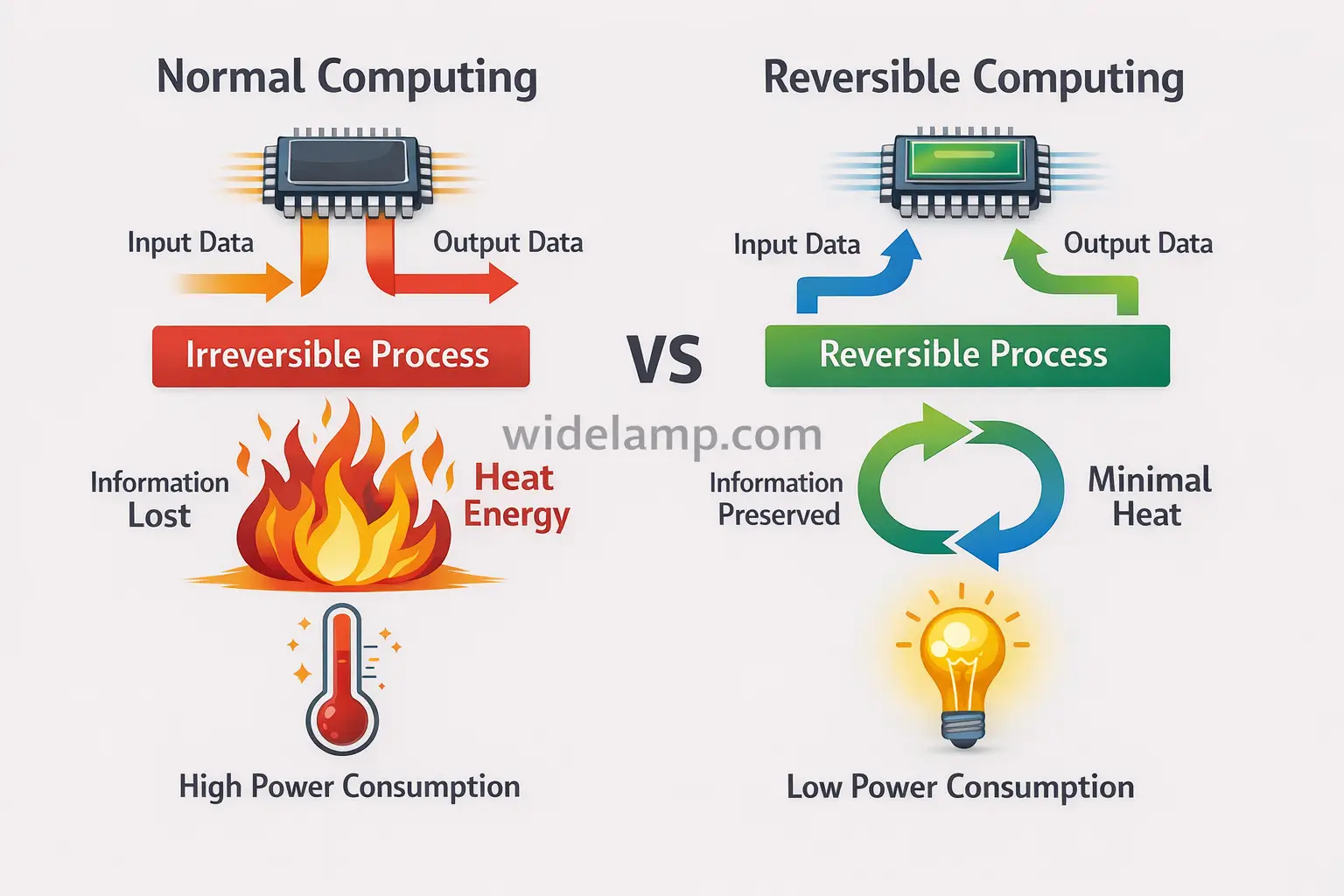
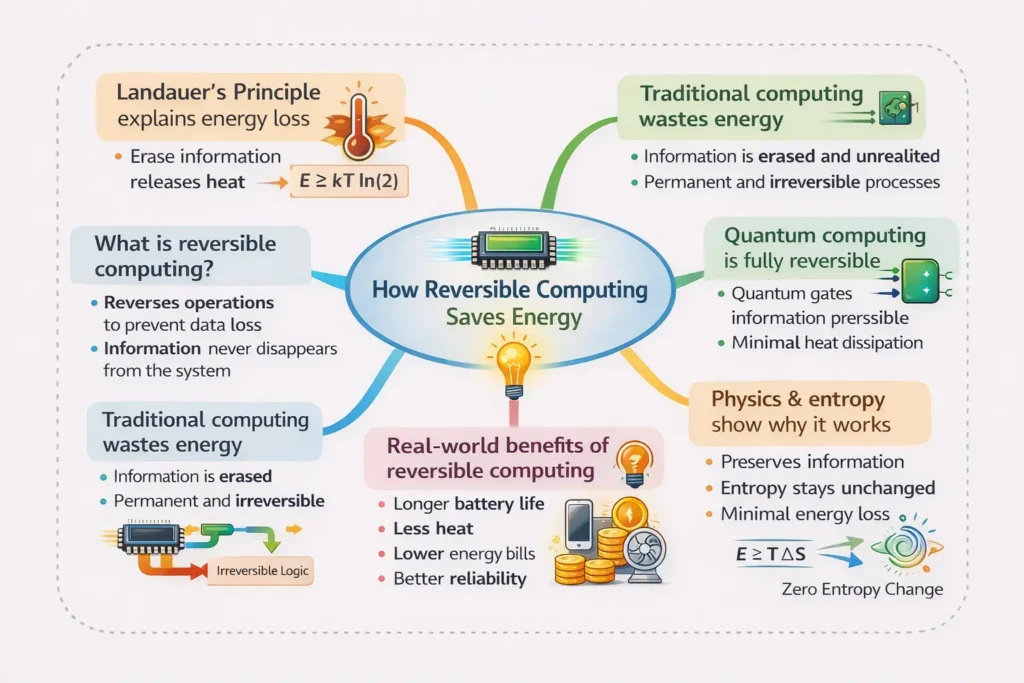
Reversible computing saves energy by preventing information loss during computation. Since physics requires energy to be released as heat whenever information is erased, preserving information allows computers to operate with far lower energy consumption. This makes reversible computing essential for future low-power and quantum technologies.
Modern computers feel smart, but they behave like careless students. They solve problems quickly, then immediately forget how they did it. This forgetting looks harmless, but physics strongly disagrees. Every time a computer deletes information, energy quietly escapes as heat. Reversible computing challenges this wasteful habit by designing calculations that never forget, and that simple change allows computers to save energy in a way traditional systems cannot.
In real life we can see only one way computing called computing which are possible only in classical computing, we can’t do reverse computing in classical computing, we need special type of computing called Quantum computing.
Quantum computing also a very fast computer in comparison of classical computers, and also quantum computers help on working on reverse side, you think what is special in quantum computing which are work on reversibly, let’s comparison on classical and quantum parts.
Table of Contents
What Is Reversible Computing?
Reversible computing is a method of computation where every operation can be reversed to recover the original input. In simple terms, if a computer produces an output, it can always retrace its steps and understand exactly how that result was created. Nothing is permanently erased. The computer remembers everything it does, even the intermediate steps.
This idea matters because information is physical. Storing it, changing it, or deleting it always interacts with the laws of physics. Reversible computing respects those laws instead of fighting them.
Why Traditional Computers Waste So Much Energy?
Traditional computers use logic operations that destroy information. Many different inputs can lead to the same output, which means the computer permanently loses track of what really happened. Once that information is gone, it can never be recovered.
This loss has a physical cost. Rolf Landauer proved that erasing information always produces heat. This discovery, known as Landauer’s Principle, revealed that computer energy loss is not just an engineering problem. It is a law of nature.
Your laptop is not overheating because it is weak. It is overheating because it keeps forgetting.
Read More: Quantum entanglement IIT Delhi Breakthrough: Secure Free‑Space Communication
Landauer’s Principle Explained Without Fear
Landauer showed that deleting just one bit of information releases a minimum amount of energy as heat, described by the equation:
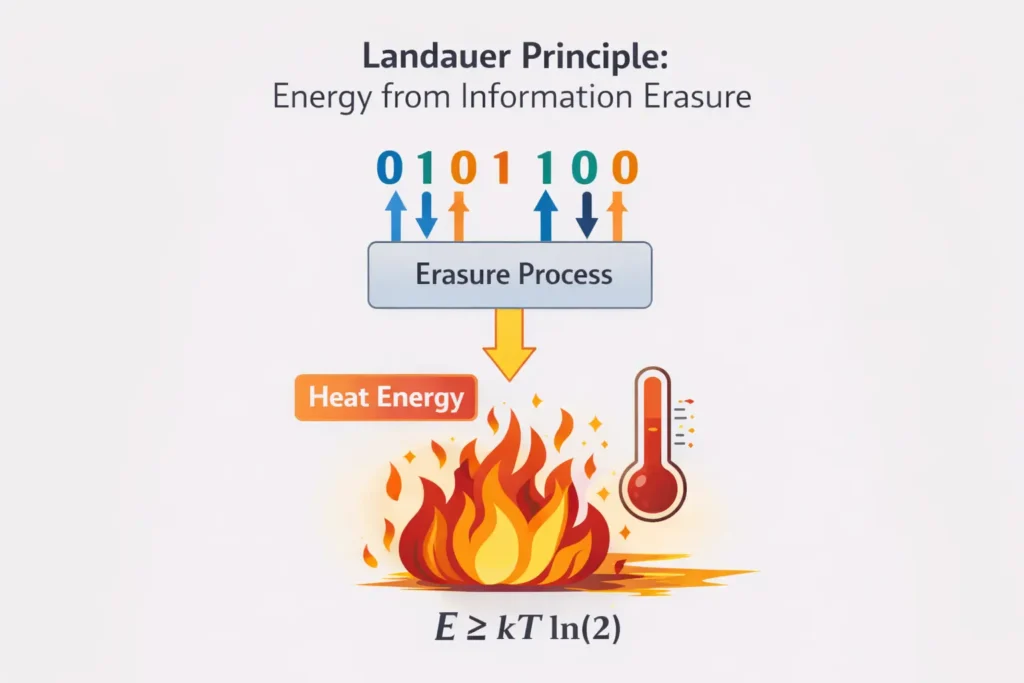
Here, k is the Boltzmann constant and T is temperature. This equation simply means that every time a computer deletes a single 0 or 1, physics demands payment in energy. Modern processors erase billions of bits per second, so the heat builds up quickly. Cooling fans, heat sinks, and data-center air conditioning exist mainly to manage this forgotten information.
How Reversible Computing Changes the Story?
Reversible computing avoids this energy loss by refusing to erase information. Each output corresponds to exactly one input, so the calculation can be reversed at any moment. Because nothing is destroyed, the system does not need to release energy as heat to satisfy Landauer’s Principle.
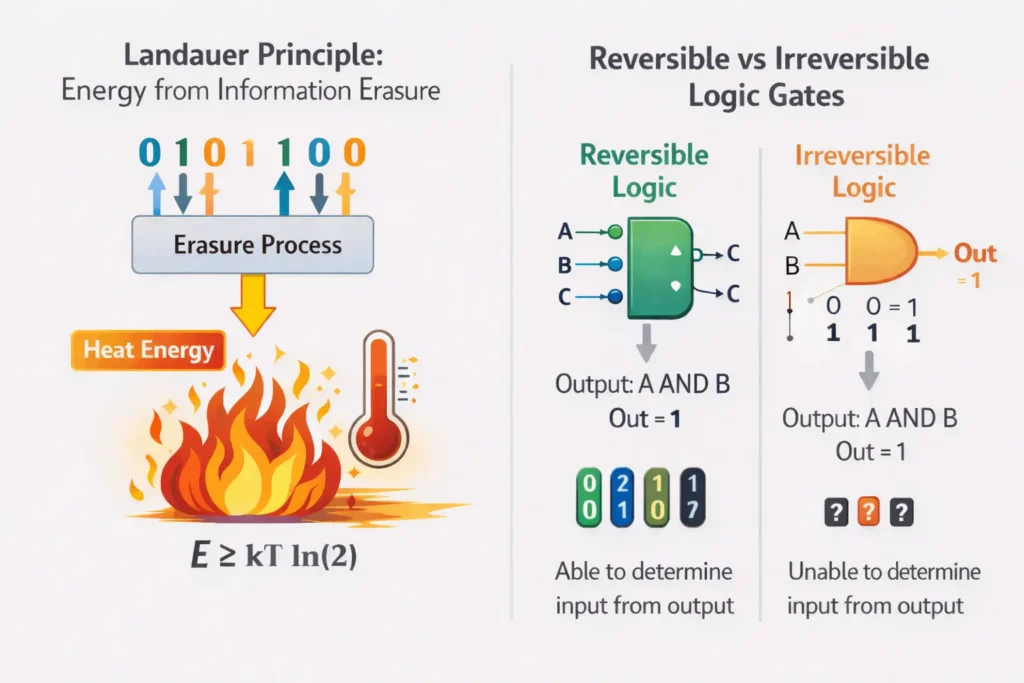
This idea was rigorously developed by Charles H. Bennett, who proved that any ordinary computation can be redesigned to work reversibly. When computations remember instead of delete, entropy does not increase, and energy loss is no longer forced by physics.
Entropy: The Real Reason Reversible Computing Saves Energy Energy
Entropy measures disorder in a system and is defined as:
where W is the number of possible internal states. In traditional computing, many possible input states collapse into one output state. This reduces W, increases entropy, and forces energy to escape as heat.
Reversible computing keeps the number of states unchanged because every output can be traced back to its input. Since entropy does not increase, energy dissipation is avoided. This relationship is captured by:
When ΔS=0, there is no minimum energy loss required by nature. This is the deep scientific reason reversible computing saves energy.
Why Quantum Computing Depends on Reversibility
Quantum computing cannot function without reversibility. Quantum operations follow unitary transformations that satisfy:
This means every quantum operation can be undone perfectly. Information is never erased, only transformed. Because of this, reversible computing is not optional in quantum systems; it is mandatory. This is one reason quantum computers promise extraordinary energy efficiency alongside immense computational power.
Real-Life Meaning of Reversible Computing
Reversible computing directly affects everyday life. Less heat means longer battery life for phones and laptops. It means data centers that consume less electricity and produce fewer carbon emissions. It also means computers that last longer because heat is one of the biggest causes of hardware failure. In space systems and cryogenic environments, where energy is precious, reversible logic becomes even more valuable. Reversible Computing Saves Energy
Future Scope: Why This Topic Will Matter More
As transistors shrink and computing demand rises, energy efficiency becomes the main limitation, not speed. Researchers are exploring reversible processors, reversible AI accelerators, and hybrid quantum-classical machines. In the future, computers may work with almost no heat, not because cooling improved, but because forgetting was eliminated.
Ignoring reversible computing means accepting growing energy waste. Embracing it means designing computers that cooperate with physics instead of fighting it. Reversible Computing Saves Energy
Q & A Section
What is reversible computing in simple words?
Reversible computing is a computing method where calculations can be undone, meaning no information is permanently deleted.
Why does reversible computing save energy?
Because deleting information creates heat, and reversible computing avoids deleting information.
Is reversible computing used today?
Yes, it is used in quantum computing research and experimental low-power systems.
Does reversible computing eliminate all energy loss?
In theory it can approach zero energy loss, but real systems still have small physical losses.
Why is reversible computing important for the future?
Because energy efficiency is becoming more important than speed in modern computing.